Standing Up – Episode 47
Posted on: February 24, 2011
 Episode 47 features Nina G, the Bay Area’s Only Stuttering Stand-Up Comic. Nina is a return guest. We first met Nina and heard her story in Episode 17, back in early August 2010. At that time, Nina talked about how she always wanted to get into comedy and what finally prompted her to take the plunge.
In today’s episode, Nina shares how it feels to be approaching her one-year anniversary as a comic and what the experience has really been like. She also shares the significance of how performing stand-up on stage allows her to perfect real “standing up” for herself.
We also discuss how important validation is, the importance of laughter and giving people permission to laugh, and how comedy has brought Nina much closer to authenticity, which is what we all strive for.
Nina also shares what the reactions have been to her comedy, from her stuttering peers, her family and mainstream audiences. And we talk about how stuttering more, and in comedy, has crossed over into other areas of her life.
Listen in to this great episode and hear how stand-up comedy from a person who stutters really does mean “standing up”. I must get to the San Francisco area one day to see Nina G perform on stage. She has offered me a “standing” invitation. Please be sure to leave comments or questions for Nina, and me too, if you wish!
Credit for the podcast safe music used in this episode goes to DanoSongs
Also, if you have not seen a clip of Nina, please be sure to check this out. Nina G – a stand up woman standing up for all of us.
Self, Divided
Posted on: February 22, 2011
- In: Posts
- 9 Comments
A friend suggested I read the Charles Van Riper classic, “The Treatment of Stuttering”. It’s a text-book, so not one that I would happen on or that would catch my eye. I was intrigued, however, as my friend talks frequently about the need for a “whole person” approach for those who stutter. And he thought I might find much that would resonate with me.
So I went looking for the title on Amazon. I found a used copy, for 8 cents and $3.99 for shipping, so the hardcover book cost all of $4.07! I got it in less than a week, in perfectly good condition. I started reading. My friend was right. I owe him a beer!
I have often wondered if there was any explanation as to why I sometimes feel I lead two separate lives, that even I am two separate people. I felt like that most of the time when I was very much covert about my stuttering, always trying to hide it or play it off as something else. I felt like I was one person on the inside, and that I presented a very different person to the outside world.
Even today, when I consider myself mostly overt, I still feel like I am not in balance sometimes. I still sometimes get surprised when I find my “one person” looking down at my “other person” in wonder and asking “who is she?” or “how can she do that?” This usually happens when I am talking freely about my stuttering, either casually with a small group or doing some type of presentation.
Because I still have some shame surrounding stuttering, my inside and outside selves still feel very divided at times.
My friend urged me to read Van Riper’s book in order, from beginning to end, and not to skip around. I began that way, but admit that I jumped ahead to see if there was anything that could explain my not being “one whole self” when it comes to stuttering.
And I found it. Van Riper talks about the whole idea of integration of self, the need for the person who stutters to reconcile with that and allow stuttering to co-exist within our very being. I have heard of the phrase “fragmented self” associated with stuttering and the fact that we very often allow our stuttering part to be separate from our “other” self.
I do that. I have felt fragmented. I have experienced that very weird feeling when you are in control and speaking fluently for a while and then suddenly, out of nowhere, a stuttering streak takes hold, and I feel disassociated from “me” when that happens. I tend to drift away a bit in that moment, especially when its a block or when I feel I have received a negative listener reaction.
In a way, it was helpful to read a very matter-of-fact clinical account that indeed people who stutter do experience this division of self, and that we need to integrate our self to feel whole.
Its one thing to talk about our stuttering and hold it out there before us and say we are ok with it. But it is something else entirely when the feelings take over, and try as we might, we feel we want to push that one part of ourself away.
Has anyone else ever felt this divided sense of self?
Episode 46 features Kay, who hails from West Africa. Kay is a lawyer currently working as counsel for a litigation firm. Kay spent many of her childhood years in France. French is her mother tongue.
We spoke with each other via Skype in early February, when Kay was in the US at the University of Minnesota. As of the posting of this episode, she is now back in West Africa.
We first met on the Covert-s email support group, where Kay was posting a lot and asking questions. I took a chance and emailed her off list. We got to know each other a bit and Kay quickly agreed to share her story to help others.
Kay shares some very personal glimpses into her life, including the effects of some early abuse. She also shares how she chose to become a lawyer, and how very hard it was for her due to her stuttering. She had grave doubts about her abilities to appear competent as a lawyer and worried how her father, an esteemed public figure and lawyer in West Africa, would perceive her.
Kay is gut-wrenchingly honest about disappointing her father and buckling under the pressure of the legal profession and communicating in courts and trials.
We discuss not only covert stuttering, but also the notion of the need to be covert for professional reasons, for self-preservation and protection. We also discuss how Kay never talked about stuttering with anyone until 6 months ago when she entered into some therapy here in the US.
She was always concerned with making her parents, friends and colleagues comfortable around her, and she tried hard to not have to subject them to listening to her stutter. She never let on how anxious and fearful she was, always putting other people’s comfort ahead of her own needs.
This was a powerful conversation. There is some background noise I was unable to remove, but the content of Kay story far outweighs any editing issues. Feel free to leave comments for Kay or just simply let her know how much you appreciated hearing her story. Credit for the podcast safe music used in this episode goes to DanoSongs.
Road To Empowerment- Episode 45
Posted on: February 10, 2011
Episode 45 features Perla Ernest who hails from Mexico, by way of the UK, Saudi Arabia, and Brunei. She is 23 years old, British/Mexican, and has a history of covert stuttering, except when she couldn’t hide it! Today, Perla views herself as a recovering stammerer.
Perla is an ambitious young woman. She wants to use her years of experience abroad to start her own business of cross-culture training. She sees a need to teach multi-cultural norms and differences in a global business world.
Perla and I were introduced by Maria McGrath, featured in Episode 38. Perla shares how the McGuire therapy program changed her life. Perla explains many of the basic tenets of the McGuire program, including breathing and voluntary stuttering.
Listen in as we discuss career goals, communication and covert stuttering. Perla tells some great stories about the elaborate avoidance techniques she used to keep her stuttering hidden. Perla poignantly shares the story of how the mother of an ex-boyfriend who referred to her as “Perla the Stammerer”, and how that jolted her out of her belief that she had hidden her stammering successfully.
We also discuss inspiration, empowerment and leadership. And we talk about rock bottom and acceptance. Perla hopes to bring the McGuire program as an option to people who stutter in Mexico.
Credit for the podcast safe musical clip”Scott Waves to April With Salty Grace” goes to ccMixter.
Feel free to leave comments for Perla (or me). Feedback is a gift!
- In: Posts
- 16 Comments
Last night I got a call from a professor from an elite university here in my area. She is teaching a graduate level physics class which is just getting underway for the semester. One of her students is from China and is pursuing his graduate degree in engineering.
The professor shared with me that he has a severe stutter. She says she talked with him about it and he told her that there is nothing that can be done for him. She wanted to find some resources to educate herself and to pass on to him, if she senses he would be OK with that.
She told me on the first night of class, she partnered students up in pairs for introductions, and she purposely paired herself with the student who stutters. As she told me this, her tone seemed to imply that she thought she was protecting him. Each person in the pair had to introduce the other.
When the professor introduced this student, she told the class that he stutters, that it is nothing to fear or shy away from, and that it will be an expectation of the class that he participate as often as everyone else and that patient listening would be the norm. She asked me if I thought she did the right thing.
My immediate reaction was, Yes, if he was OK with it. I asked her, “How did he seem to react to that? Was he embarrassed?” She said no – he seemed fine with it, maybe a little even relieved.
I then said that I thought it was great she was taking the initiative to make it OK to talk about. I shared with her how I felt in college, when I was presenting and felt so humiliated, and no one said anything, just didn’t look at me and looked liked they pitied me. I told her I would have much rather been in an open, supportive atmosphere, which she is obviously trying to do for this student.
She asked me for resources, specifically if I had any experience with therapy. I shared with her what was available in the area, and explained my take on fluency shaping and stuttering modification. She asked specific questions about both, and I could hear her writing this information down. (Smile!)
I also gave her some information on self-help and support, and some web resources, again realizing she was writing all of this down. She even asked md if there were any good books that I could recommend, so she could educate herself, and in turn, her student. I gave her information on Van Riper’s and Guitar’s stuttering textbooks and Jezer’s memoir about his life experiences with stuttering.
I was really happy this woman called and I was able to answer some questions. She had seen my name affiliated with a newspaper article I had written and with an upcoming workshop I am doing at our community library.
I was also impressed that a university professor took the time and showed an interest in educating herself to better help a student.
What do you think? Do you think the way she introduced the issue of stuttering to her class was appropriate?
Facing The Monster – Episode 44
Posted on: February 1, 2011
Episode 44 features Anna Margolina, who hails from Redmond, Washington, by way of Russia. Curiousity compelled me to find Anna and “hear” her story. Let me explain!
I found the January 2011 issue of Toastmasters Magazine in my mailbox two weeks ago. The headline “From Stuttering to Public Speaking” on the cover grabbed my attention immediately. I flipped open to the article and saw five people profiled.
They were all successful Toastmasters who also happen to stutter. Four of the five profiles were men, one of which I know – Russ Hicks from Dallas, Texas. That was pretty cool, but I didn’t want to know more about Russ (sorry, friend). I wanted to know about Anna!
I was drawn to “her” story, because women who stutter are practically invisible in media, and here she was a Toastmaster and featured in a magazine. There was no personal contact information provided for Anna, but her Toastmaster club name and city was noted. I knew that was enough for me to find her!
I found her club on the Toastmaster International website and sent an email to the club contact. I asked if they would forward a message along to Anna. They did, Anna responded, and we connected. Anna was happy to share her story and voila, here we are.
Listen in as we chat about acceptance, negative self-talk, and positive change. Anna demonstrates “blocking” and how voluntary stuttering helped her face her monster. We also discuss Toastmasters, of course, John Harrison on Redefining Stuttering and Neurolinguistic Programming.
This episode is an absolute treasure trove. We dive into everything. This is the link to the article on “From Stuttering to Public Speaking” which only scratched the surface and fueled my fire to “meet” her and hear her story.
Anna also happily shares a video of one of her speeches on stuttering. You have to see this! She’s great!
- In: Posts
- 4 Comments
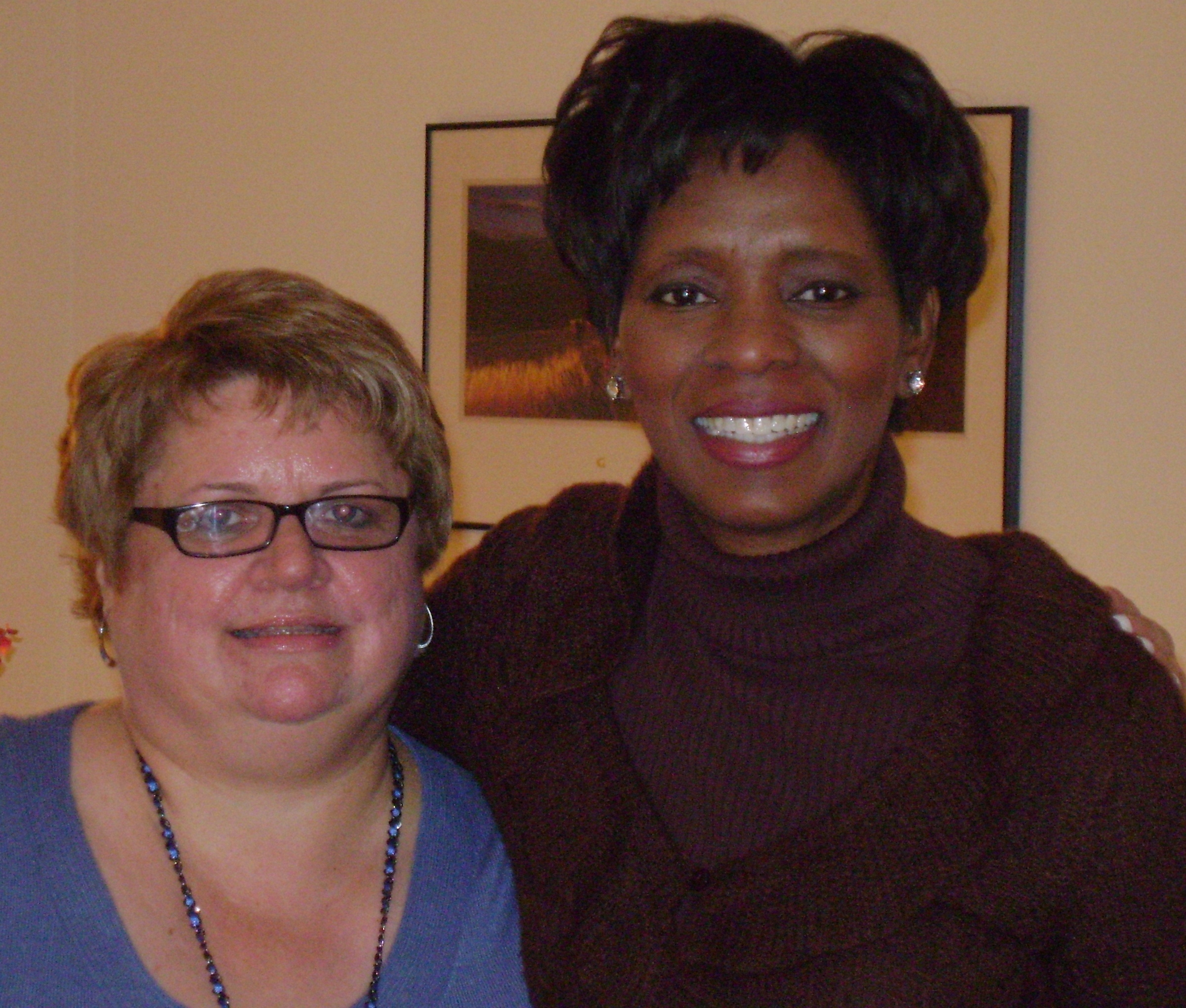 With all of the media attention and buzz surrounding the movie “The King’s Speech”, I wondered why there was no coverage in my area. We have a local college with a 40 year history of working with people who stutter. And the College of St Rose has an affiliated chapter of the National Stuttering Association as well.
So, I emailed one of the popular local anchor/reporters, told her a bit of my story and shared that I have a unique perspective on the experiences of women who stutter. I asked her if she would be interested in doing a story. She responded the next day, saying she would love to, and we set a date for a week later. Wow!
On Friday morning I welcomed Elaine Houston and her camera technician, Jesse, into my home. It was exciting and surreal at the same time. Elaine and I chatted while Jesse transformed my living room into a studio, complete with bright lights and lots of cameras. And then we got down to the business of talking and stuttering and talking about stuttering.
Turns out, Elaine had not even seen the movie. We were not going to talk about “The King’s Speech”. I wasn’t fully aware of this, but the reason that Elaine jumped at the opportunity to hear this story is that she is passionate about women’s issues. She was excited about the podcast highlighting women who stutter telling their stories. She does a weekly segment called “Today’s Women” which airs on News Channel 13 which is also included on the station’s website.
So, we discussed the “often not talked about” issues of stuttering, including the emotions and vulnerability, and how I have been affected personally and professionally. We talked about my journey,why I started this blog and how the women’s podcast morphed from there. Elaine was really interested in the women I have talked to, their hopes and dreams, and how stuttering does not limit anyone from living life fully.
Elaine had this huge, bright, enthusiastic smile the whole time we were chatting. Her passion is obvious, and she shared with me about her visit to Africa. She is working on a documentary about the lives of women around the world. I was telling the perfect person about my journey. And what I have learned from being brave enough to start talking to women all over the world.
We spent over 90 minutes together, taking lots of pictures and talking about everything. Especially about the powerful stories of women who stutter and how my life has been enriched simply by being part of this. I was grateful to have this opportunity to tell this story, and open up a conversation about stuttering from the women’s perspective.
Funny how things happen, huh? I have been so empowered by inviting women to share their stories. Elaine has had the same experience. Check out the book she wrote, The Friendships Between Women.
Things happen for a reason and usually at just the right time.
Letting Go Of Fear – Episode 43
Posted on: January 27, 2011
Episode 43 features Elaine Saitta, who hails from Seattle, Washington. She has been an active member of the National Stuttering Association (NSA) for many years. She has held several NSA positions such as Chapter Leader, Regional Chapter Coordinator, Board of Directors member, and Executive Director.
Elaine is a SLP in the Seattle school system and also works in private practice with children who stutter. She coordinates a teen support group as well as youth and adult workshops locally and nationally.
She believes in being open about her stuttering and educating others. But that wasn’t always the case! Like many people who stutter, Elaine was covert for a long time. Even though her stutter was mild, she was always very embarrassed and felt shame. She shares that she didn’t have the tools to talk about stuttering and her feelings.
Listen in as we talk about how and what changed for Elaine. Meeting other people who stutter had a profound affect on her perspective and her very sense of self. Elaine also shares “the conversation” she always wanted and needed to have with her dad. And she talks about the journey and how she arrived at acceptance.
We wrap up with how being more open to life’s experiences in general can broaden one’s life. I prompt her to share her recent solo journey to China and how letting go of fear enabled that. How powerful those four words are – letting go of fear!
Speaking of that, Elaine was recently featutred on NPR in Seattle to raise awareness on stuttering! Check it out here!
Feel free to leave comments or just let Elaine know what a great job she did. Feedback is a gift!
Credit for the music clip “Echoed” used in this episode goes to ccMixter.
What Happens When They Forget?
Posted on: January 24, 2011
- In: Posts
- 8 Comments
I had an interesting conversation Sunday with a friend. She wondered out loud what will happen when the attention surrounding “The King’s Speech” dies down and mainstream forgets about the movie. They will, you know.
By the end of the year, people who don’t stutter won’t even remember the movie. Attention will shift to the slew of movies that are always released at the end of the year, just in time for Academy Award buzz.
My friend mentioned that someone told her that right now, the movie almost makes it “cool to stutter”. A year from now, we will still have to worry about sending the message that it is “OK to stutter”.
In this fast paced world, people’s attentions spans are about as long as my pinkie-finger. We move from one thing to the next at lightening speed. I even have trouble these days recalling what I said an hour ago, unless I write it down. And then I can’t always even read my hand-writing any more. And speech recognition software doesn’t work well if you stutter! I tried it years ago!
So what do we do? How do we keep a reasonable focus on stuttering and remind the world that we are here, competent and able?
Another friend posted on Face book that the DVD and Blue Ray for “The King’s Speech” will be available on April 29, 2011. Who needs to know that? Who will buy the DVD? My bet is that most sales will be to us – people who stutter and people who care about people who stutter.
So we will need to continue educating others, raising awareness, talking about stuttering openly and advocating for ourselves. That includes keeping our blogs and podcasts alive and current, encouraging people who stutter to step out from behind the shadows and do everything we can to eliminate bullying of kids who stutter and workplace discrimination of adults who stutter.
That stuff will still happen. Kids will be teased and adults will be passed over for opportunities because people just don’t understand something outside of their “own world” realm.
Reminds me of a comment I saw posted on one of the stuttering email groups a few months ago. A woman asked, “are there any women who stutter in high power, visible,management positions?” Like CEO or Executive Director of known businesses?
We hear about Jack Welch of GE (20 minutes from me) and John Stoessel of 20-20 News (but he records his broadcasts and edits out stuttering). And here in my community, we have a male Mayor who stutters. But where are the women who stutter?
That’s why we will still need to keep talking and making our voices heard long after this movie is forgotten. For the kids who come behind us, and for the women who stutter openly that are not visible in those high level positions.
I recently met a woman who stutters who is her company’s Chief Branding Officer and the company is very successful. Hopefully, we will hear her story soon.
But in the meantime, we can’t complacently ride the coat tails of this movie. We who stutter every day and make room for it in our lives will have to be stronger and louder than ever to keep teaching the world that we are OK and what we have to say is important.
What do you think?
I Am Enough – Episode 42
Posted on: January 21, 2011
Episode 42 features Nora O’Connor, who hails from Los Angeles, California. Nora is a Licensed Clinical Social Worker. She presently works as a therapist in a residential drug treatment program for male parolees.
Nora shares how she always wanted to be in the helping profession. But she thought for a long time that being a social worker with a severe stutter (that she did not accept) was a real oxymoron. It’s a good thing for us that Nora worked this out, because as you will hear, she is a real gift.
Nora shares glimpses of her very personal journey with addiction and the dark depths of hopelessness. She turned to alcohol and other drugs to deal with her stuttering, and has now celebrated 15 years in recovery. She strongly believes that this journey has influenced every aspect of her being. It has also helped her find the beautiful, strong woman Nora always was, just waiting to emerge.
Listen is as Nora talks about what authenticity means to her, and how she discovered that bringing her whole true self to the table is very inviting to others. We also discuss finding acceptance, and how Nora wants to move beyond that, to just “being”. Not being a woman or person who stutters, but just being and breathing. (By the way, check out Nora’s blog, Just Breathe and Stay Human, for more on that).
We also talk about the important people in her life, and how Nora is excited to discover the opportunities that await her in the next decade. I always look for a key phrase or thought that a woman who is telling her story shares with us. This was hard, as Nora shares many gems. But in addition to the apt title of this episode, I loved how Nora refers to stuttering as “humility in disguise.”
Nora also co-wrote a paper on Self-Image Issues as part of a panel presentation on Women Living with Stuttering for the 2002 International Stuttering Awareness Day (ISAD) on-line conference, which can be found on The Stuttering Home Page, an absolute wealth of information on stuttering.
The podcast safe music clip, “Today Then Tomorrow” used in this episode is credited to DanoSongs.
If Nora’s story touches you (as it did me), be sure to leave a comment. Feedback is a gift.
He Too Will Have A Voice
Posted on: January 20, 2011
- In: Posts
- 3 Comments
I got this letter from a gentleman who read the print newspaper article I had written about The Kings’s Speech movie. I was surprised to hear from someone in Pennsylvania, as I did not know my article had been printed outside of the Albany NY area.
I share this to show that we have no way of knowing that what we do can impact others. And also how touched I was to learn he has a three-year old grandson in therapy for stuttering.
Dear Pam:
The piece that you wrote for the Albany Times Union, “The King’s Speech” Puts Spotlight on Misunderstood Disability: Stuttering, appeared in our local paper, The Sunday News in Lancaster, PA. It caught my attention because I am a stutterer. It brought back some old feelings from the days of my struggle with my speech. I first became aware of my “handicap” when I was 12 and in sixth grade.
Jumping ahead to Penn State at 19, my sophomore year, I met a fellow stutterer in Speech 101, a required course. He introduced me to the Speech Clinic at PSU. I attended therapy sessions through my senior year. The “graduation” effort was to address a large class of students on a topic I had chosen. It was a big step toward liberation. Some people accuse me of not shutting up since.
I still stutter/stammer occasionally but I get past that pretty quickly. I graduated with a degree in forestry (I could live in the woods and hide from people), began a program in rural sociology, served two years in the army, completed additional credits in secondary education and earned a certificate in education and became a science/health teacher. I continued on and got my Masters Degree and became a counselor in secondary education, sometimes call a guidance counselor, a term I dislike.
My experiences and interests led me to become a high school career counselor. I was responsible for establishing career development centers in four schools districts for which I worked in Delaware, New Hampshire and Pennsylvania. I began my career in 1960 and retired after 40 years in 2000. I volunteered as an aid in the Career Development Center in PA after I retired.
This year at 77 I finally hung up my last life and career rainbow.
Three things prompted me to write to you: first, the title of your piece; second, your last name and its similarity to mine; and third, the fact that you are a career counselor. I am interested in hearing how you arrived at your destination.
Coincidently or otherwise, my three-year old grandson is in therapy for stuttering. He too will have a voice.
I wrote back to this gentleman and shared how I arrived at my destination of career counselor, and he shared a little more about himself.
It is always such a nice surprise to hear from someone unexpected that shares stuttering in common and feels comfortable enough to share it with a stranger. Proof that we never know who we may impact on a day-to-day basis. Our words and actions often have a farther reach than we know. It is nice to acknowledge that, and thus, be acknowledged.
Why It Matters – Episode 41
Posted on: January 17, 2011
Episode 41 is a departure from the usual format of this podcast. A woman of strength and courage, Irina, whom we met in episode 16, takes the microphone and the lead and invites me to tell some of my story.
This felt strangely awkward, but I was so glad that Irina was the one asking the inviting questions. We have become friends and share a lot in common. We had to do the Skype session twice, because the first time we had such a poor connection between New York, USA and Burgas, Bulgaria.
I hail from Albany, New York and have been “out” about my stuttering for about four years. My whole life changed in an instant in 2006, when I was fired from a job due to stuttering. That rock bottom moment helped me find resources and support, and my voice. Turns out, I always had a voice, but just didn’t know it.
Listen in as I share what it has been like for me going from “covert to overt”, how stuttering has affected me both personally and professionally, and how I really am not the same person I was just four short years ago. Irina invites me to share how and why I started this unique space for women who stutter, and how this has changed me as well.
I am proud of my journey and have no idea where it may take me next. I look forward to whatever it may be. And I am grateful for what I have learned from the strong, beautiful women from all over the world I have met. My heart and soul has been touched by each of you. Thank you!
Credit for the podcast safe music clip “Fire Babies” goes to ccMixter.


What people are saying!