Author Archive
Her Coming Out Year-Episode 156
Posted on: May 18, 2016
 Episode 156 features Elizabeth Wislar who hails from Chicago, IL and now lives in Athens, Georgia. Elizabeth is a teacher of students with disabilities, is mom to amazing daughter Clare and is really into fitness.
Elizabeth has been teaching for 17 years and prior to this year, had been in denial and covert about her stuttering. This year has been her coming out year, as you’ll learn from listening to her story. Knowing another teacher who stutters and asking her students to embrace disabilities was the catalyst Elizabeth needed to come out of the covert closet.
Listen is as Elizabeth talks about introducing her class to Nina G, a comedian who stutters and also has learning disabilities. Nina spoke to Elizabeth’s class via video and the class also used Nina’s book, “Once Upon An Accommodation.”
We also talk about the relief Elizabeth feels from finally being open about stuttering, her father’s stuttering and the concept of stuttering being a disability. Elizabeth is going to be a co-leader for a new NSA chapter in Athens and will be attending her first NSA conference this July.
Music used in today’s episode is credited to ccMixter.
Amazing Communication Skills
Posted on: May 16, 2016
For years, I believed that stuttering could not be used in the same sentence as effective communicator. The two did not equate. Stuttering to communication was like a bull in a china closet – not going to work.
But ever since I joined Toastmasters and practiced public speaking and realized that I could communicate effectively, things changed. I began to believe in myself as a communicator and others did too. I’ve been asked to speak to many groups about my stuttering journey, something I never imagined myself doing when I was younger.
Last week, I had the opportunity to speak to a high school science class about the neurobiology of stuttering.The students were a great audience and asked thoughtful questions. They also provided me with great feedback.
These are just a few of the comments students emailed me the day after the presentation:
“Listening to you speak was amazing. You’re so confident and knowledgeable on the topic and it was truly inspirational.”
“Your ability to conquer your fear of stuttering was inspiring. I wish I had your amazing communication skills.”
“I truly admire the courage it took for you to present to us! You are an inspiration and I hope you know what a great communicator you are!”
It was so gratifying to talk to these kids and have them share that they think someone who stutters can still be a great communicator.
We CAN be great communicators. Remember, there is so much more to effective communication than being fluent. Speaking regularly and getting feedback proves that.
Getting Healthy – Episode 155
Posted on: May 11, 2016
Episode 155 features Megan Aldrich, who hails from Keene, New Hampshire. Megan’s mission in life right now is sobriety and getting healthy.
Listen in as we talk about how Megan is starting to tell people she stutters, which is a huge step for her. We talk about covert stuttering, and also dealing with being made fun of for stuttering.
We also discuss Megan’s experience with the Speech Easy device, researching stuttering and the importance of having stuttering resources. Megan and I met through the Stutter Social app and have also been in a hangout together, which was her first time interacting with 8 or 9 other people who stutter.
Megan also shares parts of her story with addiction and recovery, and other health problems she has recently confronted. Megan proudly just celebrated her 4 year sobriety anniversary.
The music used in today’s episode is credited to ccMixter.
Stuttering Awareness Week 2016
Posted on: May 9, 2016
- In: Posts
- Leave a Comment
This week is National Stuttering Awareness Week in the United States. It’s an opportunity for people who stutter to talk about stuttering to those who don’t, to educate and raise awareness.
There are many ways to advertise and promote stuttering awareness. Here are a few.
1. Consider wearing a stuttering awareness tee-shirt, wrist band or lapel pin to work or out in the community. If people ask about it, mention you stutter and take the opportunity to explain what it is and how it feels.
2. In your office, display posters or a coffee mug that says something about stuttering. (These items can be found in the store at the National Stuttering Association.)
3. Consider contacting a radio station and asking if you can make a public service announcement (PSA) about stuttering.
4. Read blog posts or articles or literature about stuttering to educate yourself more about stuttering. Great free resources are available at The Stuttering Foundation.
5. Stutter openly this week. If you are usually covert about stuttering, try to give yourself permission to stutter openly. Be open if people have questions about your speech.
This week I am speaking to a high school senior class that is specific to scientific research and public health. I will be addressing my personal experience with stuttering along with talking about the neural and genetic basis of stuttering. I have asked the class to read an article about stuttering research so we can discuss it during my presentation.
I have also submitted a brief article to my local newspaper about how important listening is when engaging with someone who stutters. I am hoping it will be published this week.
What will you do this week?
Nobody Threw Tomatoes-Episode 154
Posted on: April 27, 2016
 Episode 154 features Sharon Steed who hails from Chicago, Illinois, and presently lives in Pittsburgh, Pennsylvania. Sharon is a freelance business writer and also a professional speaker.
Sharon tells us that stuttering had such control over her life that she was terrified to speak to people. Sharon reached a point where she knew she needed to face her fear head on and she decided to tackle it by taking on public speaking.
Listen in as we discuss how Sharon has used speaking as a way to build business. She says “Being vulnerable and open helps you a lot more than it hurts you.” This applies to both business and stuttering. We also talk about active listening, effective communication, empathy and patience. In fact, those are some of the topics Sharon has spoken about in her business talks.
Sharon wants others who stutter to know, “I struggle with it too. I’m not any more courageous than anyone else. I’m just willing to try and fail.”
Music used in today’s episode is credited to ccMixter. Below is a video of one of Sharon’s talks.
Episode 153 features Lisa Costello, who hails from Las Vegas, Nevada, although she is originally from the East Coast. Lisa works in real estate and enjoys yoga, cooking, traveling and poker.
Lisa is new to the “stuttering world.” She only began researching stuttering about 6 months ago and has pretty much immersed herself since then. Prior to that, Lisa led a covert life.
It was when she began to be overly tired and drained all the time and realized it was from the mental exhaustion of hiding stuttering, that she decided to take action.
Listen in as we talk about Lisa’s recent experience at the America Institute for Stuttering’s (AIS) 3 week intensive therapy program. She explains how she has pledged to herself that she is no longer going to hide and wants to be open. She talks about advertising, telling clients, “Don’t fret, I just stutter.”
Lisa also talks about how much she has done that keeps surprising her, in such a short time. Since returning from AIS, she has led two of her National Stuttering Association chapter meetings. And she says she’s more at peace than she’s ever been. She’s learned she’s an effective communicator.
Lastly, we talk a little about Lisa’s love for poker. This was a great conversation that went way too fast. Check us out.
The music clip used in today’s episode is credited to ccMixter.
The Stuttering ID Card
Posted on: April 11, 2016
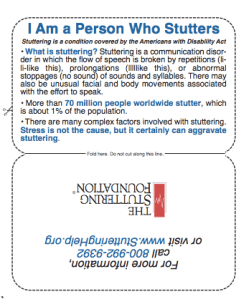 Up to this point, I’ve been quiet about the Stuttering ID Card that has been created by the Stuttering Foundation for people who stutter to carry in their wallet. This card was created in response to an incident that occurred at an airport where a person who stutters claims to have been detained because of her stuttering.
When I first heard about it, I did chime in on Twitter to say there is going to be hundreds of people who stutter coming through the airport in July for the annual conference of the National Stuttering Association. But I’ve been quiet since, as there has been no word from the airport about what happened and there is always two sides to a story.
The young woman has garnered a lot of attention in the stuttering community. She has written articles for the Huffington Post and was also featured in The Mighty.
Recently, I saw that the American Speech-Language-Hearing Association wrote about the ID card on their blog, The ASHA Leader.
So, now, two prominent organizations have advocated that people who stutter carry this card when going through customs at airports, to help explain that they stutter.
I wouldn’t feel comfortable carrying this card. I don’t need a piece of paper to state that I stutter. I can tell people that myself, if it becomes necessary. Sometimes, it’s very obvious that I stutter, sometimes not so obvious. There are times when I feel comfortable advertising that I stutter and times where I am not.
I’m curious. How do you feel about this? Would you carry this card with you when traveling?
Looking At Ourselves Stutter
Posted on: April 5, 2016
- In: Posts
- Leave a Comment
A very courageous poster today made a comment in a Facebook stuttering group about how hard it is to watch himself and other people who stutter on video.
He shares very honestly that he can’t stand to see himself stutter and can’t bring himself to watch other people who stutter either. For him, it’s not a way of desensitization, but rather a form of torment.
This made me think about how hard a time I had when I was asked to make a video of myself stuttering when I did speech therapy some years back. I remember quite vividly how much I resisted doing it. I just did not want to see myself stutter. I felt my stuttering was ugly and I was aware of how I tensed up when I blocked and I just did not want a video reminder of that.
My speech therapist at the time really wanted to deconstruct my stuttering with me and felt strongly that viewing my stuttering was the best way to do it. She also wanted to be able to “count” my stutters as part of required data collection for her class. I hated that too, as I felt it made me nothing more than a piece of data to be collected and not really a person who just happens to stutter.
It took me the whole semester to allow her to record me doing a very short monologue where I hardly stuttered at all. Even looking at that with her, with very little stuttering, made me feel self-conscious and embarrassed. I just didn’t like to see myself on video. I didn’t believe it could be helpful.
Fast forward, about 9 years later, and I find I am one of the people posting a video of me talking and stuttering in some of the Facebook groups. Something I never thought I could or would do, now I am doing with ease and posting publicly on the Internet. Wow!
What’s changed? Mostly, my attitude. I have reached a point in my life where I am OK with my stuttering and feel that I can help educate and raise awareness about stuttering. I am OK with looking at myself and hearing myself on video. I think most of this comes with maturity and experience and a good dose of “I don’t give a crap.” 🙂
I am in awe of all the members in the stuttering groups who have taken a risk to post videos of themselves talking about their story with stuttering. Some of them have acknowledged that they are new to the community and have never met another person “in real life” that stutters. Through posting video stories, people are seeing and hearing other people who stutter and I think that it’s great to lessen feelings of isolation, which are common for people who stutter.
I’m glad that the poster had the guts to share how he really feels about seeing stuttering. It certainly gave me pause to reflect on where I’ve been and where I am at now.
I’m curious what you think. Have you ever seen a video of yourself talking and stuttering? How did it make you feel? Would you be willing to post a video of yourself in a stuttering forum on the Internet?
Book Review: First Person Shooter
Posted on: March 29, 2016
- In: Posts
- Leave a Comment
 A member of the global stuttering community from Australia reached out to me and asked if I would read his new book. I was delighted, as I always enjoy reading about stuttering.
I recently read “First Person Shooter,” written by Cameron Raynes, a person who stutters. The book is a young adult novel, with some adult themes. The book is narrated by young Jayden, a 15 year old boy who stutters. Jayden is addicted to video games and has a crush on his best friend Shannon.
The story is pretty intense, loaded with characters who all have their own story. Jayden and his father are surviving after losing his mother 12 years earlier. Shannon’s mother is due to be released from prison. Jayden is constantly trying to outrun a couple of school bullies. He has a part-time job at a meat shop and looks in on his neighbor, a disabled veteran. The town is bracing for violence from Pete, who is looking to exact revenge for the murder of his father. And Jayden’s beloved dog is dying.
There is a great deal I could focus on in this gritty coming of age story. For the purposes of this blog, I’ll focus primarily on the stuttering. Stuttering is not always portrayed well in the media and the arts, so I was eager to see how the author incorporated it into the story.
The first thing I’ll say is the stuttering experience is beautifully handled. It is obvious that the writer has first hand experience with stuttering. He nails Jayden’s struggle with having much to say, but feeling unable to express himself the way he wants. Jayden has a love of poetry but can’t make his own words flow.
Jayden shares many real and poignant feelings about his stuttering, which at 15, he realizes will be with him for life. Early on, he reflects that “to speak is to be human,” inferring that perhaps he doesn’t always feel human because of the way he talks. When he speaks, his words are ugly. He escapes these feelings by getting lost in his video games.
Jayden also thinks that deep down, something is wrong, that he is broken inside. That is not unusual for a teen who stutters to feel. I sure felt defective when I was his age and often wondered, “Why me?”
Jayden also describes the dread of sitting in class and having the teacher go around the room and know that he is not going to be able to get out of speaking. He speaks of scanning ahead, which is a trick that many people who stutter use to avoid stuttering. In class, he has also tried being funny, to draw attention away from his stuttering, which doesn’t always work.
Jayden has a circle of friends who accept him. Several of them have also been picked on by the school bullies, so they are a small group with commonalities. Jayden appreciates his friends because he can be himself and not be consumed by the constant worry of how he will sound and how they will react.
Throughout the story, Jayden dreads an oral poetry presentation he must do before the end of the school year. Anyone who stutters can empathize with Jayden’s terror of having to speak and stutter for a prolonged period of time. It can be a harrowing experience for an adult, and this is an adolescent dealing with the cruelty of teens. Jayden gets through the experience and closes the door on another school year.
I highly recommend this book for teens or adults who stutter and anyone for that matter. It is well written, with an honest, believable character who stutters. The author lets us into Jayden’s head and we get how tough stuttering can be. Most fluent people don’t really “get” stuttering. Raynes masterfully weaves Jayden’s stuttering into a story that is dramatic, intense and satisfying. You feel for the kid and applaud his tenacity and courage on many fronts. You’ll have to read it yourself to know what I mean. And I hope you do.
Episode 152 features CiCi Adams, who hails from Pennsylvania, but is presently living in Brooklyn, New York. CiCi is a journalist at People Magazine and enjoys writing, dance and eating lots of Chinese food.
Listen in as we discuss what’s helped her to be OK with stuttering, how she handles interviews at work, interacting with other people who stutter and so much more.
CiCi is a member of the NYC National Stuttering Association chapters and talked about the one day conference that NSA NYC is sponsoring in May.
And Cici blogs. She wants her blog to grow. Please check her out at The Plight of the Stuttering Journalist and let her know you’ve visited by leaving a comment.
This was a great conversation with yet another amazing woman. I feel so lucky to be able to host this podcast. My life has been enriched by all of these women’s stories.
The music clip used in today’s episode is credited to ccMixter.
Comedy And Stuttering
Posted on: March 15, 2016
- In: Posts
- 5 Comments
I recently had the opportunity to attend a comedy show, headlined by Drew Lynch, a person who stutters. Drew was featured on last season’s reality TV show, “America’s Got Talent” (AGT.) Drew did stand-up comedy on the TV show and wound up finishing the talent competition in second place.
Drew did not grow up as a stutterer. He claims he began stuttering a few years ago, after being injured in an accident. He was hit in the throat by a softball and began stuttering. He had aspirations to be an actor and decided to try his hand at stand-up comedy when fate intervened and he was injured.
I remember last year when Drew was on AGT. A lot of people in the stuttering community did not find him funny and did not think it was cool to make fun of stuttering. Audiences laughed at his stuttering jokes and the way he made fun of himself. He almost always laughed himself after telling a joke.
I found him to be funny and his humor appropriate, but was only seeing him in 3 minute segments.
When I heard he was coming to my hometown to headline a comedy show, I was very interested in seeing him perform. I wondered how he would handle performing for a longer stretch. And I wondered how my hometown audience would react to a comedian that stutters.
My sister had asked me to go with her to the show, which was a surprise, as I didn’t think she would be interested in seeing someone who stutters. She and I don’t talk about stuttering. It’s always been a taboo topic in my family and continues to be so, even though I am very open and public about my stuttering.
So we went to the show and had a great time. There were two opening acts, one which was very funny and the other was just OK. Neither of them stuttered! 🙂
When Drew came out to perform, he immediately started with a joke about stuttering. He laughed and the audience laughed. Drew went on to perform for almost an hour, which I marveled at, given that it’s a long time and a lot of material to remember for the performance.
His material was not all stuttering related. He had funny jokes about every day life which the audience enjoyed. About half of his material was related to stuttering, and making fun of his own stuttering. I think his willingness to poke fun at himself and laugh at his own jokes and funny stories gave the audience permission to laugh. And laugh they did. It appeared everyone in the packed room was having a great time.
I posted something about having attended this comedy show on Facebook. Several people commented that it is not good to laugh at stuttering, because it opens the door for anybody to laugh at stuttering.
I say that most people can appreciate the context and will not laugh at someone stuttering just because they happened to laugh at a stuttering comedian.
After the show, Drew stayed around to meet and greet fans and signed autographs and took pictures. The line was so long, which was a great sign that the audience had enjoyed Drew’s performance. I did not stay to talk to him, although I really wanted to let him know that I stutter too.
Turns out, after my sister drove me back to my car, she went back and stood in the line to get an autograph and a photo. Guess she really enjoyed the performance.
So, what do you think? Is it OK to laugh at someone who stutters when they are telling jokes and making fun of their own stuttering?
Stinking Thinking
Posted on: March 8, 2016
I recently asked a question on one of the Facebook stuttering forums. I was interested in what people think about when stuttering. So I posed the question, “What do you think about during a moment of stuttering?”
I was amazed by the number of responses. This question drew about 40 comments.
And guess what? Most of them were negative. People shared that what they think during a stuttering moment is usually tied to shame.
Here’s a sampling of the responses.
Embarrassment.
“I should have kept quiet.”
“I’m thinking about what the other person is thinking.”
“Panic, panic, panic.”
“My mind goes blank.”
“When will this be over?”
“Scanning my brain for words I can substitute.”
“Please just let this moment end.”
“Why do I bother?”
“Uh oh, too late.”
“Here we go again.”
“How stupid I sound right now.”
“I hope my face isn’t getting red.”
What do you think? What goes through your mind when you are in a stuttering moment? Is there anything we can do to change the way we think so that it’s not negative or shameful?
I am definitely guilty of wondering what the other person is thinking when I’m stuck in a block. I wish I could get myself to think, “it’s OK, I got this.”
Stutterer Wins The Oscar
Posted on: February 29, 2016
- In: Posts
- Leave a Comment
“Stutterer” won the Oscar last night at the Academy Awards for best live action short film. It was up against 4 other short films and clearly moved audiences. The Academy got it right by bestowing the award on “Stutterer.”
Have you seen it yet? It is only 12 minutes long and you can buy it from YouTube and make it part of your personal library.
The stuttering community is abuzz about the film, with people offering mixed feelings about how the character’s stuttering was portrayed. People are also talking about how they feel about another character with “flawed” communication being the one to interact with the stutterer.
The film really helps put into perspective the whole notion of imperfections.
Do check it out when you can.
Episode 151 features Nora Sadik, who hails from Urbana, Illinois. Nora is a Master’s student at the University of Illinois at Urbana-Champaign. She is studying environmental engineering with an emphasis on water quality in the developing world. She enjoys creative activities such as painting and cooking and also enjoys live music.
Nora shares that she has always had a pull toward human health. She’s had a drive to help people, but it’s really the people helping her.
Listen in to a great conversation that covers a lot of ground. We talk about how women don’t take as many risks, that we’re perhaps wired to be cautious and protect ourselves. We relate that to women who stutter, and talk about protecting ourselves based on who we are and our feelings about stuttering.
We talk about thinking about what the other person is thinking about us when we are in conversation. We create fear, which can be consuming and exhausting.
And we talk about Nora’s experience as a Keynote speaker at a conference for girls called “Authentic Voices.” She shares that her talk was about her journey toward self-acceptance with her speech and how self acceptance of any challenge we have is important to empower girls.
The music used in today’s episode is credited to ccMixter.
 Make Room For The Stuttering
What people are saying!