Posts Tagged ‘advertising stuttering’
What Impact Means
Posted on: April 20, 2011
- In: Posts
- 2 Comments
 A few weeks ago I had a chance encounter with someone who is a blogger and writer. I experienced one of those times when a whole series of events occurred that was absolutely meant to happen. I wrote about it here!
A friend of mine who stutters shared her original work at a local public reading event. I was there to listen, record and cheer her on. After the readings, I found the courage to introduce myself to the woman who teaches my friend’s writing class. We talked and in just a few minutes, shared that we were both bloggers and what we wrote about.
Marion asked me to send her the link to my blog and podcast and she would feature it on her blog, She Said, She Said, one of those featured on The Sister Project. The Sister Project was started by Marion Roach and her sister Margaret Roach. As described on their blog, The Sister Project “is a network of blogs about the many facets of the word sister, and the concept of sisterhood. A sisterhood of sister blogs, you could say”.
Of course, sisters and sisterhood resonates with me. I have four sisters, and have been podcasting with women who stutter from all over the world for almost a year. So I am delighted to see that both my blog and the women who stutter podcast was featured on The Sister Project yesterday.
And I absolutely love the title of the piece, Meet A Sisterhood of Triumph. Please go over there and take a look, now! Check it out if you are interested in stuttering and especially if you are a woman who has shared her story. Our voices are being heard.
These three lines grabbed me, and made me realize what “impact” means:
“I enjoyed that rare and wonderful feeling when admiration begins a sisterhood where only moments before there was none. When referring to herself as a unicorn, I had somehow mistakenly pictured my student as the only adult female stutterer out there. Crazy, I know, but it happened, and suddenly I saw this sisterhood”.
Thank you Marion for honoring women who stutter with a piece on your blog tagged “sisters we admire.” Visit The Sister Project often. Good things are happening over there.
Local Blogging Event
Posted on: April 16, 2011
- In: Posts
- 3 Comments
Just a quick note! I am attending the first ever TechValley Blogger Tweetup event this evening, April 16, 2011, in Albany, NY. Why would anyone care?
Well, this will be my first effort to share my blog and podcast about stuttering to other local bloggers who don’t stutter. I am hoping to network with the local blogging community, put myself out there (a new concept for me, right?), and further increase awareness of a local stuttering resource.
I have been hoping my area would eventually create a local meet-up so that local bloggers could meet in person, share ideas and get our words and voices out there. One of my friends, Lisa, of Outspoken Media and Voice Interrupted will be on a panel. I am excited about attending and learning. And I have linked my blog to the TechValley blog site as well.
The more exposure, the better, right? And I seem to be landing in places lately that I should. I have a good feeling about this. I bet someone will learn something about stuttering that they didn’t know before! I hope so!
Finding Confidence
Posted on: April 15, 2011
- In: Posts
- 5 Comments
 Today’s post is from a special guest writer, who has inspired me with her words and courage. The following was written by Amanda Schott.
(Amanda gave me permission to slightly edit her piece for length. This article will also be printed in the next issue of the FRIENDS newsletter, Reaching Out. Amanda’s mom also gave consent for her piece to be published here!)
Stuttering is a setback that affects me every day of my life. Last year, when I was in eighth grade, I began to stutter. It happened overnight. There wasn’t any gradual thing where I did it once or twice and then it grew to a full-on problem. It hit me suddenly, and since I had never stuttered before, people noticed it big time.
I’m Amanda, a fifteen year old with a bubbly personality and an awesome sense of humor. But most people don’t see me that way. They only see the tourettes, ADHD, depression, and the stutter. They see a twitch that can’t control her emotions and acts like a two year old sometimes. I’m innocent and wise at the same time. Through it all, I grin and bear it, but the insults hurt all the same whether I show it or not.
My little brother and sister have both been through speech therapy for a couple years. They both went to two preschools at once for their speech and continued therapy in elementary school. It was a classic case for kids their age: talking too fast and dropping sounds mostly. So, when they learned to slow down and enunciate, they graduated from the speech class and talk fine. Neither of them have ever had a stutter.
I talked to my siblings’ speech therapist, and she said that there was no way I just got a stutter out of the blue. I did, though, and now I still have it a year later. I don’t stutter sounds, really, but I repeat words, especially short ones like ‘its’. ‘I think it’s, it’s’ it’s’ (long pause while I grit my teeth and force the next word out) ‘it’s because I…’ is something I do all the time.
‘Hey Amanda, do you st-st-stutter?’ I hear CONSTANTLY. What’s sad is that I get that from my friends who know that I don’t even stutter like that!
I found out about an organization for teens who stutter while I was just searching the internet for anything that could help. I searched for ‘teens who stutter’ and clicked on a random link. It led me to the FRIENDS website and I saw there was a mentoring program for kids and teens. I printed the application and filled it out, thinking it could be good for me to be able to meet other kids like me.
I got an email from Gracie not too long later. I could tell right away that we would be amazing friends. We email almost every day and talk about everything from stuttering to boy problems. We haven’t gotten around to calling each other because she doesn’t like talking on the phone. I want to talk her into it and show her that some people don’t care whether she stutters or not.
Talking to Gracie is so fun and I’m lucky to have her. We support each other and we’ve gotten really close. It’s helped a lot to have someone to talk to who understands what I’m going through and can relate to what I’m saying. Seeing a new email from Gracie always makes me smile and brightens my day.
I started to lose my passion for speaking when I got my stutter. I got quieter, I held things inside that I wanted to say because I was afraid it wouldn’t come out right, I even avoided people that I talk more around! My best friend Chrissy was hurt because I didn’t talk to her for a while, and it wasn’t good at all. Now that I know a bit about stuttering, I’m more confident about it.
The most frustrating part of my stutter is when people finish my sentences! I hate that so much! It makes me feel bad to say anything though, because my friends are ‘just trying to help’, but it makes me feel incompetent when I can’t even talk for myself. So I decided to tell them all to stop. Now, whenever I can’t say something, I make a joke, like, ‘Hang on! I’ll get this!’ or I try to rephrase what I was going to say. I also remind my friends that ‘I can speak for myself if you’ll let me’ in nice tones.
It also bothers me when people interrupt me while I talk. I’m very talkative and I like to tell stories, but if I stutter and stop for a second, my friends will just launch into another story when I’m not done with mine. I’ve learned this is the line I don’t like having crossed, so I remind them ‘That was rude’. I still try to be humorous about it, but I can’t stand it when people are rude to others who are talking.
Learning how to tell people about the twitching? Not as easy at all. Usually, it happens just by people seeing me twitch in class or something, they’ll look at me funny, and I just say, ‘Sorry. I have tourettes. I can’t control it.’ When kids know about it, they’re less likely to judge me on what I do. I tell a lot of people now, and I get less stares and weird looks because they understand.
The other day, I was sitting in English class, and two of my classmates were sitting behind me when I had a huge shoulder twitch. I heard one tell the other, “Don’t say anything. She has tourettes. She can’t control it.” Then I heard, “But it’s so freaky!” and the first boy stood up for me. “How would you like it? Leave her alone.” Just that simple gesture helped me more than that boy will ever know.
I love the Friend’s mentoring program. I have a few friends who stutter and I told them about it, and they want to sign up too. Because despite all having stutters, we have different stutters and different problems to face. Having good friends to help me through my troubles is invaluable to me and I wouldn’t trade them, even if it meant losing my stutter forever.
If you were inspired by Amanda, please leave a comment. I will make sure she sees any feedback left for her. Amanda, you ROCK!
What An Honor For Stuttering!
Posted on: April 12, 2011
- In: Posts
- 7 Comments

 I was a little reluctant to post this information here, but some friends encouraged me to do so. Last Monday, April 4, I was honored at an awards ceremony for the Jefferson Awards. These awards were begun in 1973 in the United States by Jacqueline Kennedy Onassis, U.S. Senator Robert Taft Jr. and Sam Beard.
The Jefferson Awards annually celebrate America’s commitment to public service. Recognizing both the famous and the unknown, individuals and organizations, the young and old, the awards reflect one of the founding ideals of our nation, that of contributing toward the larger good.
In our local area, the focus is on ordinary, non-famous people doing extraordinary things. My sister Kimberly nominated me for work I have done to raise awareness and tolerance of stuttering. She submitted an essay about my visiting schools to talk about bullying prevention, advocating in the media by having articles published and appearances on radio and television, and the podcast I started last year giving women who stutter a space to share their stories.
Of hundreds of nominations, 18 of us were chosen as finalists. I was then notified that I was chosen as one of 7 Jefferson Award Medalists. One of the Medalists was chosen to attend a ceremony in Washington DC in June to represent the Capital Region of NY. That person is a man whose son committed suicide at the age of 18, and his efforts since to raise awareness to schools, teens and parents. I was honored and touched to be part of this elite group of 7. The others were working to improve and raise money for important social causes.
I was chosen as part of that field for bringing a local voice and face to stuttering, and for giving women all over the world an opportunity to share their stories. Thank you to all of the women who have so beautifully and courageously shared your stories. Together, we have showed the world that we do have stories that need to be heard.
Thank you also to my sister for having the courage to nominate me for recognition for something that was always a taboo topic in our family. And thank you to my friends and family who attended the ceremony and cheered me on and made me feel so special.
Thank you to Claudia for immediately forwarding the details to the National Stuttering Association. They have posted this information on their page as well, which made me proud.
And thanks to my friends and listeners who encouraged me to post this here on my main page. They reminded me doing so is not bragging, rather it is inspiring. And the best way for regular readers/listeners to know that this special honor even occurred.
A Monday WOW Moment!
Posted on: March 1, 2011
- In: Posts
- 22 Comments
I had a great experience yesterday at my school that I wanted, well needed, to share. Two weeks ago I did a workshop at a library called “An Un-Royal Talk About Stuttering: Lessons from The King’s Speech”. It was free and open to the community and we had close to 50 people there. One of them present was a colleague of mine, who had seen the movie, knew I stuttered and was really interested in learning more. She also brought her mother.
She came to me the next day and asked if I would do a similar presentation to the Adult LPN classes, one today and the other one, in a more remote location, next week. She felt students preparing to work in the medical field could benefit from hearing this information from someone who lives it every day. I was nervous, but agreed.
I changed the presentation slightly to adapt to a nursing student’s point of view but planned to keep it close to what I had already done, so I didn’t have more work to do.
One of the first things I started with was the question how many in the class had seen the movie! ZERO! These are all working adults with families who take a demanding and intensive LPN course in 10 months and have little time to breathe, let alone watch a movie.
So I quickly changed my focus, and started telling MY story, hoping they wouldn’t be bored to tears. I shared about my covert years, why I chose that, the hidden feelings of shame and my reluctance to ever show emotion and vulnerability, in addition to stuttering publicly. I shared how I got fired, there was a collective gasp, they wanted to know wasn’t that illegal, etc. I started getting emotional, and one of the teachers brought me the Kleenex box!
Then I shared how my family had NEVER talked with me, or about stuttering, so it was always hard to talk about. I talked about how profoundly my life changed when I was fired and how I decided I wasn’t going to pretend anymore. I was going to let ME out.
You could have heard a pin drop in the room. I noticed and heard a few sniffles. At one point, I asked if anyone knew anyone who stutters, or does anyone stutter. One young woman in her 20’s raised her hand – she said , “I stutter” with tears streaming down her face.
I asked if her class knew, they were all looking now, and she said no, not until that moment. Her classmates then applauded. One girl said, “I thought so, but you are always so quiet, I wasn’t sure”. Heads were nodding and the girl who had disclosed smiled and looked OK.
I started talking about what stuttering is and what it isn’t, and the teacher in the room asked if it drove me insane if people finished my words for me. I smiled and said yes, she said, that as nurses, they are inclined to just want to help.
I then described the different ways stuttering can manifest, and when I got to sometimes people will use lots of filler words, like uhm, and that I used to do that, another hand went up, and a woman said, “OMG, that’s exactly what my 14-year-old son does, all the time. Maybe he stutters. I keep telling him to slow down, take a deep breath”, and she asked what I thought of that. I smiled and said that’s generally not helpful.
She looked concerned and asked out loud, “have I been making it worse for him?” and I said “if we could, we would”. She said she was going to talk to her child about it. She whispered “thank you” to me.
Towards the end, we were running out of time. We had not talked about the movie at all. I showed 1 minute of the 2 minute trailer. They got it. I then asked them if they had ever heard of Porky Pig, and what was he known for. They all knew. They stayed 10 minutes over, which the teachers told me they NEVER do. And they gave a huge applause at the end.
Several came up to me privately, and one more admitted she stutters and is dyslexic but has not told anyone, and that she “got me”. She said she has felt such a huge disconnect, but felt connected with my story as soon as I started telling it. She started crying as we spoke privately and she said she never heard anything this courageous as a teacher standing up in her school telling this story. She kept saying over and over “I got you.”
Who would have thought? 40 students in this Adult class, 2 stutter and one has a child who stutters.
This was a WOW moment for me and I wanted to share it!
- In: Posts
- 16 Comments
Last night I got a call from a professor from an elite university here in my area. She is teaching a graduate level physics class which is just getting underway for the semester. One of her students is from China and is pursuing his graduate degree in engineering.
The professor shared with me that he has a severe stutter. She says she talked with him about it and he told her that there is nothing that can be done for him. She wanted to find some resources to educate herself and to pass on to him, if she senses he would be OK with that.
She told me on the first night of class, she partnered students up in pairs for introductions, and she purposely paired herself with the student who stutters. As she told me this, her tone seemed to imply that she thought she was protecting him. Each person in the pair had to introduce the other.
When the professor introduced this student, she told the class that he stutters, that it is nothing to fear or shy away from, and that it will be an expectation of the class that he participate as often as everyone else and that patient listening would be the norm. She asked me if I thought she did the right thing.
My immediate reaction was, Yes, if he was OK with it. I asked her, “How did he seem to react to that? Was he embarrassed?” She said no – he seemed fine with it, maybe a little even relieved.
I then said that I thought it was great she was taking the initiative to make it OK to talk about. I shared with her how I felt in college, when I was presenting and felt so humiliated, and no one said anything, just didn’t look at me and looked liked they pitied me. I told her I would have much rather been in an open, supportive atmosphere, which she is obviously trying to do for this student.
She asked me for resources, specifically if I had any experience with therapy. I shared with her what was available in the area, and explained my take on fluency shaping and stuttering modification. She asked specific questions about both, and I could hear her writing this information down. (Smile!)
I also gave her some information on self-help and support, and some web resources, again realizing she was writing all of this down. She even asked md if there were any good books that I could recommend, so she could educate herself, and in turn, her student. I gave her information on Van Riper’s and Guitar’s stuttering textbooks and Jezer’s memoir about his life experiences with stuttering.
I was really happy this woman called and I was able to answer some questions. She had seen my name affiliated with a newspaper article I had written and with an upcoming workshop I am doing at our community library.
I was also impressed that a university professor took the time and showed an interest in educating herself to better help a student.
What do you think? Do you think the way she introduced the issue of stuttering to her class was appropriate?
- In: Posts
- 4 Comments
 With all of the media attention and buzz surrounding the movie “The King’s Speech”, I wondered why there was no coverage in my area. We have a local college with a 40 year history of working with people who stutter. And the College of St Rose has an affiliated chapter of the National Stuttering Association as well.
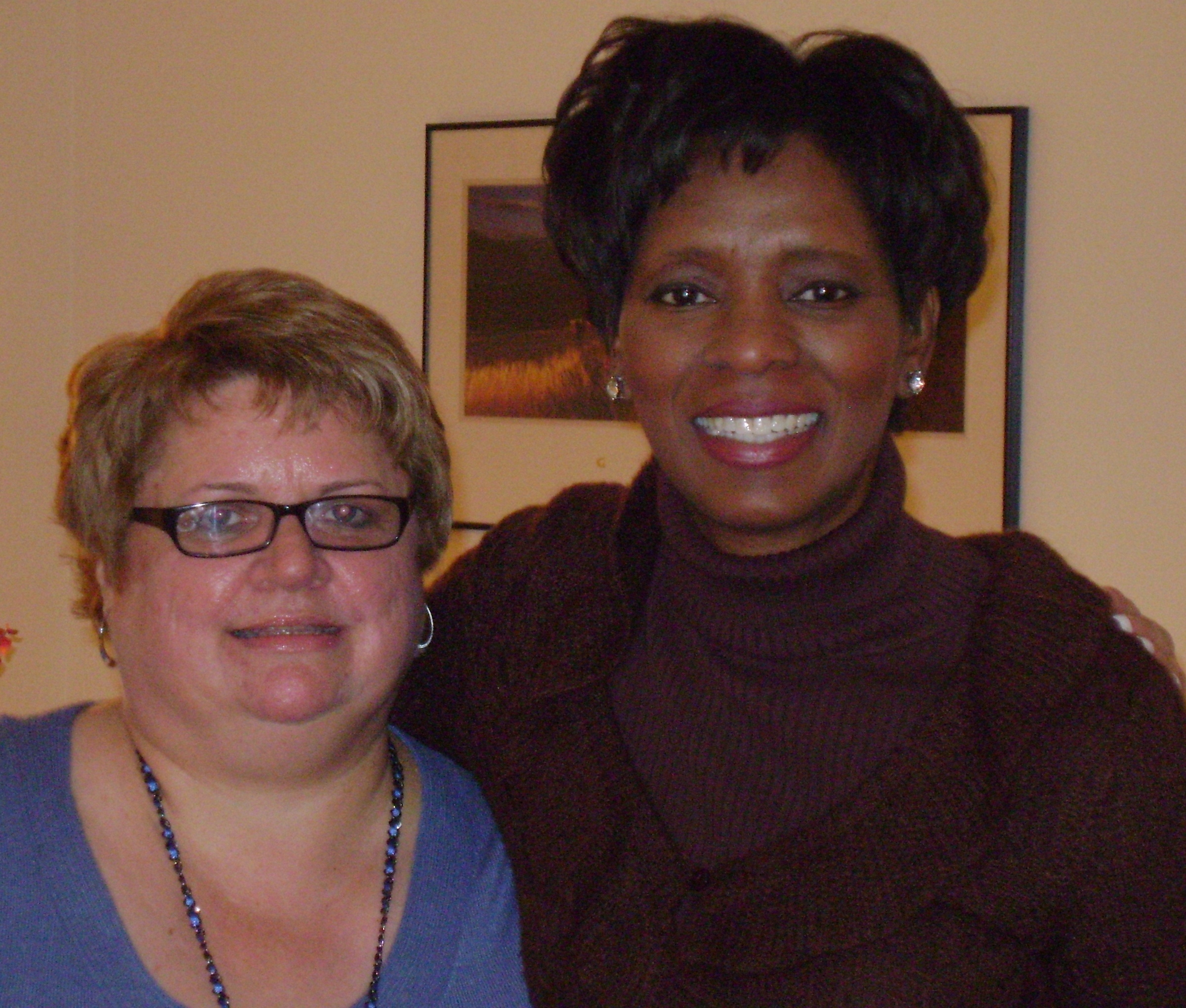
So, I emailed one of the popular local anchor/reporters, told her a bit of my story and shared that I have a unique perspective on the experiences of women who stutter. I asked her if she would be interested in doing a story. She responded the next day, saying she would love to, and we set a date for a week later. Wow!
On Friday morning I welcomed Elaine Houston and her camera technician, Jesse, into my home. It was exciting and surreal at the same time. Elaine and I chatted while Jesse transformed my living room into a studio, complete with bright lights and lots of cameras. And then we got down to the business of talking and stuttering and talking about stuttering.
Turns out, Elaine had not even seen the movie. We were not going to talk about “The King’s Speech”. I wasn’t fully aware of this, but the reason that Elaine jumped at the opportunity to hear this story is that she is passionate about women’s issues. She was excited about the podcast highlighting women who stutter telling their stories. She does a weekly segment called “Today’s Women” which airs on News Channel 13 which is also included on the station’s website.
So, we discussed the “often not talked about” issues of stuttering, including the emotions and vulnerability, and how I have been affected personally and professionally. We talked about my journey,why I started this blog and how the women’s podcast morphed from there. Elaine was really interested in the women I have talked to, their hopes and dreams, and how stuttering does not limit anyone from living life fully.
Elaine had this huge, bright, enthusiastic smile the whole time we were chatting. Her passion is obvious, and she shared with me about her visit to Africa. She is working on a documentary about the lives of women around the world. I was telling the perfect person about my journey. And what I have learned from being brave enough to start talking to women all over the world.
We spent over 90 minutes together, taking lots of pictures and talking about everything. Especially about the powerful stories of women who stutter and how my life has been enriched simply by being part of this. I was grateful to have this opportunity to tell this story, and open up a conversation about stuttering from the women’s perspective.
Funny how things happen, huh? I have been so empowered by inviting women to share their stories. Elaine has had the same experience. Check out the book she wrote, The Friendships Between Women.
Things happen for a reason and usually at just the right time.
What Happens When They Forget?
Posted on: January 24, 2011
- In: Posts
- 8 Comments
I had an interesting conversation Sunday with a friend. She wondered out loud what will happen when the attention surrounding “The King’s Speech” dies down and mainstream forgets about the movie. They will, you know.
By the end of the year, people who don’t stutter won’t even remember the movie. Attention will shift to the slew of movies that are always released at the end of the year, just in time for Academy Award buzz.
My friend mentioned that someone told her that right now, the movie almost makes it “cool to stutter”. A year from now, we will still have to worry about sending the message that it is “OK to stutter”.
In this fast paced world, people’s attentions spans are about as long as my pinkie-finger. We move from one thing to the next at lightening speed. I even have trouble these days recalling what I said an hour ago, unless I write it down. And then I can’t always even read my hand-writing any more. And speech recognition software doesn’t work well if you stutter! I tried it years ago!
So what do we do? How do we keep a reasonable focus on stuttering and remind the world that we are here, competent and able?
Another friend posted on Face book that the DVD and Blue Ray for “The King’s Speech” will be available on April 29, 2011. Who needs to know that? Who will buy the DVD? My bet is that most sales will be to us – people who stutter and people who care about people who stutter.
So we will need to continue educating others, raising awareness, talking about stuttering openly and advocating for ourselves. That includes keeping our blogs and podcasts alive and current, encouraging people who stutter to step out from behind the shadows and do everything we can to eliminate bullying of kids who stutter and workplace discrimination of adults who stutter.
That stuff will still happen. Kids will be teased and adults will be passed over for opportunities because people just don’t understand something outside of their “own world” realm.
Reminds me of a comment I saw posted on one of the stuttering email groups a few months ago. A woman asked, “are there any women who stutter in high power, visible,management positions?” Like CEO or Executive Director of known businesses?
We hear about Jack Welch of GE (20 minutes from me) and John Stoessel of 20-20 News (but he records his broadcasts and edits out stuttering). And here in my community, we have a male Mayor who stutters. But where are the women who stutter?
That’s why we will still need to keep talking and making our voices heard long after this movie is forgotten. For the kids who come behind us, and for the women who stutter openly that are not visible in those high level positions.
I recently met a woman who stutters who is her company’s Chief Branding Officer and the company is very successful. Hopefully, we will hear her story soon.
But in the meantime, we can’t complacently ride the coat tails of this movie. We who stutter every day and make room for it in our lives will have to be stronger and louder than ever to keep teaching the world that we are OK and what we have to say is important.
What do you think?
Watching Yourself Stutter
Posted on: December 28, 2010
- In: Posts
- 2 Comments
 I recently read on one of the stuttering forums that a good way to desensitize yourself to your own stuttering is to watch yourself stutter in a mirror. Thing is, I don’t stutter the same when I am alone with the guts to look in a mirror.
The week before Christmas I facilitated a story-telling circle with a very supportive audience. These were people who understand the value of sharing our stories, as any one story has the potential to trigger an impact on someone else. So this group were wonderful listeners. I felt very honored sharing some of my stuttering stories with them, one a very personal one that I had never shared the way I did that night.
It was very empowering for me to tell my stories, especially to an audience of people who do not stutter. And because it was story telling, which is very different from giving a speech, I did not use notes. So I wasn’t quite sure how it would unfold, as I planned to just tell from the heart.
I knew it would be special, so I had a friend record the three stories I told. I wanted to have a record of what I told. I spent a lot of time editing the video clips, as I planned to share the clips, my message, with others.
It was very hard watching the videos of myself telling and stuttering. It is one thing to hear myself stutter, like when I do the podcasts or even just hear myself talking to others. But to “see my stuttering”, it kind of brought tears to my eyes the first time. I saw how deliberate I was, I saw what my pauses looked like, I saw what mutiple-repititions looked like. A couple of times, I saw one eye squeeze closed when I blocked. And I saw some physical tension.
Watching myself tell my stories and stutter very openly with people I did not know well was very emotional, very poignant for me. I wondered as I watched (the video) what the listeners thought as they watched me.
It was not easy watching the first time. But I did watch several more times and it was easier. I caught the point where I almost choked up, but didn’t. And I realized that sometimes I stutter a lot, and sometimes hardly at all.
I don’t think I could ever purposely practice stuttering in front of a mirror. It would be contrived, not real. It would not help me be anymore comfortable stuttering publicly.
It takes a lot of guts to be who you are in the many different areas of our lives. And to look back on those moments and realize just that. Watching myself be myself in front of others can’t be replicated in private with a mirror.
Real life needs us to be ready to be ourselves when it counts. When sharing our gift of self can make a big difference.
The People In Our Lives
Posted on: December 22, 2010
- In: Posts
- 4 Comments
Short and sweet today. I have spent a lot of time reflecting on how rich my life is. And that is because of the many people I share my life with. It is so true what they say that it is not money that measures our riches – but indeed the relationships we build.
My life has been enriched by the people I come into contact with, and I truly feel I am a better person because I let my heart be open to new people and experiences.
Thank you for enriching my life!
- In: Posts
- 4 Comments
I have written about friends who stutter here before. I have many friends whose names begin with J, so if you are reading this and think its you, you’re probably right!
J and I hung out the other night. It’s good to spend time with friends who stutter. We can let our guard down, stutter freely and sometimes, offer candid feedback to each other about stuttering moments. Not always a good idea with non-stuttering friends.
I went to his place and we talked for a while before leaving to see a play. We weren’t sure where to park when we got there, so I called and asked for directions. No problem making the call and stuttering a bit during the brief conversation. I stutter more on the phone, like many of us who stutter.
J then decided he wanted to make sure the play was not going to be too “somber and depressing” for a Thursday night, (he wanted to be entertained) so he called them back. He said he would “practice his speech on the phone”, as that is when he stutters the most too.
As soon as he started talking, he started to tense up, lean forward and block. Immediately, he stood, turned his back to me and walked away as he tried to push the first word out and then move into conversation. This really surprised me. He has never reacted like this, at least around me.
Of course, I have not seen him make many calls. When he calls me on the phone, I can’t see him, only hear, and he is very comfortable with me. I rarely hear him stutter over the phone.
When he finished his call, I mentioned this. I offered that it looked like he did not want me to see his struggle. He said he always does that on the phone. He tenses, leans forward and blocks and that he needs to stand and walk to help him move through the block.
I quietly wondered aloud if he was also uncomfortable with having me actually “see” this struggle. I asked him if he was ashamed of that, and he simply said “maybe”.
We talked about it a little more a couple of days later, and he said it’s not really shame. He said that when he gets in a block, he can’t think. He is so focused on the block that he can’t think. He says anyone around him is a distraction, and that I was a distraction, that’s why he had to move, so he could think.
His blocks are silent blocks, that over the phone I am not going to hear. There is no audible stuttering. Watching him initiate a phone call really allowed me to see the physical tension he has.
It was good that we talked about it. I suggested that if he allows himself to struggle in front of people he trusts, he can desensitize himself when it really happens making calls at work. And I further offered that he is not always going to be able to move away from distractions, and that maybe he needs to think of a way to work with this.
I remember when we recently listened to one of my podcast episodes together. When he heard me stutter on a “p” sound, which I always do, I felt embarrassed having him hear it. I commented “I hate when I do that.” He said it doesn’t bother him and asked, “Why are you so hard on yourself?” I simply said, “I don’t know.”
Yes, it’s always good to talk about our stuttering with someone else who stutters.
Fluent Talk on Stuttering
Posted on: November 17, 2010
- In: Audio Links | Posts
- 2 Comments
A friend of mine, Burt, pointed me to this great video he found. Thanks Burt! A guy who stutters explains what stuttering is and how it impacts his everyday life. It is a great illustration of how to raise awareness of stuttering, as well as an example of his good graphic work on the video.
He also describes this talk he did as an “Ignite Talk”, which I have heard of before, being familiar with Toastmasters. It is a fresh and fast way to deliver a presentation that only allows 15 seconds per slide. This forces the speaker to be short and concise in what he or she is delivering and keeps the listeners involved, as the talk moves swiftly along with the slides.
Credit for this video goes to John Moore, of Brand Autopsy. He has a comment section set up on his blog if you want to leave him specific comments. This is a terrific piece for all people to see, both those who stutter and those who want to learn more about stuttering.
Why Be Angry? – Episode 33
Posted on: November 5, 2010
 Episode 33 features Sadia Khan, who hails from Brampton, Ontario, Canada, by way of Pakistan when she was just 3 years old.
Sadia is a Grade 3 teacher, which was a life-long dream. Teaching is meaningful for Sadia, as she was told in high school that she should not be a teacher because of her stuttering. Her guidance counselor told her she would be a poor role model.
Listen in to this fascinating conversation about being a teacher who stutters despite having a very negative experience herself in school. Sadia shares about her fear of judgment and largely keeping her stuttering hidden from work colleagues. She shares how important it is for her today as a teacher to create a place of comfort and safety for all of her students.
We also talk about how angry she was with her dad for many years, and how she finally let go of that anger and forgave her dad. Sadia tells us about how she was naturally left-handed and her dad forced her to become right-handed. She thought maybe that trauma of having that change forced upon her was why she started stuttering.
Sadia has been involved with the Canadian Stuttering Association, and gave a speech about her journey with being a woman and teacher who stutters. She has also spoke on the radio about stuttering.
At the end, we have a great back and forth about learning how to build confidence as women who stutter.
As always, please feel free to leave comments for Sadia. Please tell her what a great job she did sharing her story. I think many teachers who stutter will be inspired by Sadia’s courage to share.
Credit for the podcast safe music clip “Firebabies” goes to ccMixter.
- In: Posts
- 15 Comments
I was honored to get an email from a reader of the Covert-S email group asking permission to share the article I wrote about kids who stutter on her blog. Liana shared that she does not stutter, but has friends who do, so she subscribes to several of the stuttering lists to learn more about stuttering.
How great is that? She wants to understand more about stuttering so she can better support her friends. So she asked me if she could re-post my story on her blog – Liana’s Place – A Blog About Life, Lies, Laughter and Love. Of course, I gave permission. Great to have more potential readers. And greater that she asked for permission. Lots of people on the internet just pilfer other people’s content without permission nor do they give credit.
Of course, I checked out Liana’s blog, and found it to be a wonderful place. Liana is a published author who has won awards for her romance novels. But she does more important work by writing and blogging the story of a friend’s faith journey.
She writes weekly about her friend Louis. He was a covert stutterer for a long time, but now stutters openly. Liana shared with me that my published story reminded her of things that Louis had shared with her about his stuttering. Liana’s writes on Fridays about Louis and gratitude and inspiration.
I am honored to be featured as a guest on Liana’s blog today, Sunday October 24, 2010. Talking about stuttering anywhere gets the word out and raises awareness. Thanks Liana and please say hello to your friend Louis for me!
Addendum: I have included some comments that I received directly from readers of the TU article, and also some comments from Liana’s blog, from readers who don’t stutter (with her permission of course).
 Make Room For The Stuttering
What people are saying!