Author Archive
Choosing Her Path – Episode 90
Posted on: August 6, 2012

Episode 90 features Briana Pipkin who was born and raised in Dallas, Texas. Briana is 21 years old and currently a senior at Lamar University in Beaumont, Texas. She is studying to become a speech language pathologist.
Briana decided to study speech language pathology after ruling out other career paths and remembering a positive experience she had as a child.
Listen in as we discuss stuttering choices, disclosure and fear of judgment.
We also discuss covert stuttering as it relates to choices and the responsibility of educating others so they know how to respond. We also talk about the rise of on-line stuttering forums and support groups.
Feel free to leave comments for either Briana or me in the below comment section.
The podcast safe music used in this episode is credited to ccMixter.
Social Media and Stuttering
Posted on: August 1, 2012
- In: Posts
- 8 Comments
 I host two podcasts for people who stutter to share their stories. The Women Who Stutter: Our Stories is going strong more than two years in. And the occasional series for men who stutter, He Stutters: She Asks Him, is more than a year old.
Here’s an interesting trend happening with the women’s stories. About 8 women, months after their episode has been published, have contacted me and asked if their conversation could be removed. That is a little complex, as they are numbered, archived and on iTunes.
Compromises were reached and the last names of some of the women were removed. Some names were changed entirely.
Why?
People are discovering that upon a Google search, their names are popping up associated with stuttering. If they are doing a job search, they don’t want to be linked to anything relating to stuttering. They are afraid that potential employers will draw conclusions that may result in adverse employment decisions.
Several women came right out and told me that is the reason they wanted to remain anonymous and not be outed on Google.
As open as we are about stuttering, and the more progressive we get about advocacy and raising awareness, some things don’t change.
We still fear being exposed and still believe that being found to be a stutterer will result in negative social punishment. Including missed job opportunities or promotions.
And it appears to be more of a women’s issue. Hmmmm . . . . . .
Thoughts?
Family Processes Tragedy Together
Posted on: July 25, 2012
- In: Posts
- Leave a Comment
Why am I writing about the senseless movie theater shootings that happened last week in Aurora, Colorado? Because I was in Aurora that night. I was at a conference for young people who stutter and their families. The locale was Denver, but our conference hotel was in Aurora.
Each year, Friends: The National Association of Young People Who Stutter holds an annual conference in a different major city. I have been fortunate to be part of this “extended family” since 2008, this year being my 5th conference.
I am not exaggerating when I use the word family. Friends was founded 15 years ago by a mom of a kid who stutters who wanted a support organization that was specific to the needs and goals of young people and their families who live with stuttering.
The attendees of that first conference are all grown up now, and still attend every year. They have grown up together, and each year welcomed new kids and parents to the family. People who know each other for 10 or 15 years and watch their kids grow up together are indeed family.
So it was not unusual for a group of these kids, ages 14-22, to have planned in advance to go to the midnight premiere of the Batman movie in Aurora. The older brother of a young woman who stutters was with the group and had organized transportation.
No one could have expected that this small group of kids who stutter would have been affected by senseless tragedy. But they were indeed. Our Friends kids were in the next theater when a young man opened fire in the theater next door.
 Bullets came through the wall, hitting one of our teens in the arm. At first, he didn’t realize he’d been hit.
In fact, many of the kids didn’t realize what was happening, as the loud “pops” of gunfire were at first thought part of the movie. But as smoke and screams filled the air, the Friends teens indeed knew they were in trouble. Their survival instincts, and love for each other, took over and they all calmly and quickly got out of that theater.
Accounts from the kids, who are survivors, and their parents can be found here (Gage and his parents) and here (Linnea and Melia and their mom’s account.)
I wasn’t at the theater. None of the adults who stutter or parents in our group were. I can’t provide an eye-witness account. So why am I writing about this?
I am reflecting on what can be learned from horrific random acts of violence. Because there are lessons learned.
When the calls and texts started coming in from the kids at the theater to the parents at the hotel, everybody acted together as family. Parents made sure that the parents of the kid who was shot got transported to the hospital. Parents made sure that the 14-year old brother who’d been at the theater was cared for all night and the next day. That call that is every parent’s worst nightmare was a little easier because so many other parents were there for support. 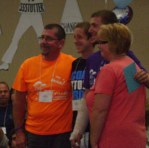
As the other kids returned to the hotel, shaken and emotional, the hotel staff were wonderful. They brought blankets, pillows, snacks and drinks, so the kids could stay together as a group in the lobby all night and process what they had experienced together.
In the morning, as news spread among the conference attendees, people wondered what would happen. Would the conference proceed? Would activities still happen?
The answers were YES and YES! Normalcy needed to prevail. The group needed to come together in workshops and sessions and experience the love and support that is unique to FRIENDS. When 300 people who share stuttering and the impact of “too close to home” tragedy, the natural instinct is to continue on and share the love and support of family.
That is what I am writing about here – the healing nature of support and family. The kids who were in the theater helped each other by being together all weekend. The parents and families and adults who stutter helped each other by sharing and talking, hugging and crying together, all weekend.
The only change to the conference agenda was the addition of group counseling sessions late Friday morning that were made available to anyone in need. Teens, parents and friends of the kids affected took advantage.
It seems cliché to talk about how senseless tragedy brings people together, closer, or helps us see what good can result from a major tragedy. So I won’t say that.
The FRIENDS friends were already a supportive close-knit family. The power of family and unconditional love and support helped our FRIENDS family process the magnitude of these tragic events and keep talking and holding tight to each other.
And that is the power of support.
Perspective Shift
Posted on: July 21, 2012
I am sitting in my hotel room in Aurora, CO at the end of the last day of the FRIENDS conference. Soon, we will gather for dinner and the kids will dance and sing karoeke and have fun being kids.
Having fun being kids is what the FRIENDS conference is all about. Kids who stutter gather for three days to savor the moments where they can just be kids, free from worrying about being teased or judged.
This 3 day conference was marked by senseless tragedy yet the kids who stutter are showing resiliance, grace and dignity. They have showered each other with love and support and have been talking and sharing their feelings.
We adults are pondering how random life is and re-examining our priorities. When tragedy strikes close to home, we look at things differently. Our perspective shifts – we realize how tomorrow is never guaranteed, and we must live each day as if it were our last.
For we know it can be. Senseless violence is random and can affect anyone anywhere.
Kids who stutter learn how to handle challenge and adversity every day just by living their lives as stutterers. They learn how to handle teasing and bullying and that life is not always just or easy.
The kids at FRIENDS who were touched by the violence in Colorado this week have shown how strong they are and how powerful support is.
These kids have taught me a thing or two about life. Life is about living and sharing and being true to self. No matter what you are faced with.
They Can Bloody Wait – Episode 89
Posted on: July 18, 2012
Episode 89 features Mandy Taylor, who hails from Belfast, Northern Ireland. Mandy returned to college about 5 years ago to study accounting.
Mandy felt unsupported by her family, especially her father. Her journey began when she left home at 18.
After seeing the movie “The Kings Speech” she felt empowered to research stammering for the first time and learned about the British Stammering Association. She attended her first BSA conference last year, meeting other women like herself.
We discuss raising stammering awareness, the support group that Mandy started herself, stuttering as a disability, employment discrimination and the need for advocacy. Mandy concludes by sharing her belief that persons who stammer have to be the ones to tell others about stammering, so people will understand and know what to expect.
I had so much fun chatting with Mandy and hearing her story. Feel free to leave comments below for either of us.
The podcast safe music used in this episode is credited to ccMixter.
Good Life and Stuttering
Posted on: July 14, 2012
- In: Video
- 3 Comments
I can’t resist sharing this video of Katherine Preston talking about her journey to finding her voice. I had the pleasure of meeting Katherine in person at a NSA conference and at a FRIENDS convention during the summer of 2010.
Katherine was a guest on my podcast “Women Who Stutter: Our Stories,” in the 25th episode Think With Your Heart in September 2010.
Katherine was interviewed by Jonathan Fields for his Good Life Project. Fields is the author of Uncertainty: Turning Fear and Doubt into Fuel for Brilliance. I read this book last year, within a week or so of it’s release. I highly recommend it for anyone who needs a push outside of their comfort zone.
This is a great interview for two reasons. Katherine stutters with confidence, and Jonathan Fields is a patient and respectful interviewer who found no need to rush the conversation.
This is a must see – whether you stutter or not!
Having An Open Mind – Episode 88
Posted on: July 12, 2012

Episode 88 features Anna Deeter, a speech educator who hails from Russia (former Soviet Union) and presently lives in Temecula, California.
Anna has participated in several online stuttering groups and shared her strong beliefs about a unique stuttering program.
She has been mentored and taught by Russian professor, Roman Snezhko, who believes that stuttering can be eliminated through the intensive “relearning” of “normal speech” (similar to NLP, which we mention briefly.)
In the spirit of being open to different ideas, I was curious about Anna’s approach and invited her to tell her story. It is easy to misinterpret written messages on social media. Listening, asking questions and engaging sheds more light on where a person is coming from.
Listen in as we discuss a very different approach to managing stuttering, that might be tough for people to understand. For more information, please visit the website Live Stutter Free. If interested, you can also see some video of several people who have participated in the speech class called ETALON.
Feel free to leave questions or comments for Anna in the comment section below. The podcast safe music used in this episode is credited to DanoSongs.
NSA Conference Memorable Moments
Posted on: July 9, 2012
- In: Posts
- 2 Comments
First open mic session of the conference: a first-time adult stutterer from Mexico gets up and talks about the warmth and emotion he felt so quickly by being with so many people who stutter. His wife got up and shared that she couldn’t have realized how great support feels and burst into tears, with no shame at all.
Workshop: “Inviting Women Who Stutter to the Table” – about 25 women talked about issues unique to women. We discussed claiming our space, strengthening our voice, and how stuttering affects our femininity. Many shared that it was a very powerful workshop, that it’s important for women who stutter to share with women who stutter. Many came up to us suggesting that this be a staple at future conferences.
Presentation: “The Stuttering Monologues” – first time ever trying something new, a story telling performance that included lessons learned, inspiration, humor and dignity. The room was packed, standing room only, until someone finally decided to raise the wall and open another room. People came up to me saying how great it was. It was such a good feeling to see that this worked as well as I had hoped it would. Hope we get to do it again.
First-timer moment: met Kurt from Austria, as he was heading up to his room about 9pm on Tuesday night. I introduced myself and asked him where he was going. He said he didn’t know what to do and how to meet people. We chatted for a while and I suggested he come with me to the hotel lobby and I introduced him around. By Friday’s first-timer luncheon, he looked right at home and shared that he was so glad he had not gone upstairs that night.
First-timer moment – met Ali from Montreal, Canada in person after having only talked over Skype and briefly communicated via Facebook. It seemed like we already knew each other, as we had an instant connection.
Impact moment: seeing Anita from Sweden in person after several years. She told me that she heard from a lot of people that I have made an impact on their lives. That was a shared “cry” moment.
Impact moment: Tracy called me over to show me a picture on her cell phone that she has kept since last year. It is me wearing my tee-shirt that says “I Stutter. Deal With It.” She says she shows people that all the time. Made me feel really good!
Impact moment: had quite a few people come up to me and say “Are you Pam?” I’ve heard your name so much I really wanted to meet you in person.” So humbling to know that a lot of people know me from how “out there” I am.
Impact moment: chatting with the wife of a second-timer who stutters on the hotel veranda Saturday night. We got talking about how much she learned in such a short time. She said, “I never knew how much he really goes through with his speech, because he never told me. Being here has completely opened my eyes. I will be a more patient listener.” She had tears in her eyes.
Workshop: “Using Story Telling to Create a Culture” – participants paired up and shared a personal story with each other. It was so special to see the oldest guy in the room, a stutterer, paired up with the youngest guy in the room, a 14-year-old guy whose brother stutters. These two actively shared stories with each other, and then were seen exchanging contact information with each other.
First-timer moment: meeting Kervin (originally from St. Lucia) in the hallway of the hotel, as he stopped me and asked, “excuse me, what do we do now?” We chatted for a bit and I took him and introduced him to a bunch of people, who I later saw him with throughout the weekend. We touched base every day, and on the last day, he came up to me and told me he knows we are going to be great friends for a long time. We have already emailed each other since being home!
Impact moment: getting the chance to really spend time with Hanan (from Israel) and realize how much we have in common even though we come from different worlds.
First-timer moment: meeting Connie (from Alberta, Canada) who had emailed me a few weeks ago to tell me that she was scared to get up in front of others at an open mic session, but really wanted to do it. We had also talked on the phone before the conference, and talked about what to expect. I was so proud to see her speak with confidence at two open mic sessions.
It’s these little moments that paint the picture of how significant it is to come together in a community of support.
Devil In My Throat – Male Episode 13
Posted on: July 2, 2012

Episode 13 of this series of conversations with men who stutter features Ali Salem, who hails from Montreal, Quebec, Canada via Lebanon and the United Arab Emirates.
Ali is a self-employed web specialist and free-lance photographer. Check out his site Almost a Whisper.
Stuttering has shaped his life in many positive ways, most importantly his appreciation of the little things that we often take for granted.
Listen in as we talk about emotional acceptance and the power of support. Ali gives a shout out to Stutter Social, and we also talk about looking forward to the upcoming National Stuttering Association conference.
Feel free to leave comments for either of us in the comment section. Feedback is a gift.
The podcast safe music used in this episode is credited to ccMixter.
MPiStutter App
Posted on: June 28, 2012
- In: Posts
- 3 Comments
I received a request from Casa Futura Technologies to provide some information here about their iPhone apps to be used for stuttering therapy.
Casa Futura makes medical technology for treating stuttering and other speech disorders. The company was founded in 1992 and is now the #1 manufacturer of stuttering treatment devices. More than 5,000 speech-language pathologists and stutterers use their devices.
They are applying for a grant that will enable them to provide training to SLPs to use the iPhone apps. If you are interested in getting a FREE app, please read the below information and follow the instructions.
Go to https://www.missionsmallbusiness.com/.
– Click “Log in & Support.”
– In the “business name” search field enter “Casa Futura”.
– You’ll see “Casa Futura Technologies”. Click the blue “VOTE” button on the right.
MPiStutter is an iOS (iPhone, iPod touch, iPad) app to support Minimum Phonated Interval (MPI) stuttering therapy. It analyzes the user’s vocal fold activity and trains him or her to eliminate too-rapid speech elements and speak fluently at a normal speaking rate.

The fine print: You must vote before midnight Saturday, June 30. They are only giving free apps to SLPs. Consumers can request a free app from their SLP. Apple limits Casa Futura Technologies to 50 free copies of each app.
If they find a way around this restriction they will give an app free to everyone who votes. After you vote send an e-mail to sales@casafuturatech.com requesting MPiStutter and include your ASHA membership number (or the name and e-mail address of your SLP.)
Disclosure: I have been offered a free download of the app to try and review.
Grateful – Episode 87
Posted on: June 25, 2012
Episode 87 features Molly Tkacik, who hails from Coopersburg, Pennsylvania. Molly is 23 years old and works as a Certified Nurse Assistant with Alzheimer’s patients.
Molly just recently returned from an eleven month mission trip to eleven countries. What a feat for a young person! Amazing!
Listen in as Molly describes how she found this once-in-a-lifetime opportunity to travel the world and engage in ministry work.
Molly shares her journey with stuttering and the perspective shift she has had as a result of her physical journey. We also discuss building up and tearing down walls, acceptance, confidence and gratitude.
To learn more about the work Molly was involved in, please visit her blog at worldrace. I was very inspired by Molly’s story. Please feel free to leave comments for Molly (or me!) Remember, feedback is a gift.
The podcast safe music used in this episode is credited to ccMixter.
Conversational Use Of The “S” Word
Posted on: June 18, 2012
- In: Posts
- 3 Comments
You all know that I write about my experiences involving stuttering. I have wondered what will happen when the day comes when I don’t have anything more to say. Well, I am not wondering today.
Last week, I presented a training to a professional audience on public speaking and communication. The group consisted of speech therapists, occupational therapists and training coordinators who are all terrified of public speaking.
As an ice breaker, I asked everyone to introduce themselves and use one word or phrase to describe what public speaking means. Like expected, most of the responses were negative. We heard words like nervous, anxious, stressful, shaking, sweating, fear, and embarrassment. The last person said she didn’t want to stutter when speaking.
I felt my face flush when she said that. I had not yet disclosed my stuttering. She provided my cue. I reintroduced myself and said my word for public speaking was opportunity. I then added, “oh, by the way, I stutter, and I am OK with it. I hope you all are too.”
No one said anything, but I did notice a few glances toward the woman who had mentioned stuttering. I did not say this to embarrass her. It just seemed like the perfect time to disclose and advertise.
As soon as I did, I put it out of my mind and proceeded. Towards the end of the training, someone asked me why I had used the word opportunity.
I was the only person who had chosen a positive word to describe public speaking. I replied that it allows me to grow and push outside of my comfort zone, and that I don’t let stuttering hold me back.
This past week, I facilitated the second of two adult education graduations in one week. I had coordinated both events, arranged for speakers, and was the emcee at the first one. One of our district superintendents spoke at both affairs. He spoke on the same theme, changing the second speech up just slightly from the one he gave earlier.
After the ceremony, and before we proceeded to join the graduates for a reception, the administrators were chatting and I happened to be close by.
I overheard one assistant superintendent say to the one who had spoke, “hey, you did a nice job. You didn’t stutter as much as last week.” And she laughed. I glanced at them both – she was laughing, he was not.
I felt uncomfortable. It seemed like an insensitive remark to make, given that I had stuttered openly when I had emceed last week.
Maybe I am overly sensitive. What do you think? Would you have said anything?
Lying About Cause Of Stuttering
Posted on: June 7, 2012
- In: Posts
- 3 Comments
This is an interesting story that brings up the issues of shame regarding stuttering.
Stutterer and country singer Tim Poe auditioned for the reality TV show “America’s Got Talent” in Texas this past week. Before performing his song, his pre-interview showed him stuttering. So what, you might say.
Mr. Poe is a military veteran who claims he was injured in combat in Afghanistan and suffered a traumatic brain injury (TBI.) He claims the stuttering is a result of the TBI.
Within 24 hours of his television audition, the media reported that Mr. Poe lied about being injured and that his stuttering was not the result of an injury, which would have made it neurogenic stuttering. It appears that Mr. Poe has indeed been a life-long stutterer and was so embarrassed that he felt he need to create an elaborate lie about his circumstances.
A lie that illustrates the shame of stuttering and a lie that illustrates disrespect to military veterans who have indeed been gravely injured.
I have heard of people who stutter who make up other reasons to explain stuttering, so they don’t have to admit or acknowledge the stuttering. People have coughed, cleared their throat, said they swallowed wrong, pretend to word switch.
Some people are so embarrassed and ashamed of their stuttering that they will do anything to hide it.
This example is extreme. What do you think?
 Make Room For The Stuttering
What people are saying!