Author Archive
Creative Movement And Storytelling
Posted on: July 13, 2014
- In: Video
- Leave a Comment
One of the best workshops I attended at the recent NSA conference was called Creative Movement and Storytelling for People Who Stutter. The workshop gave people a chance to see how well their bodies can work, while also helping them express their stories.
It gave people the opportunity to express themselves in different ways than just our verbal communication.
The session was facilitated by Barry Yeoman, an award-winning journalist who has studied dance and story telling.
The workshop included ice-breaking exercises, improvisations and simple movements. By the end, we all worked together to create a more complex piece that we all built together as a group.
I had marked this workshop as one I really wanted to attend, but also told a friend I was nervous about it, because I feel I have two left feet and I am not very good at creative, expressive movement. It takes me way out of my comfort zone to do things like this.
In the end, I was very glad I attended. It was a beautiful, simple, fun way to let go and be creative and not have to worry at all about our speech.
Below is a brief clip of what some of the free expression looked like.

Episode 121 features Natalia Kissamitaki who hails from Athens, Greece. Natalia is a graphic artist and she describes herself as very communicative and social. She is also a newlywed, having just married in January.
Natalia is one of the founders of the Greek Initiative for People Who Stutter. The idea for this initiative was planted several years ago, and was officially licensed by the Greek government one month ago. Check out their Facebook page here.
It is named the Greek “Initiative” because Natalia and others took initiative to advocate for an individual who was fired from his job as a police officer because of stuttering. They won, and the individual got his job back.
Listen in as we discuss workplace stuttering, the positive side of stuttering and learning to respect and accept differences.
We also discuss how the Initiative works with individuals and points them in the direction of the Greek Union of Speech Therapists.
This was a great conversation with a woman who does not let stuttering stand in her way. The podcast safe music used in this episode is credited to ccMixter.
Little Moments Are A Big Deal
Posted on: July 8, 2014
- In: Posts
- 4 Comments
 I just returned from the NSA annual conference in Washington DC. This year’s conference had a record number of 975 attendees, one third of whom were first timers.
I met a lot of new people and connected with friends that I really only see once a year.
It was a great experience. I co-facilitated several workshops and attended several that pushed me out of my comfort zone.
The best workshop I was part of was the First Timer’s Orientation. I co-facilitated this with friends Landon and Lott. Over 200 people came to the workshop, where they had the chance to meet and interact with each other. I met some of the people I had called in advance of the conference.
Some of my favorite moments:
16 year old Jeremy came and introduced himself and his parents to me. Jeremy told me that he and his speech therapist have used articles from this blog and some of my YouTube videos in his speech therapy sessions. Jeremy was thrilled to be at his first conference and had set as a goal for himself to speak at an Open Mic session. He came and told me about it afterward and said it was a success and that he felt great.
Rehan, who I corresponded with pre-conference, came up to me and said he was glad I had been so honest in my introduction during the workshop by saying that it can be overwhelming and scary to introduce yourself to strangers. He acknowledged that he was feeling nervous about doing that, as he has never introduced himself to so many people. After the conference, he told me he had met many people and was grateful for the opportunity to stay in touch during the year. He also said in an email:
As per my thoughts … well, wow. It was way beyond my expectations. I didn’t really know what to think going in to it, but when I got there and [tried] to introduce myself only to have people patiently wait for my name, I knew I was in the right place. I was definitely apprehensive about continuing to go up to people and introduce myself, but everybody was just so friendly about it! I stuttered, they stuttered, and it was fine!
Natalie came up to me one of the first evenings and introduced herself to me. We had talked on the phone before the conference and she recognized me from some YouTube videos. Natalie had traveled to the conference alone from Maine and was nervous about what to expect. Here is an excerpt from an email Natalie sent me the day after the conference:
Pam, you are a lovely person and I want to thank-you for all that you did for me at the conference. You may not think it was much, but simply being kind, talking to me when I first got there, inviting me out with you and others, calling me before the conference and just being around really made me feel at ease. You are an asset to the stuttering community.
I also met Rohan, who was one of our keynote speakers. I had the opportunity to speak to him before the conference as well, so it was pretty cool to meet up and talk a bit during the conference and then hear his amazing speech about “making things happen” and “no excuses.”
There were so many other amazing moments, but these are an example of how little moments can easily add up to a really big deal.
Embracing Our Uniqueness
Posted on: June 29, 2014
- In: Posts
- 3 Comments
I’ve been working on a talk I will give at a workshop this week at the annual NSA conference. It’s about being memorable and using what makes us different as an asset.
I’ve talked about this before on this blog – the idea that stuttering makes us memorable. My talk for the workshop centers on the premise that if we have something that makes us stand out, why not use it to our advantage?
Stuttering is unique. It applies to only 1% of the population. It makes us different. We stand out because of it. Is that a bad thing?
I remember when my sister told me about six years ago that she was jealous that I stuttered and she didn’t. I had to really wrap my brain around that at the time.
But it makes sense. In today’s world, we need to be remembered in order to get ahead.
Why not use what makes us unique? What do you think?
Pay Attention To Shame
Posted on: June 23, 2014
- In: Posts
- 3 Comments
Last night in a Stutter Social hangout, a small group talked about shame and fear, and how both can still have a grip on us as adults who stutter. While stuttering may get easier as we mature, those pesky feelings can hold on and do a real number on us.
We were talking about the times when we as adults get laughed at or someone makes a joke about our stuttering. Three of us were participating in this discussion, and we all had examples of when this has happened.
One guy mentioned that when this happens, he feels like punching the person who is so insensitive. He gets all tight and angry, but doesn’t actually act on the desire to lash out. He said he actually doesn’t do anything but feels vulnerable and ashamed.
I mentioned that I sometimes feel ashamed as well, when someone laughs or teases and I don’t do anything, for fear of drawing more attention to the matter.
We discussed how it’s important to pay attention to this shame.
When we feel shame, it’s usually a sign that we need to do something – take action – to rid ourselves of the shameful feelings.
I shared that when someone laughed at my stuttering recently and made a joke, I let it bother me for a few days. Then I decided to email her and let her know it bothered me. She apologized and explained she was unaware she had made me feel uncomfortable. I felt better after doing something and not just letting the feelings eat at me.
What do you think? Do feelings of shame ever creep in? What can you do to lessen those feelings?
A Gradual Coming Out – Episode 120
Posted on: June 17, 2014
Episode 120 features Gina Davis who hails from Oakland, CA. She has a doctorate in clinical psychology and is working on getting licensed. She plans to start off gradually with a small private practice in psychotherapy.
Gina is also a writer and film maker. She has a book, True Rock, scheduled to launch this fall. The book is about a rock band who wants to be terrible, in order to desensitize themselves to their fears of failure and being held back. The book has many parallels to stuttering, which we discuss, of course.
Gina has also started a blog, which showcases her writing, her book and her film making. Check out Cracklebash here.
Listen in as we discuss the covert lifestyle, perfectionism and dealing with the tough emotions of fear and shame. Gina shares an interesting observation about stuttering she once heard: “Stuttering is a disorder of self-presentation.” This was a deeply honest and insightful conversation.
Feel free to leave comments for Gina here on the blog, especially since she is not on Facebook. Remember, feedback is a gift.
The podcast safe music used in today’s episode is credited to ccMixter.
You can see the You Tube video we discuss in this episode below.
Be Brave – Episode 119
Posted on: June 10, 2014
Episode 119 features Heather Cazares, who hails from Edinburgh, Texas. Heather is studying to be a speech language pathologist at The University of Texas – Pan American. Heather is also mom to a three year old daughter.
Heather is a NSA Chapter leader for a new chapter she founded just last August. Heather was looking for ways to advertise her new chapter and sought out an opportunity to be interviewed on TV.
Listen in as we talk about Heather’s experiences with leading a new support group. We also talk about the importance of self-advocacy.
Heather also shares that stuttering runs in her family, on both sides. I ask Heather if she worries about her own child stuttering.
This was a great conversation with a strong young woman who is making a difference in her community. Feel free to leave comments or ask questions in the comment section, for feedback is a gift.
The podcast safe music used in this episode is credited to DanoSongs.
Episode 118 features Natalie, who hails from London, England and currently is based in Bristol, England. Natalie is a beauty therapist and absolutely loves her job. She enjoys helping women look and feel good about themselves and looking the part herself.
Listen in as Natalie talks about the challenges and opportunities of a service profession that requires constant communication.
We talk at length about The McGuire Program, which has helped Natalie become a competent and confident communicator. She aspires to one day be a coach and course instructor for the program.
Natalie is an upbeat, social and bubbly young woman who doesn’t let stuttering stand in her way. It was a delight to chat and get to know her.
Feel free to leave comments below, for feedback is a gift. The podcast safe music used in this episode is credited to ccMixter.
From A Kid’s Perspective
Posted on: May 30, 2014
- In: Posts
- 5 Comments
I had the wonderful opportunity two weeks ago to speak to 9th graders about my stuttering and how it has impacted my career. I really should say that I “took” the opportunity to speak about stuttering.
You see, I was invited to speak to the students about my career as part of their annual Career Day. Since it was on May 15th and during National Stuttering Awareness Week, I felt I needed to weave my stuttering story into my talk. I find I can no longer talk about my career without also talking about stuttering.
I took a pretty big leap of faith that this would be OK and I faced stiff competition. The students were also going to be hearing from people who do cool things with science and who get to design video games for a living. One guy even brought a robot.
But I decided to talk about how my career has changed over the years and how being open about my stuttering has helped make me memorable.
Yep! I talked about being memorable and used stuttering as an example. I reminded the kids that we all have “something” – mine just happens to be stuttering. Being successful includes shifting whatever the something is that we maybe don’t like and turning it into an asset. I shared how that mindset shift has helped me come to terms with my stuttering and “use” it in a way that people will remember.
It’s important in job interviews to “stand out from the crowd” in some way. I have done that by openly disclosing that I stutter and by openly stuttering.
The kids were great. I had to do my presentation 6 times to 6 different groups, so I was tired by day’s end, but the kids were engaging and asked lots of good questions. They were curious about stuttering. Some mentioned that they have a sibling or cousin who stutters. Their questions were thoughtful.
One girl came up to me after class and told me that she has a brother who stutters and she was very glad I had come in to talk to their class. She gave me a hug.
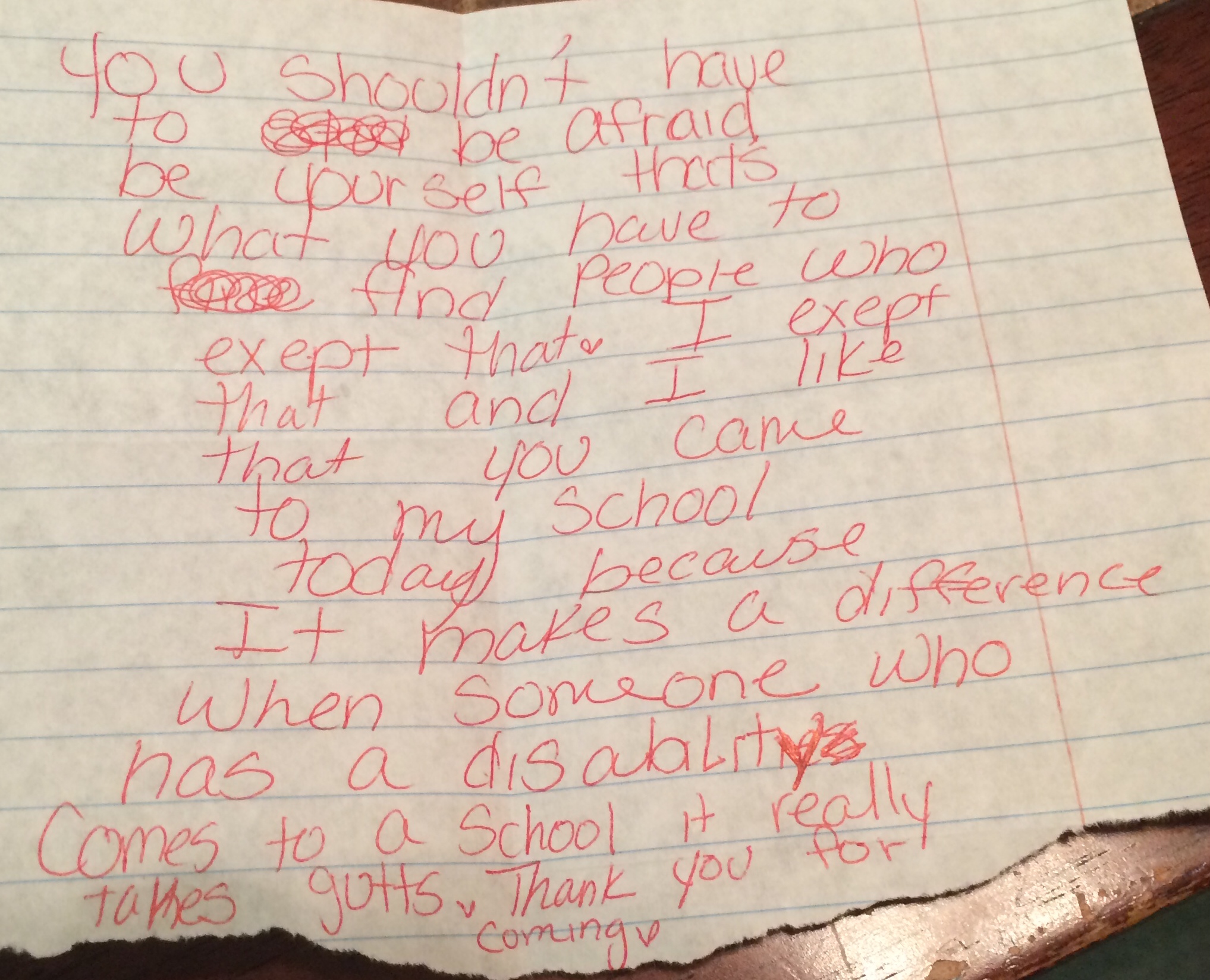
Another girl came up to me in a different class and gave me the below note. It brought tears to my eyes. I definitely believe I made the right decision to talk about stuttering that day. Any time you can go and talk to kids about stuttering, differences, tolerance and respect, do it. It makes a difference.
Another Inspiring TED Talk
Posted on: May 20, 2014
- In: Video
- 2 Comments
Here’s another very inspiring talk by a woman who stutters. At 28, she finally feels she can “come clean” with her stuttering.
And she sings beautifully at the end too. A must watch!
Inspiring Graduation Speech
Posted on: May 15, 2014
- In: Video
- Leave a Comment
Do you think this young man has a disability? This clip has been making the rounds on social media and many are saying the young man is so inspiring, being able to make such a speech with a disability.
2014 Stuttering Awareness Week
Posted on: May 12, 2014
This week marks National Stuttering Awareness Week. It is an opportunity for the 1% of the population that stutters to raise awareness and educate the 99% of the population that doesn’t stutter.
We get to let people know how unique we are and that stuttering is just a different way of communicating.
To me, it’s very important that we approach stuttering awareness from a positive perspective. Note that I said that we get to let people know how unique we are.
It’s easier to bring up stuttering in a positive way, instead of introducing it as a disorder, which immediately implies something negative.
This week, I have been asked to be a speaker at a Career Day at a local high school. I will be talking about my career, how I got here, educational and experience requirements. I’ve decided I am also going to talk about stuttering during my presentation, which I will give 5 times, to 5 different classes.
On reflection, I felt that I couldn’t talk about my career without also talking about stuttering. And it perfectly worked out that the presentation is scheduled this week, right smack in the middle of National Stuttering Awareness Week.
I’ll be honest and admit that I’m a little nervous about talking about stuttering in my talk on Career Day. I am worried about how it will be received and whether the high school kids will be interested. But I’ve committed to it and have begun incorporating bits of my personal story into my career presentation.
I am going to trust myself that my talks will go well and that I will educate kids on a new experience.
What will you do to mark National Stuttering Awareness Week?
Weight Of His Words
Posted on: May 7, 2014
- In: Video
- Leave a Comment
David Haas, from Syracuse, New York, gives a great talk about his experience with stuttering at TEDx Syracuse University 2014.
He gave me permission to share his talk here on the blog. Great job, David.
She Finds Confidence – Episode 117
Posted on: May 5, 2014
Episode 117 features Jamila Damani who hails from Brighton, England. Jamila is a second year university student studying anthropology and international development. She hopes to work with a women’s organization one day, in education or mental health.
Jamila shares that she started stuttering at around age 11 or 12. She held back a lot and felt insignificant as a person growing up.
Listen in as we talk about early speech therapy experiences and finding The McGuire Program. Initially, Jamila shares she was skeptical of the McGuire program. That all changes when she attends an International Women’s Day event and meets an inspiring panelist. Jamila loves to tell the story of how she never knew someone so confident could have a stutter.
Jamila went on to do a McGuire course before starting university and has found her confident and eloquent voice. She hopes to one day be a panelist at an International Women’s Day event and be a role model for others. I think she already is one, wouldn’t you say?
Feel free to leave comments or ask questions in the comment section below. Feedback is a gift.
The music used in today’s episode is credited to ccMixter.
 Make Room For The Stuttering
What people are saying!