Posts Tagged ‘National Stuttering Association’
Nobody Threw Tomatoes-Episode 154
Posted on: April 27, 2016
 Episode 154 features Sharon Steed who hails from Chicago, Illinois, and presently lives in Pittsburgh, Pennsylvania. Sharon is a freelance business writer and also a professional speaker.
Sharon tells us that stuttering had such control over her life that she was terrified to speak to people. Sharon reached a point where she knew she needed to face her fear head on and she decided to tackle it by taking on public speaking.
Listen in as we discuss how Sharon has used speaking as a way to build business. She says “Being vulnerable and open helps you a lot more than it hurts you.” This applies to both business and stuttering. We also talk about active listening, effective communication, empathy and patience. In fact, those are some of the topics Sharon has spoken about in her business talks.
Sharon wants others who stutter to know, “I struggle with it too. I’m not any more courageous than anyone else. I’m just willing to try and fail.”
Music used in today’s episode is credited to ccMixter. Below is a video of one of Sharon’s talks.
Episode 153 features Lisa Costello, who hails from Las Vegas, Nevada, although she is originally from the East Coast. Lisa works in real estate and enjoys yoga, cooking, traveling and poker.
Lisa is new to the “stuttering world.” She only began researching stuttering about 6 months ago and has pretty much immersed herself since then. Prior to that, Lisa led a covert life.
It was when she began to be overly tired and drained all the time and realized it was from the mental exhaustion of hiding stuttering, that she decided to take action.
Listen in as we talk about Lisa’s recent experience at the America Institute for Stuttering’s (AIS) 3 week intensive therapy program. She explains how she has pledged to herself that she is no longer going to hide and wants to be open. She talks about advertising, telling clients, “Don’t fret, I just stutter.”
Lisa also talks about how much she has done that keeps surprising her, in such a short time. Since returning from AIS, she has led two of her National Stuttering Association chapter meetings. And she says she’s more at peace than she’s ever been. She’s learned she’s an effective communicator.
Lastly, we talk a little about Lisa’s love for poker. This was a great conversation that went way too fast. Check us out.
The music clip used in today’s episode is credited to ccMixter.
 Episode 152 features CiCi Adams, who hails from Pennsylvania, but is presently living in Brooklyn, New York. CiCi is a journalist at People Magazine and enjoys writing, dance and eating lots of Chinese food.
Listen in as we discuss what’s helped her to be OK with stuttering, how she handles interviews at work, interacting with other people who stutter and so much more.
CiCi is a member of the NYC National Stuttering Association chapters and talked about the one day conference that NSA NYC is sponsoring in May.
And Cici blogs. She wants her blog to grow. Please check her out at The Plight of the Stuttering Journalist and let her know you’ve visited by leaving a comment.
This was a great conversation with yet another amazing woman. I feel so lucky to be able to host this podcast. My life has been enriched by all of these women’s stories.
The music clip used in today’s episode is credited to ccMixter.
I Still Stutter – Episode 150
Posted on: February 17, 2016
Episode 150 features Jia Bin, who hails from China. She is currently living in Michigan in the U.S. while studying for her Master’s degree in secondary education. Jia taught English in China for 9 years, and is currently teaching Chinese here in the U.S. to high school students.
Listen in as Jia describes why she wanted to come to the U.S. She was looking for a way out and thought she’d find the answers to stuttering in the U.S.
We have a fascinating conversation about the cultural differences between China and the U.S. Jia describes China as a “culture of shame” where it comes to being different. In China, it’s all about being the same. Differences are shameful and shame is hidden in China.
We also have a rich discussion about covert stuttering, finding support through the National Stuttering Association and stuttering with confidence. We also talk about Jia’s speech therapy experiences and the huge emotional attachment that stuttering really is. She talks of carrying her country on her back when she talks.
This was a great conversation that could have gone on for hours. Feel free to leave comments or questions.
The music used in this episode is credited to ccMixter.
I Just Stutter – Episode 149
Posted on: February 2, 2016
Episode 149 features Audrey Bigras, who hails from Montreal, Quebec, Canada. Audrey works as an advisor in research and development in public colleges in Quebec.
She is also involved in the world of stuttering as a bi-lingual blogger and she is on the board of directors of the French speaking stuttering association.
Listen in as we discuss how she found the stuttering community, the importance of meeting others who stutter and making friends, and the life changing experience she had at her first National Stuttering Association conference in the United States.
We also discuss how important it is for her to help to demystify stuttering. When Audrey first began researching stuttering on the internet, she discovered a lot of negative information. She wanted to ensure there was positive, factual information about stuttering available.
She was also concerned that there was not much French content available on stuttering and she wanted to provide a resource that was bi-lingual and easily accessible in both English and French. So, she founded her blog, Advertising Stories, which she writes in French and then translates into English. Check it out here.
The podcast safe music used in today’s episode is credited to ccMixter.
Showing Up – Episode 148
Posted on: November 16, 2015
Episode 148 features Karen Krajcer, who hails from San Antonio, Texas. Karen teaches creative writing to high school students and is also working on her own novel, titled “Whisper, Sing.”
The novel is about two siblings who stutter, who make dramatically different choices about how they deal with their stutter. Karen shares that the emotional truth of the novel is based on real life experience.
Listen in as we discuss what it is like to be a covert stutterer and how it can take over your whole life. We discussed missed opportunities, “coming out,” acceptance, speech therapy and so much more.
We also discuss Karen’s involvement in the National Stuttering Association – she reinstated the San Antonio NSA Chapter. Karen talks about how important it is for people to just show up at support meetings, as it can change their lives, like it did hers.
And we discuss Karen’s part in the book “Turning Points” which was discussed in the last podcast episode. Karen wrote an essay which became a chapter in the book called, “The Problem of Passing,” about her experiences as a covert stutterer.
The podcast safe music used in today’s episode is credited to ccMixter.
It’s All About The Kids
Posted on: October 9, 2015
- In: Posts
- 3 Comments
I just recently returned from a trip to the west coast, that included a weekend in Tempe, Arizona for the 2nd Annual National Stuttering Association Regional Fall Conference.
The regional conferences are similar to the national conferences except that they are on a much smaller scale. 104 people attended this event in Arizona, making it a very intimate gathering where you actually got to know and talk with one another.
There was a mix of adults who stutter, parents, kids and teens and some SLPs. I had a great experience at the workshops, which focused on communicating with ease, managing anger and successful speech management. There was also a great Open Mic session where people told very personal, inspiring stories.
But the best part for me was seeing young people embrace the experience and totally blossom in the presence of other people who stutter. That almost always happens at stuttering conferences but it was magnified this time since it was such a small group.
Young people like Aiden, Diego and Regan felt comfortable to get up and speak to the whole group several times and they shared such pearls of wisdom. They talked about it being OK to stutter, that if you stutter, you’re not alone and that together, we are strong. These are mottoes of the NSA, but to hear them come out of the mouths of babes, so confidently and convincingly, was so inspiring.
Young people who stutter today are fortunate to interact with adults who stutter and vice versa. We adults got so much out of the kid’s confidence and were reminded that if they can speak up and advocate for themselves, then we certainly can too.
Young Regan, 11 years old, really impressed me. She has the self-assurance and sense of humor of a much older teen and clearly feels comfortable in her skin. Her mom was thrilled that they were able to attend their first conference. I fully expect Regan to one day be in a leadership position for the NSA. The kids are our future and it seems like we’ll be in great hands.
Delving Deeply – Episode 147
Posted on: September 29, 2015
Episode 147 features Mona Maali, who hails from Austin Texas. Mona was the chapter leader of the Austin National Stuttering Association (NSA) chapter for four years, and was named the NSA Adult Chapter Leader of the Year in 2010. Presently, Mona is a bookseller at an independent book store in Austin.
Mona also compiled, edited and published a book called Turning Points, which features the stories of many people from the Austin NSA chapter.
Listen in as we discuss parts of Mona’s story, where she honestly and courageously shares her journey both with stuttering and ADHD. She has lived with ADHD as long as she has with stuttering and both have had a profound impact on her life.
We discuss whether Mona thinks there is a connection between stuttering and ADHD. Mona shares that both disorders are highly stigmatized and often the individual is “blamed for” having the disorder. Mona didn’t receive help for either stuttering or ADHD while growing up.
The second half of our conversation focuses on how the book, Turning Points, came to be. It was a two year process of gathering other people’s stories and at the same time overcoming and delving deeply into Mona’s own personal journey.
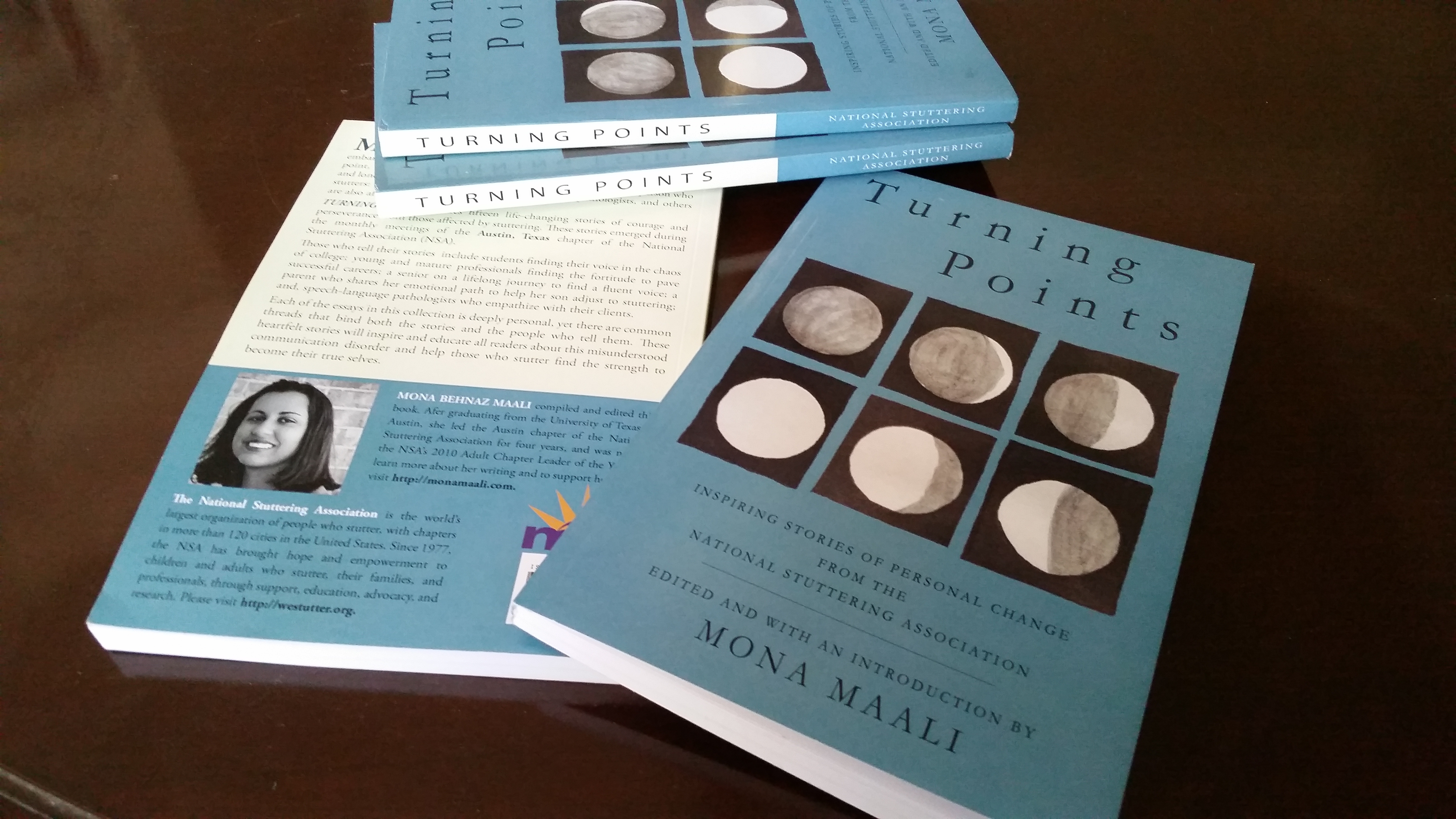 Mona shares quite eloquently why she didn’t include her own story, and how she feels very hopeful to have published a book. She is very pleased with how it turned out. You can purchase the book at Amazon or at the NSA online store.
Today’s music is credited to ccMixter.
Building Empathy In New Ways
Posted on: August 7, 2015
- In: Video
- Leave a Comment
A friend from the National Stuttering Association and Stutter Social, David Resnick, recently gave a great TEDx Talk on using technology to build empathetic resonance. I’ll let him explain in his talk exactly what that is.
I was thrilled to see another TED Talk where someone openly stutters and still communicates beautifully and effectively. Of course, my thrill was enhanced by the fact that I know David!
And it was great to see Stutter Social featured and explained. I have been a Stutter Social host for two years now and I love it. The sense of community from a virtual stuttering support group certainly does build empathy.
Enjoy David’s talk! It’s great!
Episode 144 features return guest Briana Pipkin who hails from Dallas, Texas. Briana is 24 years old, and is looking to transition in her work to become a classroom teaching assistant. She had been a speech therapist assistant but really wants to be in a classroom setting.
Briana was on the show three years ago and wanted to come back on so she could stutter more openly, something she’s been working on over the last several years.
Listen in as we talk about interview preparation, covert stuttering and advertising stuttering. This episode focuses a lot on the recent conference of the National Stuttering Association, and about an advertising workshop that Briana attended.
We also talk about work, feared stuttering situations and transitioning from covert to overt stuttering.
The podcast safe music used in this episode is credited to ccMixter. Feel free to leave comments or ask questions, for feedback is a gift.
Where Stuttering Is Normal
Posted on: July 7, 2015
- In: Posts
- 2 Comments
I just returned from the annual National Stuttering Association conference, held in Baltimore, Maryland this year. I spent a week at the conference site, catching up with friends for a few days before the actual conference started.
To say I had an outstanding experience would be an understatement. It is hard to put into words what it is like to be immersed in the stuttering community for 5+ days. It is a time filled with connection, bonding, laughter and tears. Even though it had been a year since I had seen most people, we picked up as if it had only been a week. That’s the beauty of community.
It is also the time each year where stuttering is normalized. It is freeing to stutter openly with hundreds of people who share and get the otherwise isolating experience.
I was very involved in first timer activities at this conference, hosting the first timer’s orientation workshop and welcome luncheon. It was great to meet new people just coming into the community who have not been in an environment where stuttering is the norm.
Everywhere I turned, I heard people stuttering. It is almost magical to hear the different types of stuttering and to see people thrive in a patient, non-judgemental environment.
One first timer I met in person after having “met” him online in Stutter Social hangouts was Shane. He kept looking around in wonder and exclaiming how unbelievable it was for him to be there and to hear so much stuttering. He kept saying “thank you” to us “old timers” he met, as he was so grateful for the experience to be in a normalized, inclusive stuttering environment.
The sense of community at a stuttering conference picks you up, holds you up and surrounds you with love and support. People meeting each other for the first time hugged in greeting, as if they were old friends. Sharing something as personal as stuttering is an almost instant bond. Lifelong friendships are made at conferences and people eagerly look forward to the next one before the current one is even finished.
On my last day, I became overwhelmed with emotion as I was saying goodbye to new and old friends. As I hugged people, tears flowed and I got choked with emotion so strong it surprised me.
I guess I figured after 10 years of attending stuttering conferences, saying goodbye would be easier. Not true. I felt sadness and a yearning to stay with the community rush over me like waves crashing against a shore. It will be another year before I see most of these people and get to experience the magic of the stuttering community again.
Now, I am transitioning back into a world where fluency is the norm and I am in the minority. But I take the love and support of my stuttering family with me and I will remember the power of support and community. I can’t help but remember – it flows through my veins.
She Doesn’t Shut Down-Episode 141
Posted on: May 26, 2015
Episode 141 features McKenna Rankin who hails from Dallas, Texas. McKenna is 26 years old and is currently studying for her National Counseling Exam. She will then be credentialed as a Licensed Professional Counselor. McKenna plans to be a mental health counselor and is interested in working with children.
Listen in as McKenna shares her journey with stuttering. She has found she has had to educate mental health counselors about stuttering, many who believe stuttering is anxiety based. It is exciting that McKenna is going into a field that she will be able to dispel a lot of myths about stuttering.
We also talk about a rock bottom moment that McKenna had when interviewing for grad school, where an interviewer asked her if she really thought she could be a counselor with her stuttering. This was the first roadblock McKenna saw to doing what she really wanted to do.
This propelled her to enroll in the Successful Stuttering Management Program (SSMP.) She says that was a life changing experience. She no longer shuts down because of stuttering.
We also discuss how stuttering helps her to have more empathy with clients and she thinks that will be an asset in her counseling practice.
The podcast safe music used in today’s episode is credited to ccMixter. Feel free to leave comments for McKenna.
Stuttering Awareness 2015
Posted on: May 11, 2015
- In: Posts
- 2 Comments
This week is National Stuttering Awareness Week in the United States. It’s an opportunity for people who stutter to talk about stuttering to those who don’t, to educate and raise awareness.
There are many ways to advertise and promote stuttering awareness. Here are a few.
1. Consider wearing a stuttering awareness tee-shirt, wrist band or lapel pin to work or out in the community. If people ask about it, mention you stutter and take the opportunity to explain what it is and how it feels.
2. In your office, display posters or a coffee mug that says something about stuttering. (These items can be found in the store at the National Stuttering Association.)
3. Consider contacting a radio station and asking if you can make a public service announcement (PSA) about stuttering.
4. Read blog posts or articles or literature about stuttering to educate yourself more about stuttering. Great free resources are available at The Stuttering Foundation.
5. Stutter openly this week. If you are usually covert about stuttering, try to allow yourself to stutter openly. Be open if people have questions about your speech. Seize the opportunity to raise awareness.
This week I am speaking to a high school senior class that is specific to scientific research and public health. I will be addressing my personal experience with stuttering along with talking about the neural and genetic basis of stuttering.
I have also submitted a brief article to my local newspaper about how to listen to someone who stutters. It has been accepted for publication and will be printed in the paper tomorrow.
What will you do this week?
I Stutter Amazingly – Episode 139
Posted on: April 20, 2015
Episode 139 features Heidi Reynolds, who hails from Panama City, Florida. Heidi is 23 years old and works full-time as a nanny for twin children. She is also finishing up her undergraduate degree and is waiting to hear back from grad schools to which she has applied.
Heidi aspires to be a SLP and also wants to get her doctorate degree so she can research stuttering and eventually teach.
Listen in to a meaningful conversation about guilt. Heidi shares that she often feels a lot of guilt for listeners having to listen to her stutter. She is working on balancing that guilt with acceptance. She has reached a place where she feels comfortable with “this is me.”
We also discuss speech therapy experiences, use of speech tools, the Speech Easy device and so much more.
And we finish up by discussing the National Stuttering Association and the importance of self-help and support.
The podcast safe music used in today’s episode is credited to ccMixter.
Forming Internet Communities
Posted on: January 20, 2015
I was interviewed by a friend last Wednesday for an article she wrote about how people who stutter use the internet to form communities. The article is called “The way we talk when we talk about stuttering” and it was published this Sunday January 18 in my friend’s home town of Austin, Texas.
Talking to my friend was a great opportunity for me to reflect on all the different ways I use the internet to form communities.
I have the community that follows this blog, which is still going strong after almost 6 years.
I have the community of women from all over the world that have been part of my podcast “Women Who Stutter: Our Stories” for almost 5 years.
And I have the community that has formed from being a Stutter Social host every other week.
Read the article. It’s great, thorough and mentions me. What more could you ask for? 🙂
 Make Room For The Stuttering
What people are saying!