Finding Confidence
Posted on: April 15, 2011
- In: Posts
- 5 Comments
 Today’s post is from a special guest writer, who has inspired me with her words and courage. The following was written by Amanda Schott.
(Amanda gave me permission to slightly edit her piece for length. This article will also be printed in the next issue of the FRIENDS newsletter, Reaching Out. Amanda’s mom also gave consent for her piece to be published here!)
Stuttering is a setback that affects me every day of my life. Last year, when I was in eighth grade, I began to stutter. It happened overnight. There wasn’t any gradual thing where I did it once or twice and then it grew to a full-on problem. It hit me suddenly, and since I had never stuttered before, people noticed it big time.
I’m Amanda, a fifteen year old with a bubbly personality and an awesome sense of humor. But most people don’t see me that way. They only see the tourettes, ADHD, depression, and the stutter. They see a twitch that can’t control her emotions and acts like a two year old sometimes. I’m innocent and wise at the same time. Through it all, I grin and bear it, but the insults hurt all the same whether I show it or not.
My little brother and sister have both been through speech therapy for a couple years. They both went to two preschools at once for their speech and continued therapy in elementary school. It was a classic case for kids their age: talking too fast and dropping sounds mostly. So, when they learned to slow down and enunciate, they graduated from the speech class and talk fine. Neither of them have ever had a stutter.
I talked to my siblings’ speech therapist, and she said that there was no way I just got a stutter out of the blue. I did, though, and now I still have it a year later. I don’t stutter sounds, really, but I repeat words, especially short ones like ‘its’. ‘I think it’s, it’s’ it’s’ (long pause while I grit my teeth and force the next word out) ‘it’s because I…’ is something I do all the time.
‘Hey Amanda, do you st-st-stutter?’ I hear CONSTANTLY. What’s sad is that I get that from my friends who know that I don’t even stutter like that!
I found out about an organization for teens who stutter while I was just searching the internet for anything that could help. I searched for ‘teens who stutter’ and clicked on a random link. It led me to the FRIENDS website and I saw there was a mentoring program for kids and teens. I printed the application and filled it out, thinking it could be good for me to be able to meet other kids like me.
I got an email from Gracie not too long later. I could tell right away that we would be amazing friends. We email almost every day and talk about everything from stuttering to boy problems. We haven’t gotten around to calling each other because she doesn’t like talking on the phone. I want to talk her into it and show her that some people don’t care whether she stutters or not.
Talking to Gracie is so fun and I’m lucky to have her. We support each other and we’ve gotten really close. It’s helped a lot to have someone to talk to who understands what I’m going through and can relate to what I’m saying. Seeing a new email from Gracie always makes me smile and brightens my day.
I started to lose my passion for speaking when I got my stutter. I got quieter, I held things inside that I wanted to say because I was afraid it wouldn’t come out right, I even avoided people that I talk more around! My best friend Chrissy was hurt because I didn’t talk to her for a while, and it wasn’t good at all. Now that I know a bit about stuttering, I’m more confident about it.
The most frustrating part of my stutter is when people finish my sentences! I hate that so much! It makes me feel bad to say anything though, because my friends are ‘just trying to help’, but it makes me feel incompetent when I can’t even talk for myself. So I decided to tell them all to stop. Now, whenever I can’t say something, I make a joke, like, ‘Hang on! I’ll get this!’ or I try to rephrase what I was going to say. I also remind my friends that ‘I can speak for myself if you’ll let me’ in nice tones.
It also bothers me when people interrupt me while I talk. I’m very talkative and I like to tell stories, but if I stutter and stop for a second, my friends will just launch into another story when I’m not done with mine. I’ve learned this is the line I don’t like having crossed, so I remind them ‘That was rude’. I still try to be humorous about it, but I can’t stand it when people are rude to others who are talking.
Learning how to tell people about the twitching? Not as easy at all. Usually, it happens just by people seeing me twitch in class or something, they’ll look at me funny, and I just say, ‘Sorry. I have tourettes. I can’t control it.’ When kids know about it, they’re less likely to judge me on what I do. I tell a lot of people now, and I get less stares and weird looks because they understand.
The other day, I was sitting in English class, and two of my classmates were sitting behind me when I had a huge shoulder twitch. I heard one tell the other, “Don’t say anything. She has tourettes. She can’t control it.” Then I heard, “But it’s so freaky!” and the first boy stood up for me. “How would you like it? Leave her alone.” Just that simple gesture helped me more than that boy will ever know.
I love the Friend’s mentoring program. I have a few friends who stutter and I told them about it, and they want to sign up too. Because despite all having stutters, we have different stutters and different problems to face. Having good friends to help me through my troubles is invaluable to me and I wouldn’t trade them, even if it meant losing my stutter forever.
If you were inspired by Amanda, please leave a comment. I will make sure she sees any feedback left for her. Amanda, you ROCK!
What An Honor For Stuttering!
Posted on: April 12, 2011
- In: Posts
- 7 Comments

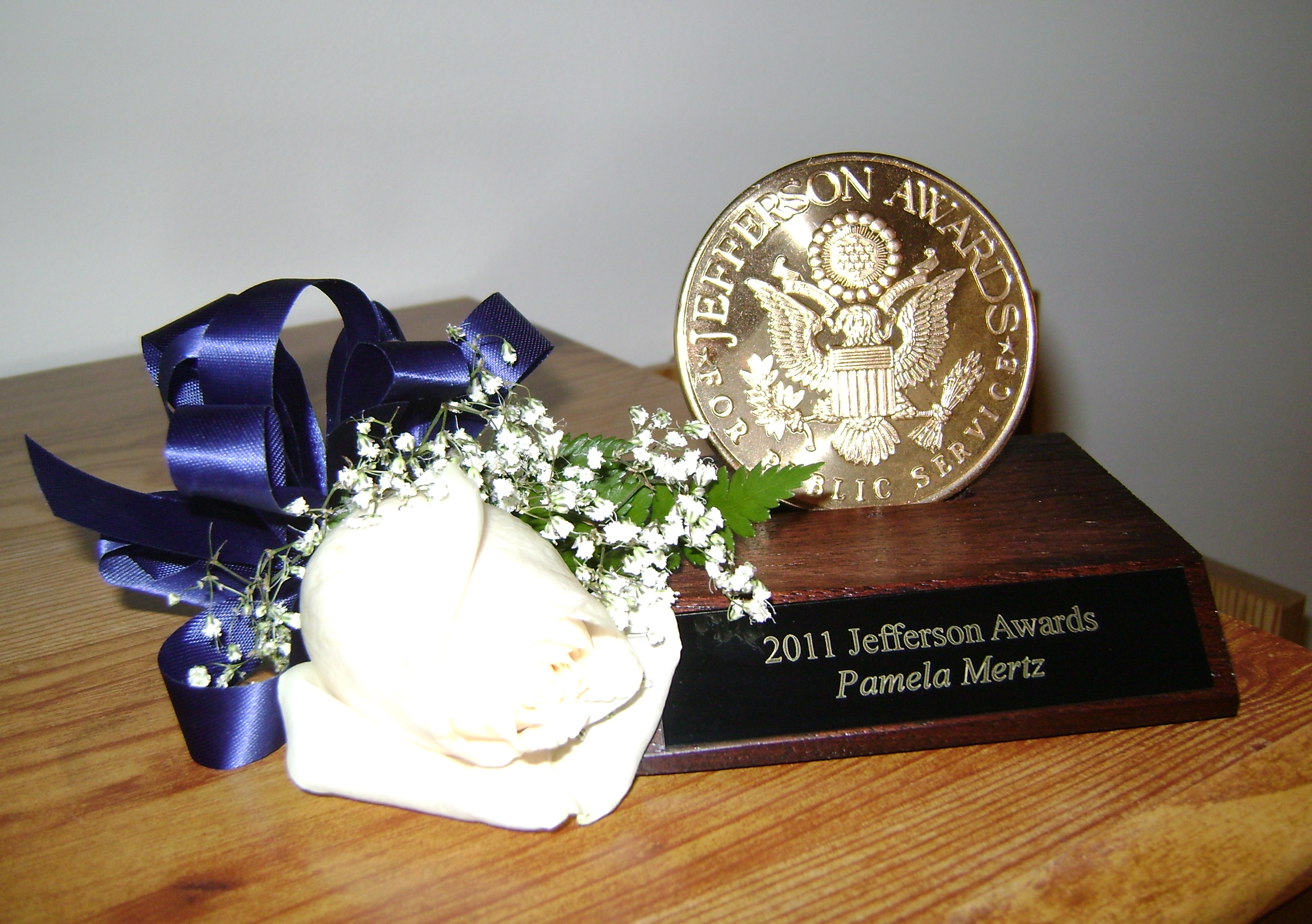 I was a little reluctant to post this information here, but some friends encouraged me to do so. Last Monday, April 4, I was honored at an awards ceremony for the Jefferson Awards. These awards were begun in 1973 in the United States by Jacqueline Kennedy Onassis, U.S. Senator Robert Taft Jr. and Sam Beard.
The Jefferson Awards annually celebrate America’s commitment to public service. Recognizing both the famous and the unknown, individuals and organizations, the young and old, the awards reflect one of the founding ideals of our nation, that of contributing toward the larger good.
In our local area, the focus is on ordinary, non-famous people doing extraordinary things. My sister Kimberly nominated me for work I have done to raise awareness and tolerance of stuttering. She submitted an essay about my visiting schools to talk about bullying prevention, advocating in the media by having articles published and appearances on radio and television, and the podcast I started last year giving women who stutter a space to share their stories.
Of hundreds of nominations, 18 of us were chosen as finalists. I was then notified that I was chosen as one of 7 Jefferson Award Medalists. One of the Medalists was chosen to attend a ceremony in Washington DC in June to represent the Capital Region of NY. That person is a man whose son committed suicide at the age of 18, and his efforts since to raise awareness to schools, teens and parents. I was honored and touched to be part of this elite group of 7. The others were working to improve and raise money for important social causes.
I was chosen as part of that field for bringing a local voice and face to stuttering, and for giving women all over the world an opportunity to share their stories. Thank you to all of the women who have so beautifully and courageously shared your stories. Together, we have showed the world that we do have stories that need to be heard.
Thank you also to my sister for having the courage to nominate me for recognition for something that was always a taboo topic in our family. And thank you to my friends and family who attended the ceremony and cheered me on and made me feel so special.
Thank you to Claudia for immediately forwarding the details to the National Stuttering Association. They have posted this information on their page as well, which made me proud.
And thanks to my friends and listeners who encouraged me to post this here on my main page. They reminded me doing so is not bragging, rather it is inspiring. And the best way for regular readers/listeners to know that this special honor even occurred.
Let It Be
Posted on: April 7, 2011
- In: Posts
- 7 Comments
I found myself responding to someone who was thinking out loud about stuttering. She said, “I just don’t get it.” I mused she probably was referring to, “Why is stuttering so unpredictable?”
The variability and complexity of how we sound, how we feel, how one day it’s one way and the next it is completely different is quite amazing. To me, anyway. There are some who will surely find ways to describe stuttering that does not include the adjective “amazing.”
For a long time, I tried to figure things out – why this, why that, why some people react one way, why others say dumb things, why sometimes I am like an open book, and other times, I find myself with heat on my face and my heart thumping. I stopped trying to figure it out.
It is so much easier to just let things be the way they are going to be. It sounds simplistic. Perhaps it may even seem to minimize the struggle of stuttering for some.
I have an embroidered framed art piece of one of my favorite sayings, “It Is What It Is”. I used to think that even thinking that about stuttering or my reaction was a “cop-out”. Some things are just going to happen and life will go on. I have determined that to be a fact.
No matter how hard I try to analyze or rationalize or convince myself otherwise, some days I am going to stutter a lot and feel tense, and some days I am going to hardly stutter at all.
I think sometimes its harder to just relax and let my natural self be. I had become so used to making excuses, rationalizing, over-thinking, obsessing about everything. It’s what I did, all of the time. That was when I considered myself very covert about my stuttering.
Now, to just relax and be, really BE, sometimes I have to remind myself of just that – that who I am is really OK. Screw everyone else who doesn’t think so.
Yes, this is hard to do in a (perceived) judgmental world, but I guess I just have reached the point where all the needless worrying about how I will sound or what someone will think is just not so important anymore.
Just like the song says, “Let It Be”.
My Greatest Gift – Episode 51
Posted on: April 4, 2011
 Episode 51 features Mary Wood, who hails from Fort Wayne, Indiana, via Hamilton, Ontario, Canada. Mary is an ordained Unity Minister. She went back to school at age 66 and was ordained in 2005. Mary recently celebrated her 74th birthday!
I met Mary last year at the NSA Conference in Cleveland. She did a workshop called, “I Need Your Love. Is That True?” I joked with her that it was one of the few workshops with an 8:30am start time that I have actually remembered attending! A friend introduced me to Mary after her workshop.
The theme of the workshop was fear of rejection. We go through life needing people to tell us what a great job we have done, so we can feel worthy, affirmed, loved. But the basis for Mary’s workshop, and her recent life’s work, is that we really only need to believe that about our selves. We don’t need for others to tell us that we are good. Easier said than done!
Listen in as Mary shares some of the compelling questions she has asked herself (and then others) as she learned more and more about the connections to stuttering and self-esteem. She has asked herself, “What is it that I don’t like about stuttering?” She has found it to be that fear of rejection that we all know, even though it may be hard to admit.
We also discuss replacing negative thinking with positive thinking and how stuttering became like a self-fulfilling prophesy for Mary. We talk about involvement in stuttering support, Toastmasters, and how Mary knew that she was supposed to be speaking to people every chance she got.
Credit for the podcast safe musical clip “Echoed” goes to ccMixter. Feel free to leave comments or questions for either Mary or me. Feedback is a gift!

Episode 50 features Jenny who hails from Santa Clarita, California. Jenny and her husband are the proud parents of two boys, Matthew and Nathan, with a third boy arriving in July. Congratulations to all!
Congratulations also to “Women Who Stutter: Our Stories”, for this milestone 50th episode. I am proud to be part of this magical telling of stories that have just been waiting to be heard.
Before becoming a stay-at-home mom, Jenny was pursuing her doctorate in higher education at UCLA. She was researching what impact choosing two year community colleges before transferring into four year schools might have on the typical college student.
Jenny jokes that she had vowed that she would not be one of those women who did not complete her educational goals because of pregnancy, but so far, parenting has kept her busy enough to not finish the PhD yet!
Listen in as we talk about acceptance, guilt and shame, and what it has been like for Jenny’s son Matthew, who is 9 years old and also stutters.
Matthew was having a hard time with bullying and teasing by peers, which ultimately helped Jenny begin to resolve her own acceptance issues with being a woman who stutters.
Jenny found a great speech therapist for Matthew, who has also met two other kids his age who stutter. Jenny herself has recently begun attending the NSA chapter in San Fernando Valley and hopes to attend her first NSA conference herself in 2012.
Credit for the podcast safe music clip used in this episode goes to DanoSongs.
As always, feel free to leave feedback for either Jenny or me. We’d love to hear your thoughts on being a woman who stutters who also has a child who stutters.
The Outer Rim Of A Bowl-Episode 49
Posted on: March 14, 2011
Episode 49 features Hannah Laday, who hails from Central New Jersey. Hannah came out of the woods of rural Maine to attend a stuttering retreat, met and married George, and moved to New Jersey.
Hannah is the leader of the Central New Jersey NSA chapter. We got to know each other through NSA conferences, email, the covert support list and phone chats. Hannah also works as a direct support professional for women with developmental disabilities.
Hannah has had quite the journey. She literally moved out of the woods onto a road and began using a phone after a long time of not doing so. “Bottoming out” finally propelled her to make changes in her life.
She has pushed outside of her comfort zone many times. She “exposed” herself at the NSA Covert panel workshop and contributed a paper about covert stuttering to the 2010 ISAD online conference. Read and learn about “Lightening the Load of Covert Stuttering”.
Listen in to a robust dialogue with plenty of emotion. We talk about how and why we limit ourselves, being in groups but not really part of them, courage and change. The take away from this episode – never, ever think you don’t have a story that needs telling. We all need to be heard. Our stories are powerful!
Credit for the podcast safe musical clip “Echoed” goes to ccMixter. Be sure to leave comments. Feedback is a gift!
I Still Have To Talk – Episode 48
Posted on: March 7, 2011
Episode 48 features Annette, who hails from Victoria, British Columbia, Canada. Annette is 23 years old, and is a Registered Nurse. She graduated from nursing school two years ago and has been practicing for one year.
She has been working in a long-term care home, and as of this publication, will be starting a new position in a rehabilitation hospital. She easily discloses that it’s not always easy being a nurse who stutters, but she knows she is just as competent as any of her co-workers.
Annette explains that she finds it easier to talk with her patients and co-workers than it is with doctors. We explore how very often talking with anybody in a position of authority can be stressful and intimidating. Annette shares that she feels more in control when interacting with her patients.
We talk about how stuttering has impacted relationships with friends and family, and the differences in how her mom and dad have approached it with her. Annette also shares her experiences with speech therapy and what has been most helpful for her.
The biggest insight for Annette has been overcoming fear, gaining confidence and being open. And that comes through loud and clear in this conversation. Give it up for a strong, independent young woman doing exactly what she wants to do. You go girl. That’s what it is all about!
Credit for the podcast safe music used in this episode goes to ccMixter. Feel free to leave comments for Annette or just let her know how cool she is!
Clowning and Fluent Stuttering
Posted on: March 3, 2011
- In: Posts
- 11 Comments
Today’s post is inspired by new friend Anna, who was featured in the January 2011 edition of the Toastmaster magazine. She was also a featured guest on “Women Who Stutter: Our Stories”, in Facing The Monster – Episode 44.
Anna contributed some great comments on the most recent episode featuring Nina G – Standing Up. Anna notes the importance of “fluent stuttering”, which is a term described by Van Riper in the classic stuttering book, The Treatment of Stuttering.
Someone once told me, “if it’s any consolation, at least your stuttering is easy to listen to”. I remember thinking, “why did she have to add the disclaimer phrase, if it’s any consolation?” To me, it sounded like she was paying me a compliment, but framing it as a negative, as if we are not ever supposed to say something positive about stuttering. Well, Anna de-bunks that and more!
I want to share Anna’s recent comments about “fluent stuttering” and how it can be attained by focusing on “the outside” rather than “the inside”. I like to think of that as quieting our inner self-talk!
Pam,thank you for yet another wonderful pod cast. Nina is another example (one is you) of a person who has something that I call “fluent stuttering”. This means speaking confidently and passionately, without avoidance and fear. The difference with this kind of stuttering from “typical stuttering” – that which can be monotone, deliberate, struggled, or covert speech (I had this too) – is that such fluid stuttering is easy to listen to. In a while you stop noticing the stuttering just as you stop noticing a bit of an accent or some other different speaking pattern.
Speaking openly, expressively, without holding back is a very real goal. I myself aim for total fluency, but if I end up with fluent stuttering instead, I will be just as happy. By the way, I also learned a lot when I enrolled in a clown class – I am not performing on a real stage, but the whole approach to performing – learning how to interact with an audience and feeling confident on stage – is very valuable.
One great thing I learned in clown school is about directing your attention outward. We have lots of exercises to make sure that we focus on the outside rather than staying inside our heads. We, people who stutter, are usually all inside our heads – watching ourselves, anticipating stuttering, trying to figure out listeners’ reaction etc.
Having your attention concentrated on the outside allows you to enter the state of fluency and freedom of fear. The moment you go inside your head (I wonder how I am doing, do they like me?), you get tense and nervous. Nina’s confidence on stage indicates that her attention is out there, she is connected to her audience. This is what makes Nina and others so fluent, despite stuttering. Fluent stuttering sounds strange, but it is a real phenomena and one that everyone can learn how to do.
I just loved Anna’s thoughts and honesty, especially sharing that she took classes at Clown school. How exciting is that? What do you think of Fluent Stuttering? Can you see yourself doing that and being happy with it, as Anna suggests? Let us know your thoughts!
A Monday WOW Moment!
Posted on: March 1, 2011
- In: Posts
- 22 Comments
I had a great experience yesterday at my school that I wanted, well needed, to share. Two weeks ago I did a workshop at a library called “An Un-Royal Talk About Stuttering: Lessons from The King’s Speech”. It was free and open to the community and we had close to 50 people there. One of them present was a colleague of mine, who had seen the movie, knew I stuttered and was really interested in learning more. She also brought her mother.
She came to me the next day and asked if I would do a similar presentation to the Adult LPN classes, one today and the other one, in a more remote location, next week. She felt students preparing to work in the medical field could benefit from hearing this information from someone who lives it every day. I was nervous, but agreed.
I changed the presentation slightly to adapt to a nursing student’s point of view but planned to keep it close to what I had already done, so I didn’t have more work to do.
One of the first things I started with was the question how many in the class had seen the movie! ZERO! These are all working adults with families who take a demanding and intensive LPN course in 10 months and have little time to breathe, let alone watch a movie.
So I quickly changed my focus, and started telling MY story, hoping they wouldn’t be bored to tears. I shared about my covert years, why I chose that, the hidden feelings of shame and my reluctance to ever show emotion and vulnerability, in addition to stuttering publicly. I shared how I got fired, there was a collective gasp, they wanted to know wasn’t that illegal, etc. I started getting emotional, and one of the teachers brought me the Kleenex box!
Then I shared how my family had NEVER talked with me, or about stuttering, so it was always hard to talk about. I talked about how profoundly my life changed when I was fired and how I decided I wasn’t going to pretend anymore. I was going to let ME out.
You could have heard a pin drop in the room. I noticed and heard a few sniffles. At one point, I asked if anyone knew anyone who stutters, or does anyone stutter. One young woman in her 20’s raised her hand – she said , “I stutter” with tears streaming down her face.
I asked if her class knew, they were all looking now, and she said no, not until that moment. Her classmates then applauded. One girl said, “I thought so, but you are always so quiet, I wasn’t sure”. Heads were nodding and the girl who had disclosed smiled and looked OK.
I started talking about what stuttering is and what it isn’t, and the teacher in the room asked if it drove me insane if people finished my words for me. I smiled and said yes, she said, that as nurses, they are inclined to just want to help.
I then described the different ways stuttering can manifest, and when I got to sometimes people will use lots of filler words, like uhm, and that I used to do that, another hand went up, and a woman said, “OMG, that’s exactly what my 14-year-old son does, all the time. Maybe he stutters. I keep telling him to slow down, take a deep breath”, and she asked what I thought of that. I smiled and said that’s generally not helpful.
She looked concerned and asked out loud, “have I been making it worse for him?” and I said “if we could, we would”. She said she was going to talk to her child about it. She whispered “thank you” to me.
Towards the end, we were running out of time. We had not talked about the movie at all. I showed 1 minute of the 2 minute trailer. They got it. I then asked them if they had ever heard of Porky Pig, and what was he known for. They all knew. They stayed 10 minutes over, which the teachers told me they NEVER do. And they gave a huge applause at the end.
Several came up to me privately, and one more admitted she stutters and is dyslexic but has not told anyone, and that she “got me”. She said she has felt such a huge disconnect, but felt connected with my story as soon as I started telling it. She started crying as we spoke privately and she said she never heard anything this courageous as a teacher standing up in her school telling this story. She kept saying over and over “I got you.”
Who would have thought? 40 students in this Adult class, 2 stutter and one has a child who stutters.
This was a WOW moment for me and I wanted to share it!
Listen To Your Mother
Posted on: February 28, 2011
- In: Posts
- 2 Comments
That was heard Sunday night a few times as Academy Award winners picked up their Oscars and gave acceptance speeches. It was an extraordinary night for people who stutter. We now have a dignified face put on that which we often hide out of fear and shame.
The King’s Speech won for Best Actor (Firth), Best Director (Hooper), Best Screen Play/Writer (Seidler) and Best Picture. Sweet!
Stuttering is hard to talk about, but has been made easier these past few months and will surely continue in light of this triumph!
My own mother, who doesn’t often say anything about my stuttering, or what I have done with being open about it, did so tonight. Using social media, she posted this on facebook just a few minutes after The King’s Speech won Best Picture.
“Very good night that you really deserve and I know people (including me) appreciate how much you have done to break down walls and shatter secrets and shine a light in some dark corners.”
That was more important to me than anything else I heard the Hollywood people say. Thanks Mom! That touched me!
And below is David Seidler accepting his academy award and thanking people who stutter all over the world.
Standing Up – Episode 47
Posted on: February 24, 2011
Episode 47 features Nina G, the Bay Area’s Only Stuttering Stand-Up Comic. Nina is a return guest. We first met Nina and heard her story in Episode 17, back in early August 2010. At that time, Nina talked about how she always wanted to get into comedy and what finally prompted her to take the plunge.
In today’s episode, Nina shares how it feels to be approaching her one-year anniversary as a comic and what the experience has really been like. She also shares the significance of how performing stand-up on stage allows her to perfect real “standing up” for herself.
We also discuss how important validation is, the importance of laughter and giving people permission to laugh, and how comedy has brought Nina much closer to authenticity, which is what we all strive for.
Nina also shares what the reactions have been to her comedy, from her stuttering peers, her family and mainstream audiences. And we talk about how stuttering more, and in comedy, has crossed over into other areas of her life.
Listen in to this great episode and hear how stand-up comedy from a person who stutters really does mean “standing up”. I must get to the San Francisco area one day to see Nina G perform on stage. She has offered me a “standing” invitation. Please be sure to leave comments or questions for Nina, and me too, if you wish!
Credit for the podcast safe music used in this episode goes to DanoSongs
Also, if you have not seen a clip of Nina, please be sure to check this out. Nina G – a stand up woman standing up for all of us.
Self, Divided
Posted on: February 22, 2011
- In: Posts
- 9 Comments
A friend suggested I read the Charles Van Riper classic, “The Treatment of Stuttering”. It’s a text-book, so not one that I would happen on or that would catch my eye. I was intrigued, however, as my friend talks frequently about the need for a “whole person” approach for those who stutter. And he thought I might find much that would resonate with me.
So I went looking for the title on Amazon. I found a used copy, for 8 cents and $3.99 for shipping, so the hardcover book cost all of $4.07! I got it in less than a week, in perfectly good condition. I started reading. My friend was right. I owe him a beer!
I have often wondered if there was any explanation as to why I sometimes feel I lead two separate lives, that even I am two separate people. I felt like that most of the time when I was very much covert about my stuttering, always trying to hide it or play it off as something else. I felt like I was one person on the inside, and that I presented a very different person to the outside world.
Even today, when I consider myself mostly overt, I still feel like I am not in balance sometimes. I still sometimes get surprised when I find my “one person” looking down at my “other person” in wonder and asking “who is she?” or “how can she do that?” This usually happens when I am talking freely about my stuttering, either casually with a small group or doing some type of presentation.
Because I still have some shame surrounding stuttering, my inside and outside selves still feel very divided at times.
My friend urged me to read Van Riper’s book in order, from beginning to end, and not to skip around. I began that way, but admit that I jumped ahead to see if there was anything that could explain my not being “one whole self” when it comes to stuttering.
And I found it. Van Riper talks about the whole idea of integration of self, the need for the person who stutters to reconcile with that and allow stuttering to co-exist within our very being. I have heard of the phrase “fragmented self” associated with stuttering and the fact that we very often allow our stuttering part to be separate from our “other” self.
I do that. I have felt fragmented. I have experienced that very weird feeling when you are in control and speaking fluently for a while and then suddenly, out of nowhere, a stuttering streak takes hold, and I feel disassociated from “me” when that happens. I tend to drift away a bit in that moment, especially when its a block or when I feel I have received a negative listener reaction.
In a way, it was helpful to read a very matter-of-fact clinical account that indeed people who stutter do experience this division of self, and that we need to integrate our self to feel whole.
Its one thing to talk about our stuttering and hold it out there before us and say we are ok with it. But it is something else entirely when the feelings take over, and try as we might, we feel we want to push that one part of ourself away.
Has anyone else ever felt this divided sense of self?
 Make Room For The Stuttering
What people are saying!