Posts Tagged ‘Toastmasters’
A Long Journey – Male Episode 4
Posted on: January 24, 2012

Episode 4 of this occasional series with men who stutter features my good friend Joseph Diaz, who hails from Dallas, Texas. Joseph and I met at my first NSA conference in 2006, which was in Long Beach, CA. We have been fast friends since.
Joseph is a long time member of the National Stuttering Association (NSA). He has held many leadership positions with the NSA, including being a long time board member.
Joesph started stuttering rather late. His stuttering didn’t make an appearance until he was a junior in high school.
Joseph shares his long journey with stuttering. He talks about the times when stuttering consumed his life, avoidance behaviors and negative self-talk. He also talks about his “rock bottom” and how he turned the corner.
Joseph honestly shares about what it was like socializing, making friends and dating. We also talk about acceptance, and how that conscious decision to accept himself as a person who stutters shaped his life.
Joseph also shares his career path, and his very active involvement with Toastmasters.
We hope you listen in! Feel free to leave comments or questions for Joseph, or just thank him for sharing and doing such a good job!
Music used in this episode is credited to ccMixter.
From Mumbai to New York
Posted on: December 23, 2011
- In: Posts
- 3 Comments
For the past several months, I have been communicating with a young man who stutters from Mumbai, India. His name is Devayan, and we started emailing each other in September.
Devayan learned about me after getting actively involved in the internet stuttering community. He started listening to StutterTalk and my own podcasts here and reading this blog.
Devayan connected with me by email in the fall, after realizing that I live in upstate New York, close to a college he was interested in attending. Devayan was hoping to come to the United States to pursue graduate studies in speech language pathology.
He asked my opinion on the graduate essays he was submitting to two colleges. He wanted my honest feedback. He got that, maybe even more than he bargained for!
Devayan didn’t mention in his first draft essay to The College of St Rose that he stuttered. I thought he should, as that would set him apart from other candidates. That and the fact that he is also a HE. Male SLP students are fairly rare.
So I suggested that Devayan rewrite his entire essay! He did, and soon after sending it in, he emailed me to let me know he had passed the first phase of admission. He would now be invited for a face-to-face interview.
We discussed that, and I suggested he ask if he could interview via Skype. It took a while for the college to confirm that a Skype interview would work. So in the interim, Devayan asked if we could chat via Skype. He wanted to pick my brain!
We coordinated the time zone difference and finally “met” over Skype, where we had a great conversation about what to anticipate in the graduate admission interview. Since that time, we have chatted via Skype a few times.
Soon after Devayan had his graduate student interview, he emailed me to let me know he was accepted. Then, in the course of just weeks, he satisfied his student visa interview and purchased his plane tickets to fly from Mumbai, India to Albany, New York, USA.
Devayan is scheduled to arrive here sometime in the first week of January 2012. We plan to meet in person soon after that, which to me is amazing and so meaningful.
It is amazing to think that one person can impact another in such a huge way that one is willing to make such a leap of faith and move half way across the world. It shows the power of connection, and what happens when we share our personal experiences honestly with another.
I don’t think either of us thought in September that we would be really planning to meet in person in January. But we are!
And the flurry of emails continues. I have given Devayan some ideas of what clothing to pack and buy for the cold Northeastern part of the USA, which is quite different from India. And he has asked me about joining Toastmasters here, as he joined a club recently in Mumbai, and wants to stay involved with that once here.
I am excited to introduce him to some of my friends here in New York, and get him involved in our monthly Chat & Chew social gathering of people who stutter.
This will be a huge change for my young friend from India. One that will change his life. And one that will likely change many lives when he eventually returns to India, armed with new tools and resources to help other people who stutter.
People who stutter can help other people who stutter, one person at a time, just by opening up, talking, sharing and connecting.
I look forward to adding more details to this story as it continues to unfold, and adding a picture of the two of us when we finally meet in person.
Oh Yeah, She Stutters!
Posted on: December 14, 2011
- In: Posts
- 2 Comments
 Last night, after our Toastmaster’s meeting, some of us went to dinner to celebrate the holidays as a group. It is always nice when we can get together to socialize outside of the regular meeting. It allows people to get to know each other in a more casual, relaxed setting.
After dinner, our small group chatted and laughed about a number of things. As it got late and people began to leave, just three of us women were left and we were still chatting and enjoying ourselves.
At one point, I got stuck on a word and JC finished it for me, then immediately touched my hand and apologized. She said, “I’m sorry. I know better than that. It’s just that I am amazed each time I hear you get stuck. I say to my self, ‘ah, that’s right, she stutters!'”
For some reason, that struck me as something I wanted to ask her about. I said, “Why does that amaze you?”
JC said, “Oh, I just forget you stutter. And then when you do get stuck, it always amazes me. I guess with my ADD, I just have to remind myself, oh yeah, she stutters.”
She further went on to say, “every time I hear you get stuck, my brain sends me this reminder, oh yeah, she stutters, oh yeah, she stutters, that’s why I should have known better than to finish your word for you.”
The other woman sitting with us was just looking at us in amazement and taking in every word. I said something like, “you look stunned!”
She said, “No, not at all. It’s just amazing to hear the two of you so comfortably talking about stuttering and ADD, like it’s no big deal.”
It’s not, right? When we put ourselves out there, it’s no big deal. People then know how to respond to us, if we show our own comfort level with whatever it is that makes us unique.
Humor At Toastmasters
Posted on: December 12, 2011
- In: Posts
- 4 Comments
I had an impromptu moment of stuttering humor at a Toastmaster’s event on Saturday, which couldn’t have been better if I had planned it!
Once a month, our Toastmaster’s division has an Executive Council meeting, where all of the officers get together and compare notes and progress.
On this day, I was asked to present the report for our division, in the planned absence of our Division Governor.
We follow a pretty tight agenda, and each presenter gets 5-7 minutes to deliver their report. Someone “times” us, and holds up helpful flags to let us know our pace and when to wind down. Red means stop! When I saw my “red flag”, I still had a couple slides left to cover and more to say.
That is not unusual for me. I often struggle to stay within timeframes, and have demonstrated that throughout my 5 years of giving Toastmaster speeches. I have given over 50 speeches and am on track towards my goal of DTM (Distinguished Toastmaster) which is the highest rank in Toastmasters.
So I said I wasn’t finished yet, and added, “Just so you know, stutterers are always entitled to more time.” That got an appreciative laugh from the audience.
Someone immediately chimed in and said, “Pam, you are well on your way to DTM, or ‘Don’t Time Me!” That got an even larger laugh from the group.
I finished up with my presentation and sat down to applause!
As I thought about it later, I realized how great a moment that really was. In a formal meeting following formal timing protocols, I injected impromptu humor about stuttering, which was well received.
And a fellow Toastmaster felt entirely comfortable to “jab” back with a perfect little joke that everybody got and enjoyed.
Another example of the value of sharing our stuttering and making it a comfortable topic for anyone to talk about.
Don’t Quit – Episode 72
Posted on: November 7, 2011

Episode 72 features Janet Lennon, who hails from County Laois, Ireland (which is just about an hour from Dublin.) Janet is 25 years old and works with young children in a playschool.
We “met” through a mutual friend on an on-line stuttering support group.
Janet has stammered since she was about 4 years old. Her parents got her involved in speech therapy at a young age. In 2008, Janet found the McGuire program and also found renewed confidence.
Listen is as we cover a lot of ground in this great episode. We chat about the support and encouragement Janet found in the McGuire program, working with children and the importance of having non-judgmental support systems.
Janet joined Toastmasters in 2010, so we have that in common and chat quite a bit about that. It never ceases to amaze me how universal Toastmasters is. We can be in different parts of the world and know exactly what we are both referring to!
Janet also talks about an article she was featured in about finding her voice and shares the encouragement and inspiration she has felt from this poem called “Don’t Quit.”
Music in this episode is credited to ccMixter. Please be sure to leave comments if you wish for Janet (or me.) Remember, feedback is a gift.

Episode 71 features Megan Hutson who hails from Fairmont, West Virginia. Megan is a 25 year old self described “professional student.”
She is studying American Sign Language (ASL) at Fairmont State University. Megan shares how she wants to use her stuttering as an inspiration to others who have difficulties with communication. She thinks she would be good at, and enjoy being, an interpreter for the deaf.
Megan shares an example of her teacher assigning the class to perform a song using ASL. (Here’s an example.) Megan talks about how different it was for her to sign instead of using her voice.
She recalls how when she would prepare a speech using her voice, she always prepared less material. She needed to give herself time to stutter. She realizes that this is not the case with ASL, because (as of yet) she is not stuttering while signing!
Listen in as we talk about some other unique perspectives. Megan did not start stuttering until age 17. We discuss late onset, and what it was like being fluent. Megan shares that she was actually timid as a fluent speaker and afraid to put herself out there. Now, as a person who stutters, she finds herself much more outgoing and willing to take chances!
We also chat about how she has handled negative reactions to her stuttering and Megan’s perspective that with stuttering, people have no time to prepare themselves to talk to us, like they might when a person encounters someone in a wheelchair.
This was a great conversation. Thanks Megan for being so honest and letting us get to know you. Feel free to leave comments or ask questions in the comment section.
Music used in this episode is credited to ccMixter.
Procrastination and Stuttering
Posted on: October 19, 2011
- In: Posts
- 12 Comments
My good friend Nina G, who is an amazing role model for “differently-abled” people, including people who stutter, found this blog post called Procrastination: Do You Stutter or Stammer? The author tries to correlate procrastination to stuttering or stammering.
The name of the blog is Change Your Thoughts, Change Your Life, and focuses on re-framing negative self-talk into ways to make positive changes in our lives.
Good stuff! Everybody has negative self-talk that can consume us if we let it. It’s always good to find ways to re-think things so we don’t get and stay “stuck.”
Except when we find the use of the words stuttering or stammering to imply something negative, that needs to be fixed or changed.
Here’s the comment I wrote on Mike Reeves-McMillan’s post. Figured I’d put it here, in case they don’t publish it!
What about those of us who really stutter? It’s not quite so simple unfortunately. I am a fast talker and a fast thinker – and I stutter. Have since I began talking. And I am an amazing communicator. I don’t procrastinate more than the average person, I don’t “stop” and “start” with my speech. I just happen to stutter sometimes, as do 1% of the adult population here in the United States (about 3 million of us) and 1% in the UK as well, and worldwide in fact. That’s a lot of people!
We are not intellectually or emotionally impaired, nor are we nervous, anxious, shy or withdrawn. What we are is this: fed up with people who casually use the words “stuttering” or “stammering” to convey a negative connotation. Sports teams get off to “stuttering starts.” A nervous teenager on his first date “stammers” hello. Employees on interviews should take care not to “stutter or stammer” their way through the first question, or risk making an indelible negative first impression.
I am all for people such as yourself selling books to help people manage their time better or figure out what obstacles exist that result in procrastination, which afflicts all of us at some point in our life.
For those of us who stutter (as it is routinely referred to here in the U.S.) or stammer (as it is routinely referred to in Europe), it is not a routine fix. Many of us struggle every day against negative social consequences, educational and vocational discrimination and exclusion. I stutter and I am very successful! I stutter and am actively involved in Toastmasters! I stutter and help people every day! I stutter and work with youth and young adults! I stutter and live and work and play in the same world as everyone else! And it’s OK!
What do you think about the use of the word “stuttering” or “stammering” when relating it to something that can be perceived as negative?
Let me know what you think!
On Leadership And Toastmasters
Posted on: October 7, 2011
Many of you know I have been involved with Toastmasters for over five years now. It has been a great experience for me. I have taken so many risks and expanded my comfort zones time and time again. I have given over 50 speeches and have helped to promote Toastmasters to people interested in joining.
Many people have asked me why do I stay involved? Right now, I am serving as an Area Governor for Toastmasters, which is a voluntary leadership position. I have several clubs in my area, and it’s my job to visit the clubs, file reports, provide support, help membership building and help facilitate speaking contests. It takes a lot of time! To say the least!
The sappy answer why I stay involved is because I want to give back. Having the support of an organization that pushes you to set goals and cheers for you along the way is priceless. I have done things I never dreamed I would or could. I have met great people from all walks of life who are also doing things they never thought possible.
People who stutter think they cannot succeed in Toastmasters. It’s too risky, fluent people won’t understand, I’ll embarrass myself, no one wants to hear a stutterer trying to give a speech. Well, that’s just not true. I have written about this before here and have engaged with people who ask questions about Toastmasters in several of the stuttering forums.
Toastmasters helps build better communication and leadership skills for all who choose to push themselves and get involved.
I visited a club last week and listened to a 24-year-old young man share why he joined Toastmasters. His reason made me smile. He said he thought it was high time he find a “grown up” club or activity to join.
He said he wanted to graduate from playing angry birds, hanging out with his buddies and going to the gym. Now, there’s absolutely nothing wrong with any of those pursuits, but they likely won’t help him along his career path.
Building confident communication and leadership skills will help him, and anyone else, achieve career, social and life goals. If I wasn’t in this current leadership role, I would not have visited his club, met him and listened to his story. His story that made me smile and reminded me why we must share our successes with others.
And I was there to cheer him on when he entered his club contest for Table Topics and won! He advanced to the next level, after just being in Toastmasters for several months. That’s what Toastmasters does – gives you the confidence and support to take chances. And it has done it for many years. Check out this Toastmasters timeline.
Because everyone wants to change and grow, and Toastmasters is a great vehicle for that. It’s all about personal growth and guts.
Please check out the article – I Stutter! How In The World Can I Join Toastmasters? – I wrote for this year’s International Stuttering Awareness Day (ISAD) on-line conference. The conference is “live” until October 22,2011. Feel free to share the link with anyone, stutterer or fluent, who wants to learn more about how Toastmasters can change their life.
Open Mic Experience
Posted on: August 1, 2011
- In: Posts
- Leave a Comment
 Last week, I did something that I have been wanting to do for a long time – speak at a local Open Mic. I have largely moved past my fears of speaking and presenting, through both Toastmasters and making presentations at stuttering conferences and workshops.
I do a lot of writing, prose and poetry, and have wanted to have my voice heard in a more creative, artistic manner for quite some time.
I searched around and found a listing of places in Albany, NY that host Open Mic sessions. A Toastmaster friend that also does stand-up comedy suggested one place in particular, so I decided to give that a shot.
Last Monday night, I signed up and “performed” in front of about 25 people. Most of the other performers before me had played musical instruments or sang, so I felt a little out-of-place with my spoken word pieces, but thing is, I DID IT. I planned to read one poem I wrote about two years ago, and then decided at the last-minute to write-up a second shorter piece that would “advertise” my stuttering a bit.
That proved to be a good decision. I read Forgive and Move On first, then paused, introduced myself by name and as a person who stutters, and then read my second piece.
What a great feeling! As I was sharing, you could have heard a pin drop. My voice was loud and clear over the mic up on stage, and everybody was watching and listening. As I walked back to my seat, one woman said, “that was beautiful”, and several guys came up to me and said what I did was wonderful and took a lot of courage. Another guy turned around and said to me, “it has been a while since I heard really great poetry.”
I was so happy I did this – I pushed myself way out of my comfort zone. I was even OK with getting a little choked up at the end. It wasn’t a “bad” choked up – I was just so happy that I did it that I felt a bit emotionally overwhelmed. I am thinking I may try it again.
I have a voice that needs to be heard!
400th Post! NSA Workshop Summaries
Posted on: July 16, 2011
- In: Posts
- 8 Comments
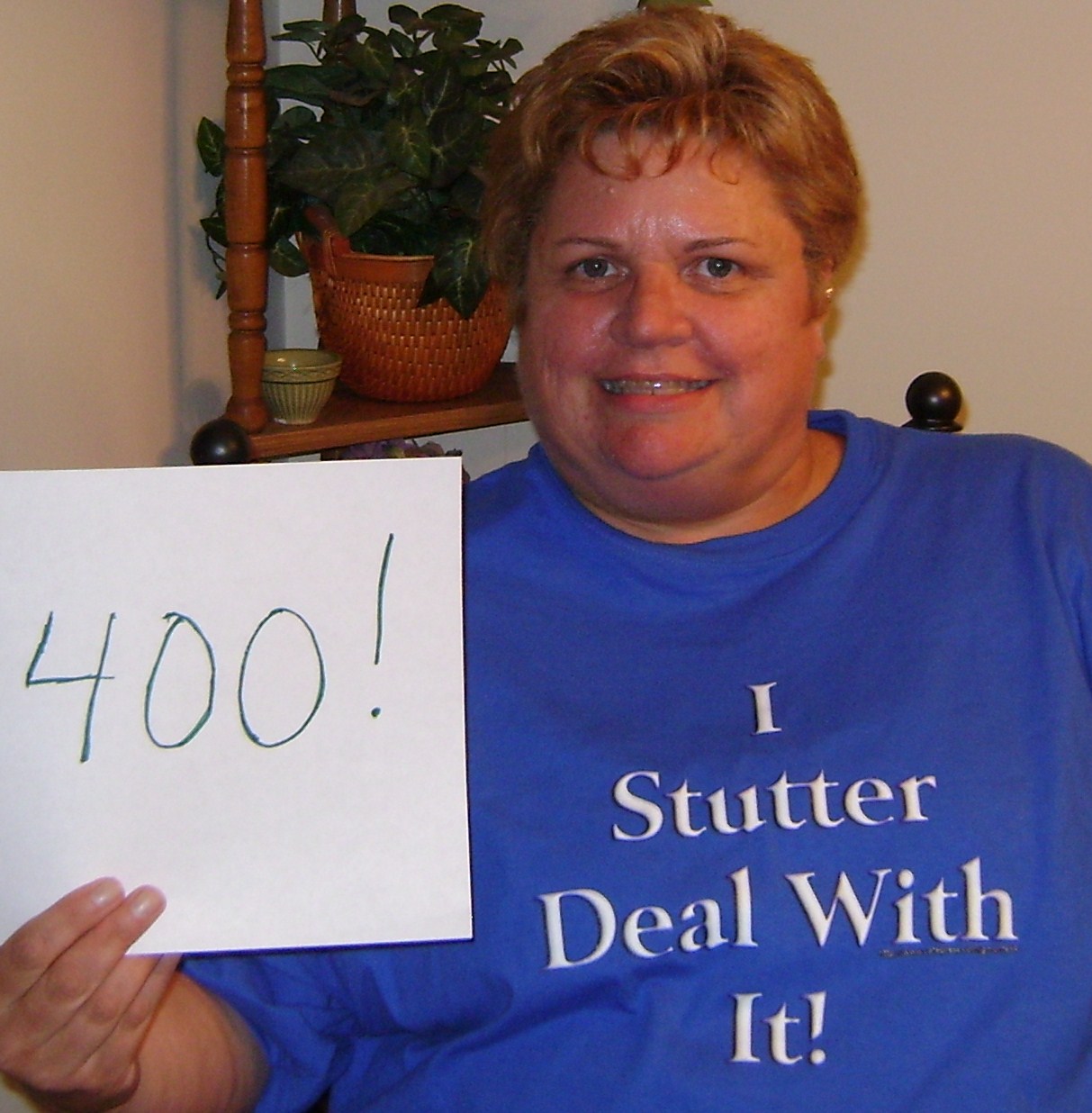 Here are summaries from some workshops presented at this year’s National Stuttering Association annual conference recently held in Texas!
I am also gratified to have reached a milestone. This is my 400th post since starting this blog in February 2009!
There were so many workshops to choose from at the same time. It’s almost unfair to have to choose. So I asked fellow attendees to summarize some of the best workshops they attended. Helps me, helps you, helps all.
You Are Changed By What You Do: “Shame-Busting” Through Avoidance Reduction Therapy. This was the most powerful workshop for me, led by Vivian Sisskin. She and several people that participate in her therapy groups led us through how to reduce shame by learning to face our fears and re-define success and progress. I listened to Vivian speak last year and became fascinated with her approach to avoidance reduction.
Shame was always my biggest issue, and learning even to identify that is hugely empowering. I have read several books on shame reduction and shame resilience over the last year as well, that has helped me move toward more acceptance of my feelings and emotions.
My friend Brandon shares his take away points from two workshops that resonated with him.
Release Fear, presented by Zaheen Nanji and NSA Career All-Stars, presented by Beth Bienvenu, Jim McClure, Tracey Wallace, Gregg Benedikt, and John Moore.
Brandon writes, “As I find myself looking for a new career opportunity I realized that the work place is my final frontier. From experience in working outside my comfort zone, I know what needs to be done but wanted to hear it from others that are doing it. The Release Fear workshop turned the abstract concept of “facing what you fear to create change” into a logical evaluation to expose the cost of making or not making the change. This workshop helped me to see that some discomfort now while facing challenging speaking situations will lead to a more open and balanced life in the future.”
He goes on to share, “Do you remember growing up thinking, “Damn, am I the only one that stutters?” Then you find an organization like the NSA and know you are not alone. Witnessing a person stuttering in the workplace is like a Bigfoot sighting for me. It is exciting and a bit scary depending on how far away I am from it.
I still feel I have one foot stuck in the mud with regard to the workplace, so I was excited to hear from the NSA Career Stars. Hearing first hand from these successful people that stutter in the work environment took away a lot of the mystery I had built up around it.
I loved the slogan “Participation is the Price of Admission”. A few years back I realized that in order to be more at ease with stuttering I would need to take it to the street. Originally I was misled to think I could practice in hiding then put the show on for all to see. I realized I was just going to have to be ME!
One of the biggest changes I had to make was to start using the world as my practice. Hearing it again from one of the speakers pinpointing the workplace really hit home for me. The phrase “Participation is the Price of Admission” has many meanings for me. Regarding stuttering, it reinforces that I need to work my speech agenda step by step, speaking up and sharing my ideas and concerns, and interacting, all for the admission to a better more fulfilling life.”
Brandon – thanks so much for sharing these thoughts and how helpful these presentations were for you!
My friend Anna shares her thoughts on some workshops she attended. Anna was a first time attendee to the conference and also presented at the Toastmasters workshop! I have so much material here that I will include her two other summaries in my next post.
Laughter Yoga – The Fun Part of Everyday presented by Judith Newman.
Anna writes: “When was last time you really laughed? Not smiled, chuckled or giggled, but laughed, openly, heartily, loudly, without inhibitions? If you can’t remember, you should check out laughter yoga classes. As Judith explained, laughter is very beneficial to our body and our brain – so we should do it often. You can do it alone and your body won’t know the difference between a “fake” laugh and the real thing.
But it is easier to burst into open laughter in a group, under the guidance of a laughter Yoga leader. For 45 minutes we did silly exercises and laughed so hard, my insides started to hurt. Regarding stuttering, it is not a therapy. But laughing with all your might, while looking a stranger in the eye, is definitely something that I don’t do in my everyday life. To me it was very liberating. To my non-PWS husband – a bit too weird.”
Thanks Anna for taking the time to share these thoughts.
In my next post, I will have two more summaries from Anna, on Dr. Baker’s Speech – Treatment Innovations and Journey of Hope presented by Robert Baker Ph.D. and Going Beyond Stammering with Confidence presented by Maria McGrath (who has been a guest on this podcast).
And I will have a summary from Alex on his powerful thoughts on the keynote by Neal Jeffrey.
I also have a few live videos from the conference that I will post, once I have secured permission from those recorded. Feel free to leave comments, so that the folks who took the time to write these up, and me, know that you found it helpful.

Episode 2 features Henryk Sarat, who hails from Chicago, Illinois. Henryk is 24 years old and recently completed his Master’s degree in Computer Science at the University of Chicago.
He worked as a trading software developer at a high-frequency trading firm and learned he wanted to create more of an impact so he became a tech entrepreneur. Henryk strives to lift the bar higher and take risks, create and inspire change. He has an entrepreneurial spirit and wants to create the next big thing that will change the world.
Listen in as we talk about how stuttering has impacted his life, positive attitude shift, inspiring change, and pushing out of our comfort zones. He also shares his experiences with speech therapy approaches and gaining confidence.
We have a great time getting to know each other in this conversation and focus on humor and not taking self too seriously.
Henryk is involved in Toastmasters and is actively involved in the global stuttering community. He created the site StutteringCommunity about 3 years ago to allow people to connect with each other via Skype.
Henryk attended his first NSA conference last year, and is planning to attend again this year in Ft Worth, Texas. I am looking forward to meeting Henryk in person this week in Texas and collecting my 22 and 1/2 hugs.
The music used in this episode is credited to ccMixter. Please feel free to leave comments. Feedback is a gift. (Episode recorded on June 30, 2011.)
By Accident – Episode 59
Posted on: June 20, 2011
Episode 59 features Maria, 28, who was born and raised in Eastern Europe. Maria presently lives in Liverpool, England, and is studying Human Resources Management.
Maria landed in the UK quite by accident! Listen in as she explains how a half-year commitment to a new job resulted in many changes.
Maria didn’t start stuttering until 12 years old. She shares that she didn’t get much support and no therapy. In fact, her family acted as if Maria’s stuttering didn’t exist, and Maria herself describes pretending she didn’t stutter.
She found therapy as an adult quite by accident as well! While browsing in a library one day, Maria picked up a book on self-development. One of the suggestions was to join Toastmasters. She did, and tells the story of how the President of that club quite assertively pulled her aside at her very first meeting and told her she must try a speech therapy program that he had attended, the McGuire Programme.
Maria attended a McGuire course one year ago, and tells us how both her speech and life have dramatically changed. She describes the feeling of “being let out of prison.” Maria has now done things she never thought possible, including many job interviews, taking a job as a receptionist and even tracking down relatives, which she would never do because of her fear of using the telephone.
Listen in to Maria’s accidental transformation from a shy, fearful hairdresser to the now confident, ambitious woman studying to become an HR Manager and living in a new country.
Credit for the podcast safe music used in this episode goes to ccMixter. Feel free to leave comments for Maria or Pam. Remember, feedback is a gift.
Getting Wet
Posted on: May 26, 2011
- In: Posts
- 10 Comments
 I have been in Toastmasters for five years. To say it has been a great experience would be an understatement. Toastmasters values and supports individual growth and thereby fosters courage and confidence. I am proof of that!
Having a safe environment to practice different speaking situations and know that people actually want you to succeed is priceless. We don’t find this everywhere.
Workplaces can be intimidating. They may encourage you to “speak up” but sometimes an employee is fearful of the consequences of doing so. In our communities, it can be tough to be heard as well, especially if you are the “new kid on the block” or you are not a social butterfly!
And if you stutter, all of these situations can be even scarier. But Toastmasters welcomes and encourages every member to build on strengths we already have and work towards personal and professional goals. It is a non-threatening environment where members simply support each another. Sometimes, we “nudge” each other a bit as well!
I have not done any planned speeches since last summer. I have been focusing on other things and mentoring a new member. That’s also part of Toastmasters – paying it forward and passing along what has helped us to the next person. I take meeting roles and enthusiastically participate whenever I can.
At this week’s meeting, a person was to be Toastmaster of the meeting for the first time. She was a little nervous, had spent a week emailing members, getting bios together and planning. She really wanted to do well. (I suspect she is a bit of a perfectionist like me!) There were two planned speakers on the agenda. Both backed out at the last minute.
While we were waiting for the meeting to start, I mentioned that some Toastmasters talk about have “back-pocket” speeches that they can do anytime. I half-jokingly mentioned that maybe we might have to do that at our meeting. Well, our Toastmaster Annette called my bluff and asked if I would give an impromptu speech. How could I say no!
So, with only seconds to prepare, I rose to the challenge, walked up to the lectern and delivered a 7 minute speech called, “When It Rains, Get Wet”. I talked about living life to its fullest and shared the personal experience of having participated in my first team 5K walk last week. Something I never thought I could do. Something way out of my comfort zone!
Unbelievably, it seemed like one of my better speeches. I was comfortable, relaxed, animated. People commented on that in the written feedback slips we give to each other after anyone speaks. And when I finished, another member volunteered to give his second ever speech, off the cuff. Talk about risk-taking.
I share this for a reason. I was always afraid to take risks, especially speaking risks. I always feared that I would be judged as incompetent, just because I stutter. But I have learned that sometimes the best lessons are taught when we just let go and do it.
I have to share some of the feedback I got after my impromptu speech. It was so gratifying and affirming. I allowed these comments in and gave myself permission to feel good!
“Smooth, fun story, nice build-up, happy ending, a lot of fun.”
“Amazing speech! I felt your joy when you crossed the finish line. You inspired me to take a risk!”
“Great! Wonderful personal story! Engaging topic, excellent delivery.”
“Pam, you are the ultimate risk-taker! Are you sure this wasn’t planned? I wish I could be as confident as you. You did an awesome job. Great body movement and non-verbal cues. You totally rock!”
Normally, I would be adverse to share compliments like this. I often feel embarrassed. I know why – I used to feel I didn’t deserve to be told I do/did a good job!
But taking this huge risk felt great and proved that good things happen when we go way outside our comfort zone. People keep telling me to share these really good things, so I just did!
My Greatest Gift – Episode 51
Posted on: April 4, 2011
Episode 51 features Mary Wood, who hails from Fort Wayne, Indiana, via Hamilton, Ontario, Canada. Mary is an ordained Unity Minister. She went back to school at age 66 and was ordained in 2005. Mary recently celebrated her 74th birthday!
I met Mary last year at the NSA Conference in Cleveland. She did a workshop called, “I Need Your Love. Is That True?” I joked with her that it was one of the few workshops with an 8:30am start time that I have actually remembered attending! A friend introduced me to Mary after her workshop.
The theme of the workshop was fear of rejection. We go through life needing people to tell us what a great job we have done, so we can feel worthy, affirmed, loved. But the basis for Mary’s workshop, and her recent life’s work, is that we really only need to believe that about our selves. We don’t need for others to tell us that we are good. Easier said than done!
Listen in as Mary shares some of the compelling questions she has asked herself (and then others) as she learned more and more about the connections to stuttering and self-esteem. She has asked herself, “What is it that I don’t like about stuttering?” She has found it to be that fear of rejection that we all know, even though it may be hard to admit.
We also discuss replacing negative thinking with positive thinking and how stuttering became like a self-fulfilling prophesy for Mary. We talk about involvement in stuttering support, Toastmasters, and how Mary knew that she was supposed to be speaking to people every chance she got.
Credit for the podcast safe musical clip “Echoed” goes to ccMixter. Feel free to leave comments or questions for either Mary or me. Feedback is a gift!
 Make Room For The Stuttering
What people are saying!