Posts Tagged ‘stuttering’
Forming Internet Communities
Posted on: January 20, 2015
I was interviewed by a friend last Wednesday for an article she wrote about how people who stutter use the internet to form communities. The article is called “The way we talk when we talk about stuttering” and it was published this Sunday January 18 in my friend’s home town of Austin, Texas.
Talking to my friend was a great opportunity for me to reflect on all the different ways I use the internet to form communities.
I have the community that follows this blog, which is still going strong after almost 6 years.
I have the community of women from all over the world that have been part of my podcast “Women Who Stutter: Our Stories” for almost 5 years.
And I have the community that has formed from being a Stutter Social host every other week.
Read the article. It’s great, thorough and mentions me. What more could you ask for? 🙂
Just Go For It – Episode 134
Posted on: January 12, 2015
 Episode 134 features Margaret Heffernan, who hails from Greeley, Colorado. Margaret is 20 years old and a senior at the University of Northern Colorado. She is studying theatrical design and technology with an emphasis in stage management.
We discuss the importance of communication in her work and how she “calls shows” as a stage manager. Margaret realizes that she can be a good communicator even if she’s not fluent.
Margaret’s dad also stutters. We discuss what it’s been like growing up with a family member who stutters, pushing herself through hard things, and not feeling so isolated.
Listen in as we also discuss entering adulthood, self-confidence, approaching job search and interviews, being open and turning a corner, and stuttering without fear. Margaret wrote a great piece describing her thoughts about stuttering, called “I Stutter and Some People Wear Glasses.”
This was a great, honest conversation about life transitions. The podcast safe music used in today’s episode is credited to ccMixter.
The Waitress
Posted on: January 8, 2015
- In: Posts
- 7 Comments
 She looked at me sort of quizzically while I placed my order, but she didn’t bat an eye and smiled the same smile she always does when I stop in. I don’t think she really cared that I asked for “lllllllemon” in my ice water.
When the waitress brought my water, it had the lemon I had asked for, that’s all that mattered.
I’ve never really liked going to restaurants by myself. I’ve always found it a bit uncomfortable. I used to imagine people saying to themselves, “Oh, that poor lady, she’s eating alone.”
I’ve gotten over that as I’ve matured and realized that people don’t think about me when they’re dining out.
So, now I feel comfortable going to a few restaurants by myself. Especially since I can do like everyone else does – whip out my smart phone and check emails or texts. Not having to make eye contact with anyone simplifies matters when you’re dining alone.
Well, on this day, the waitress wanted to chat. God forbid, right? Chatting in a restaurant like we used to do in the good old days.
The waitress wanted to know what brought me in at an off time of the day. I was there mid-afternoon and there was only one couple sitting together at the counter.
I mentioned that I was between a-a-a-appointments and had not eaten lllllllunch yet. She asked me what I wanted to order.
I was in the mood for comfort food and asked for a gr-gr-gr-grilled cheese sand-sand-sand-wich and to-to-to-mato soup.
She looked at me and smiled and said she’d wait all day for me to say what I had to say and she hoped I expected everyone else to do the same.
I took a chance and said, “well, not everyone is patient, you know.”
The waitress then simply said, “well, honey, fuck them, then. They’re not worth your time.”
And five minutes later she brought me my soup and sandwich and set it on the table, winked, smiled and went on about her business.
That was the best grilled cheese sandwich I’ve ever had.
Suffocating Inside – Episode 133
Posted on: January 6, 2015
Episode  133 features Shilpa Sagwal, who hails from Mumbai, India. Shilpa is 23 years old and is studying for her Masters degree in Chemical Engineering. She is enjoying exploring her world and moving out of her comfort zone.
Listen in as we discuss Shilpa’s journey toward acceptance and how openly bringing up stammering with family and friends has helped her. She feels more supported and is enjoying life.
We discuss what it’s like to be a woman in India who stammers, how it’s a “big big issue.” Women who stammer don’t want to expose themselves and are fearful of almost everything. Stammering is seen as an imperfection. We discuss how women in India can’t speak for themselves anyway and how having a stammer only makes that worse.
We discuss The Indian Stammering Association (TISA) and how Shilpa has found support through weekly meetings and the national conference.
This was an enlightening, honest conversation that could have gone on for hours. Feel free to leave comments or ask questions.
The podcast safe music used in today’s episode is credited to ccMixter.
Colleagues Who Stutter
Posted on: December 30, 2014
- In: Posts
- Leave a Comment
We all know the statistics. Only about 1% of the adult population stutters, so it’s common to not meet another person who stutters in our everyday lives.
I’ve talked to many people around the world who have shared that they have never met someone else who stutters, which may add to the isolation of stuttering.
I work in an organization that employs about 450 people, and I’ve met three other people who stutter through work. Statistically, that plays out as it should, but it seems strange that I’ve actually met all three of them. I don’t work directly with any of them but we have occasion to see and talk with each other.
They all happen to be men, which bears truth to the belief that there are 4 times as many men who stutter than women.
I have spoken about stuttering with two of the guys. In fact, one of them always asks me whenever I see him if I’ve done anything stuttering related recently. He’s referring to things he knows I’ve done in the past to raise awareness of stuttering, like organizing talks at local libraries and schools.
One person is a relatively new colleague that I see at least once monthly at meetings. I noticed that he stutters, but I didn’t go up to him and say, “hey, I stutter too,” I did that once with someone and it backfired. The person got offended and profusely denied he stuttered, even though to me it was quite obvious.
Everyone is at a different juncture with their stuttering journey and I don’t think it’s up to me to bring it up when I hear someone else stutter. But if this colleague approaches me and wants to discuss stuttering, I will gladly talk his ear off about it!
In an odd way, it feels good that I’ve met others who stutter in my workplace. Growing up, I never met anyone else who stuttered and always wondered if I was the only one.
It’s good to know I’m not the only one in the workplace.
Being Honest – Episode 131
Posted on: November 18, 2014
Episode 131 features Vanna Nicks, who hails from Piedmont, California. Vanna is a busy mother of two and also works full-time as a speech pathologist in a trauma center at an acute hospital in Oakland.
Vanna always wanted to be a SLP but didn’t have the confidence. She moved to Washington DC and found Vivian Sisskin’s avoidance reduction therapy group. There, she found the self-confidence to go back to school to become a SLP.
Vanna learned through avoidance reduction that she had the right to speak whenever she wanted and that she became more fluent when she stuttered openly. She learned to be truly honest with her self and others.
Listen in as we discuss advertising, workplace stuttering, being approachable, developing rich relationships and so much more.
The podcast safe music clip used in today’s episode is credited to ccMixter.
Producer note: As I played back this episode, there are parts where it sounds like I spoke over Vanna. I certainly didn’t mean to and I don’t remember doing that when we spoke. I wondered (aloud) if it was an audio glitch that I don’t know how to correct. Maybe – maybe not. Either way, enjoy the episode. 🙂
Popular Media On Stuttering
Posted on: October 30, 2014
- In: Posts
- Leave a Comment
Buzzfeed has a great article called “25 Things All People Who Stutter Will Understand.” It’s surprisingly spot-on and doesn’t make fun of, or demean, people who stutter.
Enjoy! Can you relate to any of them?
Honest Speech
Posted on: October 23, 2014
No words needed for this. Utterly powerful. Thank you, Erin.
Dream Big – Episode 130
Posted on: October 20, 2014
Episode 130 features Debbie Rasaki, who hails from London, England, UK. Debbie works as a nursery nurse in a day care setting and aspires to be a Social Worker.
Listen in as we discuss how stammering (as it is known in the UK) made Debbie a quiet person who lacked courage. She feels her “real self” is bubbly and animated, but her stammering caused her to hide the real Debbie.
Things have changed dramatically for Debbie since July of this year, when she participated in The McGuire Program and was featured in a TV documentary called “Stammer School.”
Debbie shares her experiences with both – giving us a good overview of how she benefited from participating in the intensive speech management program and opening up from her private self for the documentary.
This was a great conversation, full of honesty and insight and a reminder to dream big. Feel free to leave comments or ask questions in the comment section, for feedback is a gift.
The podcast safe music clip used in today’s episode is credited to ccMixter.
Mirror Mirror
Posted on: October 9, 2014
- In: Posts
- Leave a Comment
 What do you see when you look in the mirror? Do you see how great you are, or do you look for the things that need to be fixed?
Like many people, I often notice what’s wrong instead of what’s right. I lament over a new zit or a sudden sprung hair. I check to be sure my hair looks OK and look to see if I messed up my make up.
Rarely do I just look in the mirror and smile and say to myself, “you look great.” I have long struggled with thoughts that I’m not good enough and that often translates over to what I see when I look in the mirror.
I heard a powerful keynote speaker last month who reminded us that we need to like what we see when we look into that mirror. We need to tell ourselves that we like what we see and start our day off on a positive note.
That resonated with me, especially as I was working on a workshop about positive affirmations that friend Annie and I would present at a stuttering conference in early October.
Annie and I worked on our workshop for 6 weeks, trying out different affirmations that we would encourage people to use when looking in a mirror, both generally and about their stuttering as well. We caught ourselves saying things to ourselves and each other that were not affirming and found out how loud our inner critic’s voice can really be.
We did our mirror workshop on Saturday at the NSA regional conference in Anaheim. We were both a little nervous, worried that people wouldn’t get “into it” and that we were not well prepared enough.
We were prepared enough and people did get into it. We handed out small mirrors and asked people to look deep into their eyes while we took turns gently reading positive affirmations. We then invited people to come up and sit in front of a large mirror and say something aloud, affirming their self and their stuttering. Several people took the risk and we then shared out at the end how all of this felt.
It was a powerful workshop where we were present with each other. We ended by sharing this with the group, which everyone read aloud together.
I AM STRONG
I AM KIND
I AM BEAUTIFUL
I AM SMART
I AM IMPORTANT
I AM FEARLESS
I AM AMAZING
Hear Me – Episode 129
Posted on: September 30, 2014
Episode 129 features LaShanda Lewis, who hails from Chicago, Illinois. LaShanda and her husband have three young children, who LaShanda will be home schooling.
LaShanda is also a singer, and has been singing since about 8 years old. She is working on a solo album of Christian music, which she hopes to release in a year.
And she doesn’t stutter when she sings!
Listen in as we discuss avoidance and shame, confidence and the importance of finding support with other people who stutter. We also discuss her children’s reactions to her stuttering.
The podcast safe music used in this episode is credited to ccMixter.
Indian Stammering Commercial
Posted on: September 15, 2014
If you haven’t seen this yet, check it out. It shows us that stuttering/stammering doesn’t have to hold us back and that we can achieve anything with grit and persistence.
2014 ISAD Conference
Posted on: September 12, 2014
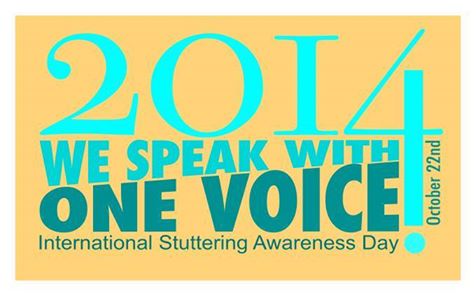 This year’s International Stuttering Awareness Day (ISAD) online conference begins on October 1, 2014 and runs for three weeks through October 22, 2014.
Authors will present papers on a variety of topics relating to stuttering – attitudes and feelings, therapy techniques, research updates and personal experiences.
Presenters are a mix of people from the international stuttering community – people who stutter, family members of people who stutter, clinical therapists and scientific researchers. This is an exciting conference where different voices from all over the world are heard.
This will be a treasure trove of information on stuttering, and you will have the opportunity to interact with the contributors and ask questions of professionals in the field.
Plan to check out the conference and plan to learn a lot. Spread the word!
 Make Room For The Stuttering
What people are saying!