Archive for the ‘Posts’ Category
A Monday WOW Moment!
Posted on: March 1, 2011
- In: Posts
- 22 Comments
I had a great experience yesterday at my school that I wanted, well needed, to share. Two weeks ago I did a workshop at a library called “An Un-Royal Talk About Stuttering: Lessons from The King’s Speech”. It was free and open to the community and we had close to 50 people there. One of them present was a colleague of mine, who had seen the movie, knew I stuttered and was really interested in learning more. She also brought her mother.
She came to me the next day and asked if I would do a similar presentation to the Adult LPN classes, one today and the other one, in a more remote location, next week. She felt students preparing to work in the medical field could benefit from hearing this information from someone who lives it every day. I was nervous, but agreed.
I changed the presentation slightly to adapt to a nursing student’s point of view but planned to keep it close to what I had already done, so I didn’t have more work to do.
One of the first things I started with was the question how many in the class had seen the movie! ZERO! These are all working adults with families who take a demanding and intensive LPN course in 10 months and have little time to breathe, let alone watch a movie.
So I quickly changed my focus, and started telling MY story, hoping they wouldn’t be bored to tears. I shared about my covert years, why I chose that, the hidden feelings of shame and my reluctance to ever show emotion and vulnerability, in addition to stuttering publicly. I shared how I got fired, there was a collective gasp, they wanted to know wasn’t that illegal, etc. I started getting emotional, and one of the teachers brought me the Kleenex box!
Then I shared how my family had NEVER talked with me, or about stuttering, so it was always hard to talk about. I talked about how profoundly my life changed when I was fired and how I decided I wasn’t going to pretend anymore. I was going to let ME out.
You could have heard a pin drop in the room. I noticed and heard a few sniffles. At one point, I asked if anyone knew anyone who stutters, or does anyone stutter. One young woman in her 20’s raised her hand – she said , “I stutter” with tears streaming down her face.
I asked if her class knew, they were all looking now, and she said no, not until that moment. Her classmates then applauded. One girl said, “I thought so, but you are always so quiet, I wasn’t sure”. Heads were nodding and the girl who had disclosed smiled and looked OK.
I started talking about what stuttering is and what it isn’t, and the teacher in the room asked if it drove me insane if people finished my words for me. I smiled and said yes, she said, that as nurses, they are inclined to just want to help.
I then described the different ways stuttering can manifest, and when I got to sometimes people will use lots of filler words, like uhm, and that I used to do that, another hand went up, and a woman said, “OMG, that’s exactly what my 14-year-old son does, all the time. Maybe he stutters. I keep telling him to slow down, take a deep breath”, and she asked what I thought of that. I smiled and said that’s generally not helpful.
She looked concerned and asked out loud, “have I been making it worse for him?” and I said “if we could, we would”. She said she was going to talk to her child about it. She whispered “thank you” to me.
Towards the end, we were running out of time. We had not talked about the movie at all. I showed 1 minute of the 2 minute trailer. They got it. I then asked them if they had ever heard of Porky Pig, and what was he known for. They all knew. They stayed 10 minutes over, which the teachers told me they NEVER do. And they gave a huge applause at the end.
Several came up to me privately, and one more admitted she stutters and is dyslexic but has not told anyone, and that she “got me”. She said she has felt such a huge disconnect, but felt connected with my story as soon as I started telling it. She started crying as we spoke privately and she said she never heard anything this courageous as a teacher standing up in her school telling this story. She kept saying over and over “I got you.”
Who would have thought? 40 students in this Adult class, 2 stutter and one has a child who stutters.
This was a WOW moment for me and I wanted to share it!
Listen To Your Mother
Posted on: February 28, 2011
- In: Posts
- 2 Comments
That was heard Sunday night a few times as Academy Award winners picked up their Oscars and gave acceptance speeches. It was an extraordinary night for people who stutter. We now have a dignified face put on that which we often hide out of fear and shame.
The King’s Speech won for Best Actor (Firth), Best Director (Hooper), Best Screen Play/Writer (Seidler) and Best Picture. Sweet!
Stuttering is hard to talk about, but has been made easier these past few months and will surely continue in light of this triumph!
My own mother, who doesn’t often say anything about my stuttering, or what I have done with being open about it, did so tonight. Using social media, she posted this on facebook just a few minutes after The King’s Speech won Best Picture.
“Very good night that you really deserve and I know people (including me) appreciate how much you have done to break down walls and shatter secrets and shine a light in some dark corners.”
That was more important to me than anything else I heard the Hollywood people say. Thanks Mom! That touched me!
And below is David Seidler accepting his academy award and thanking people who stutter all over the world.
Self, Divided
Posted on: February 22, 2011
- In: Posts
- 9 Comments
A friend suggested I read the Charles Van Riper classic, “The Treatment of Stuttering”. It’s a text-book, so not one that I would happen on or that would catch my eye. I was intrigued, however, as my friend talks frequently about the need for a “whole person” approach for those who stutter. And he thought I might find much that would resonate with me.
So I went looking for the title on Amazon. I found a used copy, for 8 cents and $3.99 for shipping, so the hardcover book cost all of $4.07! I got it in less than a week, in perfectly good condition. I started reading. My friend was right. I owe him a beer!
I have often wondered if there was any explanation as to why I sometimes feel I lead two separate lives, that even I am two separate people. I felt like that most of the time when I was very much covert about my stuttering, always trying to hide it or play it off as something else. I felt like I was one person on the inside, and that I presented a very different person to the outside world.
Even today, when I consider myself mostly overt, I still feel like I am not in balance sometimes. I still sometimes get surprised when I find my “one person” looking down at my “other person” in wonder and asking “who is she?” or “how can she do that?” This usually happens when I am talking freely about my stuttering, either casually with a small group or doing some type of presentation.
Because I still have some shame surrounding stuttering, my inside and outside selves still feel very divided at times.
My friend urged me to read Van Riper’s book in order, from beginning to end, and not to skip around. I began that way, but admit that I jumped ahead to see if there was anything that could explain my not being “one whole self” when it comes to stuttering.
And I found it. Van Riper talks about the whole idea of integration of self, the need for the person who stutters to reconcile with that and allow stuttering to co-exist within our very being. I have heard of the phrase “fragmented self” associated with stuttering and the fact that we very often allow our stuttering part to be separate from our “other” self.
I do that. I have felt fragmented. I have experienced that very weird feeling when you are in control and speaking fluently for a while and then suddenly, out of nowhere, a stuttering streak takes hold, and I feel disassociated from “me” when that happens. I tend to drift away a bit in that moment, especially when its a block or when I feel I have received a negative listener reaction.
In a way, it was helpful to read a very matter-of-fact clinical account that indeed people who stutter do experience this division of self, and that we need to integrate our self to feel whole.
Its one thing to talk about our stuttering and hold it out there before us and say we are ok with it. But it is something else entirely when the feelings take over, and try as we might, we feel we want to push that one part of ourself away.
Has anyone else ever felt this divided sense of self?
- In: Posts
- 16 Comments
Last night I got a call from a professor from an elite university here in my area. She is teaching a graduate level physics class which is just getting underway for the semester. One of her students is from China and is pursuing his graduate degree in engineering.
The professor shared with me that he has a severe stutter. She says she talked with him about it and he told her that there is nothing that can be done for him. She wanted to find some resources to educate herself and to pass on to him, if she senses he would be OK with that.
She told me on the first night of class, she partnered students up in pairs for introductions, and she purposely paired herself with the student who stutters. As she told me this, her tone seemed to imply that she thought she was protecting him. Each person in the pair had to introduce the other.
When the professor introduced this student, she told the class that he stutters, that it is nothing to fear or shy away from, and that it will be an expectation of the class that he participate as often as everyone else and that patient listening would be the norm. She asked me if I thought she did the right thing.
My immediate reaction was, Yes, if he was OK with it. I asked her, “How did he seem to react to that? Was he embarrassed?” She said no – he seemed fine with it, maybe a little even relieved.
I then said that I thought it was great she was taking the initiative to make it OK to talk about. I shared with her how I felt in college, when I was presenting and felt so humiliated, and no one said anything, just didn’t look at me and looked liked they pitied me. I told her I would have much rather been in an open, supportive atmosphere, which she is obviously trying to do for this student.
She asked me for resources, specifically if I had any experience with therapy. I shared with her what was available in the area, and explained my take on fluency shaping and stuttering modification. She asked specific questions about both, and I could hear her writing this information down. (Smile!)
I also gave her some information on self-help and support, and some web resources, again realizing she was writing all of this down. She even asked md if there were any good books that I could recommend, so she could educate herself, and in turn, her student. I gave her information on Van Riper’s and Guitar’s stuttering textbooks and Jezer’s memoir about his life experiences with stuttering.
I was really happy this woman called and I was able to answer some questions. She had seen my name affiliated with a newspaper article I had written and with an upcoming workshop I am doing at our community library.
I was also impressed that a university professor took the time and showed an interest in educating herself to better help a student.
What do you think? Do you think the way she introduced the issue of stuttering to her class was appropriate?
- In: Posts
- 4 Comments
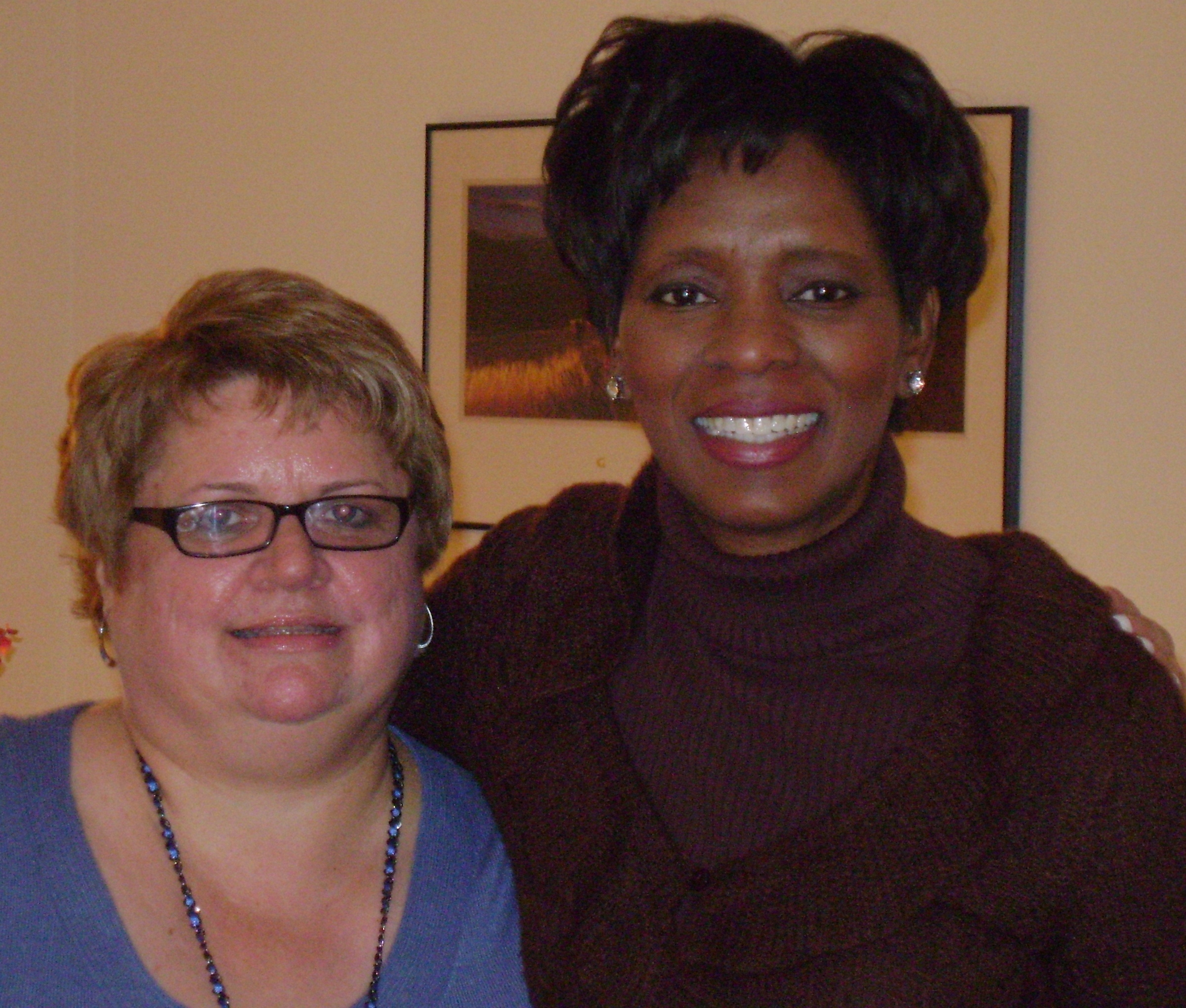 With all of the media attention and buzz surrounding the movie “The King’s Speech”, I wondered why there was no coverage in my area. We have a local college with a 40 year history of working with people who stutter. And the College of St Rose has an affiliated chapter of the National Stuttering Association as well.
So, I emailed one of the popular local anchor/reporters, told her a bit of my story and shared that I have a unique perspective on the experiences of women who stutter. I asked her if she would be interested in doing a story. She responded the next day, saying she would love to, and we set a date for a week later. Wow!
On Friday morning I welcomed Elaine Houston and her camera technician, Jesse, into my home. It was exciting and surreal at the same time. Elaine and I chatted while Jesse transformed my living room into a studio, complete with bright lights and lots of cameras. And then we got down to the business of talking and stuttering and talking about stuttering.
Turns out, Elaine had not even seen the movie. We were not going to talk about “The King’s Speech”. I wasn’t fully aware of this, but the reason that Elaine jumped at the opportunity to hear this story is that she is passionate about women’s issues. She was excited about the podcast highlighting women who stutter telling their stories. She does a weekly segment called “Today’s Women” which airs on News Channel 13 which is also included on the station’s website.
So, we discussed the “often not talked about” issues of stuttering, including the emotions and vulnerability, and how I have been affected personally and professionally. We talked about my journey,why I started this blog and how the women’s podcast morphed from there. Elaine was really interested in the women I have talked to, their hopes and dreams, and how stuttering does not limit anyone from living life fully.
Elaine had this huge, bright, enthusiastic smile the whole time we were chatting. Her passion is obvious, and she shared with me about her visit to Africa. She is working on a documentary about the lives of women around the world. I was telling the perfect person about my journey. And what I have learned from being brave enough to start talking to women all over the world.
We spent over 90 minutes together, taking lots of pictures and talking about everything. Especially about the powerful stories of women who stutter and how my life has been enriched simply by being part of this. I was grateful to have this opportunity to tell this story, and open up a conversation about stuttering from the women’s perspective.
Funny how things happen, huh? I have been so empowered by inviting women to share their stories. Elaine has had the same experience. Check out the book she wrote, The Friendships Between Women.
Things happen for a reason and usually at just the right time.
What Happens When They Forget?
Posted on: January 24, 2011
- In: Posts
- 8 Comments
I had an interesting conversation Sunday with a friend. She wondered out loud what will happen when the attention surrounding “The King’s Speech” dies down and mainstream forgets about the movie. They will, you know.
By the end of the year, people who don’t stutter won’t even remember the movie. Attention will shift to the slew of movies that are always released at the end of the year, just in time for Academy Award buzz.
My friend mentioned that someone told her that right now, the movie almost makes it “cool to stutter”. A year from now, we will still have to worry about sending the message that it is “OK to stutter”.
In this fast paced world, people’s attentions spans are about as long as my pinkie-finger. We move from one thing to the next at lightening speed. I even have trouble these days recalling what I said an hour ago, unless I write it down. And then I can’t always even read my hand-writing any more. And speech recognition software doesn’t work well if you stutter! I tried it years ago!
So what do we do? How do we keep a reasonable focus on stuttering and remind the world that we are here, competent and able?
Another friend posted on Face book that the DVD and Blue Ray for “The King’s Speech” will be available on April 29, 2011. Who needs to know that? Who will buy the DVD? My bet is that most sales will be to us – people who stutter and people who care about people who stutter.
So we will need to continue educating others, raising awareness, talking about stuttering openly and advocating for ourselves. That includes keeping our blogs and podcasts alive and current, encouraging people who stutter to step out from behind the shadows and do everything we can to eliminate bullying of kids who stutter and workplace discrimination of adults who stutter.
That stuff will still happen. Kids will be teased and adults will be passed over for opportunities because people just don’t understand something outside of their “own world” realm.
Reminds me of a comment I saw posted on one of the stuttering email groups a few months ago. A woman asked, “are there any women who stutter in high power, visible,management positions?” Like CEO or Executive Director of known businesses?
We hear about Jack Welch of GE (20 minutes from me) and John Stoessel of 20-20 News (but he records his broadcasts and edits out stuttering). And here in my community, we have a male Mayor who stutters. But where are the women who stutter?
That’s why we will still need to keep talking and making our voices heard long after this movie is forgotten. For the kids who come behind us, and for the women who stutter openly that are not visible in those high level positions.
I recently met a woman who stutters who is her company’s Chief Branding Officer and the company is very successful. Hopefully, we will hear her story soon.
But in the meantime, we can’t complacently ride the coat tails of this movie. We who stutter every day and make room for it in our lives will have to be stronger and louder than ever to keep teaching the world that we are OK and what we have to say is important.
What do you think?
He Too Will Have A Voice
Posted on: January 20, 2011
- In: Posts
- 3 Comments
I got this letter from a gentleman who read the print newspaper article I had written about The Kings’s Speech movie. I was surprised to hear from someone in Pennsylvania, as I did not know my article had been printed outside of the Albany NY area.
I share this to show that we have no way of knowing that what we do can impact others. And also how touched I was to learn he has a three-year old grandson in therapy for stuttering.
Dear Pam:
The piece that you wrote for the Albany Times Union, “The King’s Speech” Puts Spotlight on Misunderstood Disability: Stuttering, appeared in our local paper, The Sunday News in Lancaster, PA. It caught my attention because I am a stutterer. It brought back some old feelings from the days of my struggle with my speech. I first became aware of my “handicap” when I was 12 and in sixth grade.
Jumping ahead to Penn State at 19, my sophomore year, I met a fellow stutterer in Speech 101, a required course. He introduced me to the Speech Clinic at PSU. I attended therapy sessions through my senior year. The “graduation” effort was to address a large class of students on a topic I had chosen. It was a big step toward liberation. Some people accuse me of not shutting up since.
I still stutter/stammer occasionally but I get past that pretty quickly. I graduated with a degree in forestry (I could live in the woods and hide from people), began a program in rural sociology, served two years in the army, completed additional credits in secondary education and earned a certificate in education and became a science/health teacher. I continued on and got my Masters Degree and became a counselor in secondary education, sometimes call a guidance counselor, a term I dislike.
My experiences and interests led me to become a high school career counselor. I was responsible for establishing career development centers in four schools districts for which I worked in Delaware, New Hampshire and Pennsylvania. I began my career in 1960 and retired after 40 years in 2000. I volunteered as an aid in the Career Development Center in PA after I retired.
This year at 77 I finally hung up my last life and career rainbow.
Three things prompted me to write to you: first, the title of your piece; second, your last name and its similarity to mine; and third, the fact that you are a career counselor. I am interested in hearing how you arrived at your destination.
Coincidently or otherwise, my three-year old grandson is in therapy for stuttering. He too will have a voice.
I wrote back to this gentleman and shared how I arrived at my destination of career counselor, and he shared a little more about himself.
It is always such a nice surprise to hear from someone unexpected that shares stuttering in common and feels comfortable enough to share it with a stranger. Proof that we never know who we may impact on a day-to-day basis. Our words and actions often have a farther reach than we know. It is nice to acknowledge that, and thus, be acknowledged.
- In: Posts
- 6 Comments
Women Who Stutter Have Different Brain Connections Than Men Who Stutter; Findings May Help Explain Why More Men Than Women Stutter – – ScienceDaily (Nov. 18, 2010)
 I could not resist re-posting this article. My risk-taking friend Lori San Martin posted this link on Facebook and made reference to me in her comment. Lori mentioned that she participated in the clinical research for this study, at NIH in Bethesda, MD. So did I, way back in 2006.
Neither of us knew each other then, so there was no way of knowing this shared connection. Interestingly, Lori chose to post this link on Face book, hoping I would see it and her comment, “Eat your heart out Pam.” When I read the article, I recognized the lead author was the researcher conducting the trial when I flew to Bethesda that summer.
I volunteered for the study because I could. I was available, healthy and willing to help unlock any clues to the mysteries of stuttering, and particularly why women are a “minority within a minority.” Plus, they compensated you, and I had just been fired from my job for stuttering. I felt I could contribute somehow by letting interested researchers study my brain. Lori must have felt the same way.
I even went to Columbia University in 2009 for a similar study of different brain activity. Again, making sacrifices for the good and welfare of the stuttering community. (And it was a sacrifice indeed. I stayed with a friend overnight in his Brooklyn apartment with his wife and two cats. Suffice it to say, I am not a cat person).
Here is the content of the article! As Lori says, “Eat your heart out.” We already know women are special and unique.
According to new research, women who stutter show brain patterns that are distinct from men who stutter. Finding diagnostic brain markers that are unique to people who stutter could help scientists develop treatments that target those areas in the future.
The research was presented at Neuroscience 2010, the annual meeting of the Society for Neuroscience, held in San Diego.
About five percent of young children stutter, but up to 80 percent of them recover. Of those who don’t, most are men; about five times more men than women stutter. These new findings show one difference in brain connections that may explain the striking sex difference in chronic stuttering.
“Girls who continue to stutter past childhood may have greater deficits that are not overcome during development,” said lead author Soo-Eun Chang, PhD, of Michigan State University. “Knowing the sex-based differences in brain development that underlie stuttering may help us find sex-specific neural markers for it.”
Chang and her colleagues mapped participants’ brains using two imaging tools: functional magnetic resonance imaging (fMRI), which showed brain areas active during speech, and diffusion tensor imaging, which provided structural information on connections between brain regions. They tested 18 volunteers who stutter and 14 who don’t.
The images showed that speakers who stutter had fewer connections between the motor planning and execution areas in the left hemisphere of their brains, as well as increased connections between hemispheres. In addition, the women who stutter had distinctly greater connectivity between the motor and sensory regions in both hemispheres than men who stutter. These findings may indicate that the link between motor control and sensory functions may be abnormal in women who stutter.
“These results need to be replicated in young children to examine whether this is the case at stuttering onset or whether it later appears only in adult females who continue to stutter,” Chang said.
Research was supported by the Intramural Research Programs in the National Institute of Neurological Disorders and Stroke and the National Institute on Deafness and other Communication Disorders.
So, what do you think? Comments, thoughts, questions. Come on guys! Can there be discourse about this? Hmm?
- In: Posts
- 9 Comments
A covert stutterer posted this question on one of the email groups. It generated lots of discussion and opinions. Another covert woman asked how do we actually show our stuttering at a Toastmasters meeting and “let the cat out of the bag”. This is what I shared as a response, not realizing that I had remembered this so clearly.
One of the best topics for a person who stutters to give a speech on is stuttering. That’s how I desensitized myself when I joined 4 years ago. My first speech the – “ice breaker” – I told my stuttering story, complete with how I tried to hide it, faking it, how I pulled it off, how it made me feel, etc.
The “ice-breaker” is supposed to be 4-6 minutes. Mine was 15 minutes, because I got emotional and choked up, and did not think I could finish. There was this huge long pause – a wait, actually – and all eyes were on me. This was the first time I had ever told people I had been hiding stuttering all my life. I was fired on May 4, 2006 and I gave this speech on May 23, 2006.
While the room waited for me to compose myself, a funny thing happened. I could feel the energy in the room shift. No one was annoyed, no one was rolling their eyes, no one was being dis-respectful. In fact, I could feel most of them “willing” me to finish. I don’t think they were going to let me out of the room unless I finished.
No one said a word. It was utter silence for 1-2 minutes, which seemed forever, and I willed myself to plod along and finish. I swear I felt that energy pushing me to finish.
When I was done, they all clapped like they do for everyone as I walked back to my seat. By then, my heart was pounding and tears were streaming down my face. There was more silence, as everybody wrote little comments about how I had done and put them in a basket and passed them to me. Next, the person who had been assigned to be my formal evaluator stood up and gave his opinion of how I delivered my first speech.
As he spoke, fresh tears erupted, as I realized what I had just done. I had just done the scariest thing I could ever have imagined doing to a bunch of strangers. My evaluator, Jim (who became my unofficial mentor) stood at the lectern for a sec, then began his evaluation by uttering one word: “Bravo”.
He said he and every person in the room learned as much as they ever would that night about me, about my courage, my resilience, my desire to communicate, my writing skills and my spirit. He talked of things like wearing my emotions on my sleeve, risking being vulnerable, daring to be so personal in a first effort. He also reminded me of time limits, which I can laugh about now, and how I had started a journey that he hoped I would be compelled to finish.
People came up and hugged me after as the meeting got over, and I did not read the little slips till I got home. All of them said something similar – that is was one of the most inspirational first speeches they had heard.
A year later, I gave my 10th speech, and Jim was my evaluator again. He referred back to that night, and many of the same people were there. I still go over time a lot, I still get emotional when I share personal stuff, but that’s what makes for compelling speeches.
People want to hear things that are interesting. Even people who don’t stutter can relate to identifying fears, working to overcome them, doing things anyway, feeling struggle and triumph at the same time.
Lots of people in my club affectionately refer to “Pam’s first speech” as an example of what Toastmasters can do for a person.
In my remaining 9 speeches of the first level, I talked about stuttering twice.. One objective was to speak on something I had researched. So I spoke about the origins of stuttering, best estimates at causes, resources – including support and therapy. I demonstrated the different ways a person might stutter. That was easy. I knew how to stutter.
The other speech was on Voluntary Stuttering, as related to helping people get over fears. I related fear of water to a person gradually stepping in, getting their face wet, holding their breath, dunking in water, etc, and what a person afraid of heights might do. Then I explained how voluntary stuttering helps to break the fear someone may have of stuttering publicly. I had everyone try it with a partner and had them do repetitions on their names.
Tackling the fears we have at Toastmasters is as easy as talking about what we know best. When we talk about what we know best, its easy. We already know the material.
Sounds easy coming from someone who has already done it, but I will never forget how it felt when I made that first speech. My heart thumped, my chest heaved, my cheeks were warm, my eyes were moist. How it felt walking up to the front, how it felt walking back to my seat, how it felt watching everyone write those little feedback slips – WHICH I STILL HAVE – and how it felt to hear a veteran Toastmaster say in his evaluation that I had inspired him and others.
We all have a first time doing everything. Members of my club tell me all the time they still have their first comments slips, they still remember the anxiety, the fear, the relief, the PRIDE. Everybody feels it – stutter or not. Most people rank public speaking as the greatest fear, even over death. At a funeral, most people would rather be in the coffin than delivering the eulogy.
We all have to communicate in life. Toastmasters gives ALL OF US a place to practice, get feedback, and realize, that everybody has their own sweaty palms, dry throat, pounding heart, nervousness, desire to flee . . . . not just us.
Toastmasters has the potential to change lives. Check it out. Find a meeting near you and visit.
We Never Know Our Reach
Posted on: January 7, 2011
- In: Posts
- 14 Comments
I was so surprised and honored to receive a recent message from a woman in Brazil who had sent me a friend request on Facebook. Because I did not know her, I inquired who she was and why she was interested in connecting.
Ignes wrote: “I am the president of the Brazilian Institute of Fluency – IBF. I’m a speech pathologist specializing in the treatment of stuttering, however I’m not a person who stutters. This is my personal website: www.gagueiraonline.com.br. It is written only in Portuguese yet, but I plan to translate it into English and Spanish soon.”
“I really admire your work. Here in Brazil we use a video of you – in lectures and courses to educate teachers about what stuttering is and how to treat a person who stutters. I visited your blog and really enjoyed it. I forwarded the link to several people from the Institute and two colleagues in particular who are also founders of the IBF and women who stutter. They will probably write to you.”
“It is indeed a great pleasure to establish contact with you and be able to exchange knowledge.”
Now maybe I am just getting wimpy in my old age, but this really touched me. I did not even know that somewhere in Brazil, teachers are looking at a video of me talking to kids about stuttering so they would understand it and know how to best work with those children. The kids I talked to that day did not stutter. I was teaching them about it so they would not be afraid when they encounter someone who talks different and not laugh at someone who stutters.
What a powerful message this was for me when I read Ignes’ response. We never know who we might touch. We never know how what we do today may impact someone else tomorrow. I visited that middle school to talk to kids about respect for differences during National Stuttering Awareness Week two years ago and it is making a difference in Brazil today as well. Wow!
Moments like this remind me of why I keep doing this. Sometimes I don’t get any feedback and wonder if I should keep on writing and sharing my journey, my story. Thank you , Ignes, for reminding me that what we do does matter.
Reflections On The King’s Speech
Posted on: January 1, 2011
- In: Posts
- 12 Comments
 I went alone to see the movie The Kings Speech, wanting to experience it by myself. I had read reviews about the movie, and knew the story, but felt I needed to feel my feelings without worrying about how someone sitting next to me might react if I got emotional.
I sat in the back, eager to see this movie everyone in the stuttering community has been talking about. I sipped hot tea and had extra napkins for when tears might fall.
I did not expect the strong emotional reaction I had. From the opening scene, my heart pounded and my eyes welled up. When Colin Firth (playing the prince who would be king) stepped up to the microphone to speak publicly, I recognized the look on his face. The actor captured it perfectly – the panic, fear, shame and embarrassment, all etched on his face before he even opened his mouth.
And when he did open his mouth, nothing came out at first. Then, a faltering, struggled syllable, which seemed to reverberate through the stadium, and then, silence. The silences were deafening and as the camera panned the faces in the crowd, I saw pained looks, averted eyes, and then the look of shame on the soon-to-be-king’s face intensified.
This movie brilliantly portrays what it “feels like” to stutter. It shows that stuttering is so much more than what does (or doesn’t) come out of our mouths. It is those feelings that we almost never talk about that the movie poignantly illustrates.
I was transfixed right away. I won’t mention specific lines and scenes, because if you are reading this and haven’t seen the movie yet, I don’t want to be a spoiler. But I will share what I felt, physically and emotionally, as I watched.
My heart was pounding and my eyes overflowed several times. I wiped tears away that streamed down my face, unabashedly. Why was I so moved? Because the portrayal of stuttering, and the reactions of those around this man who stuttered, stirred so many of my own memories and emotions. I was reminded of what I felt as a helpless child, a child who felt like I had disappointed my parents. I was reminded of how defective I felt and how I tried for so long to hide my stuttering.
I had a knot in my stomach, as I recognized how much people who stutter have in common, irregardless of whether we are royalty or common. The people close to the King reacted to his stuttering, making me appreciate that audience members were seeing that stuttering doesn’t just affect the person who stutters, but also includes siblings, parents and spouses.
I laughed at the parts that were funny. I cheered when he put his fears aside and spoke anyway. I empathized when he broke down privately with his wife and shared feelings of failure and inadequacy, which is hard to put into words. I have felt those feelings too.
Truthfully, I was deeply moved by the whole film. It was told with grace, dignity, and was funny at times, just like life. The stuttering was not demeaning or comic. It was done in such a way that you couldn’t help but “feel something” as you watched.
People in the audience applauded at the end. I so wanted to know WHY? What did they think? Why were they moved? They don’t stutter. What did it mean to them?
I hope to find out. My friend Steve (who is a SLP and stutters) and I are going to do a workshop next month at our community library. We are calling it “An Un-Royal Talk About Stuttering”. We will provide resources on self-help, support, and therapy. Hopefully, we will also dispel some myths and help people feel comfortable talking about stuttering.
It is up to us, people who stutter, to raise awareness and educate others. We can’t just stand by, assuming that someone else is speaking up. Because they might be too afraid or embarassed. This movie may remove some of the stigma and silence.
If you haven’t seen the movie yet, GO. You will be moved, I guarantee it.
This article I wrote was published in today’s print edition of the Albany, NY Times Union 1/1/2011 .
Watching Yourself Stutter
Posted on: December 28, 2010
- In: Posts
- 2 Comments
 I recently read on one of the stuttering forums that a good way to desensitize yourself to your own stuttering is to watch yourself stutter in a mirror. Thing is, I don’t stutter the same when I am alone with the guts to look in a mirror.
The week before Christmas I facilitated a story-telling circle with a very supportive audience. These were people who understand the value of sharing our stories, as any one story has the potential to trigger an impact on someone else. So this group were wonderful listeners. I felt very honored sharing some of my stuttering stories with them, one a very personal one that I had never shared the way I did that night.
It was very empowering for me to tell my stories, especially to an audience of people who do not stutter. And because it was story telling, which is very different from giving a speech, I did not use notes. So I wasn’t quite sure how it would unfold, as I planned to just tell from the heart.
I knew it would be special, so I had a friend record the three stories I told. I wanted to have a record of what I told. I spent a lot of time editing the video clips, as I planned to share the clips, my message, with others.
It was very hard watching the videos of myself telling and stuttering. It is one thing to hear myself stutter, like when I do the podcasts or even just hear myself talking to others. But to “see my stuttering”, it kind of brought tears to my eyes the first time. I saw how deliberate I was, I saw what my pauses looked like, I saw what mutiple-repititions looked like. A couple of times, I saw one eye squeeze closed when I blocked. And I saw some physical tension.
Watching myself tell my stories and stutter very openly with people I did not know well was very emotional, very poignant for me. I wondered as I watched (the video) what the listeners thought as they watched me.
It was not easy watching the first time. But I did watch several more times and it was easier. I caught the point where I almost choked up, but didn’t. And I realized that sometimes I stutter a lot, and sometimes hardly at all.
I don’t think I could ever purposely practice stuttering in front of a mirror. It would be contrived, not real. It would not help me be anymore comfortable stuttering publicly.
It takes a lot of guts to be who you are in the many different areas of our lives. And to look back on those moments and realize just that. Watching myself be myself in front of others can’t be replicated in private with a mirror.
Real life needs us to be ready to be ourselves when it counts. When sharing our gift of self can make a big difference.
 Make Room For The Stuttering
What people are saying!