Archive for the ‘Posts’ Category
It’s In The Doing
Posted on: May 24, 2011
- In: Posts
- 3 Comments
“The fact is, that to do anything in the world worth doing, we must not stand back shivering and thinking of the cold and danger, but jump in and scramble through as well as we can.” —Robert Cushing.
I love this saying. My friend Steve put this on our agenda for a discussion workshop we did recently with adults who stutter. We discussed fear and shame, and how we manage our stuttering in our daily lives.
Anything worth having is worth working for. I tell my students that all the time. Sometimes we have to make ourselves vulnerable and do things we think we cannot do, in order to achieve a goal. Then when we achieve the goal, it is often sweeter because we faced up to something we might not have dared to do.
Stuttering fits in this realm. There are lots of things people who stutter avoid out of fear or shame. For some, it might be public speaking. For others, it might be answering the telephone or placing an order through a drive-through. For still others, it might be speaking up at a meeting or answering an impromptu question.
Life is full of those moments when we have to decide what is most important. Sometimes we have to dive right in and just face our fears, so that we can feel in control, rather than our stutter controlling us.
Reminds me of an upcoming event I have scheduled. Next Wednesday is our high school awards night and our Honor Society induction ceremony.
I am the one who gets to be on stage, using a microphone, explaining the functions and what the different candles we will light actually mean. Then I will call each student’s name for their award. This is always challenging!
Even though it will be my fourth year leading this ceremony, I always feel that anticipatory anxiety. I stutter more when I am reading names.
When I read each student’s name, I repeat on the first and last name, without fail. I worry because I don’t want parents thinking I am mis-pronouncing their child’s name. Getting names right are important, especially when parents will be in the audience.
This is definitely an area that I might stand at the edge and think about the danger and cold, and wish I did not have to do this. But I will. Despite my boss having made negative comments about my performance after the first time I did it. (Not sure I will ever forget that!)
I could ask someone else to do it, but I won’t. It’s my job. It invokes anxiety for me, but I am going to do it anyway. It’s worth it to me to scramble through and do my best, for myself and my students. Even if I am not perfect.
Perfection is not the goal. Just doing it is! Right? Often, the victory is in the doing.
Can you relate? Have there been things you’d rather not do, but have done anyway? Why?
Fast Forward
Posted on: May 16, 2011
- In: Posts
- 12 Comments
 Last week I talked with a young friend of mine who asked, “Pam, does it ever get much better? Or is it always going to be like this?” He referred to his severe stutter and how hard it is for him to communicate.
He has severe blocks and is very self-conscious. He feels people should not be “subjected” to listening to him. He doesn’t mind when people finish sentences for him. He finds it a relief.
He knows I disagree with him on this. I have told him that most people will be understanding and patient once they know he stutters. He says I really don’t know what its like for him, since I communicate easily. He believes he cannot be clearly understood and its not fair to make people listen to him.
When my friend asked me if things ever get easier, I gave him the optimistic answer. Even though I cannot relate to a severe stutter, I feel confident that with the passing of time and life experiences, that things will get better for him. At least in the sense that he may likely reach a point where he is not always so self-conscious.
In a way, it seemed he was asking me to try and predict the future, which of course none of us can. But those of us who live with stuttering, no matter the severity, know it deeply affects our lives. I have heard many people say it does get easier as we mature and are better equipped to let things roll off our backs.
In my case, things became easier after making the conscious decision to stop hiding and just stutter openly.
Yesterday, in a workshop about stuttering, a young mom was there to find out as much about stuttering as she could. Her four year old son has been stuttering severely since age 2. Her pediatrican has advised her he can still “outgrow it”, but she has him in therapy already. She is looking at other options, as she feels what he is currently doing with a speech therapist is not really benefitting her son.
She wants to learn as much as possible so that she can best support her son. At our workshop (Let’s Talk About Stuttering, to mark National Stuttering Awareness Week), this mom mentioned that she had never met an adult who stutters, so she was so glad to be with a group of about 10 of us. She wanted to get a sense of what life might hold in store for her child if he continues to stutter.
She mentioned more than once that seeing him struggle now, she keeps trying to “fast forward” to his future to imagine what it might be like for him when he starts college or goes to work. She appreciated hearing adults who stutter talk about feelings, worries and our successes. Two young men who are in college were in the group, and their confidence really filled this mom with hope.
She also mentioned it was so good to see and hear women who stutter. She said in all of her reading and research, she has learned about the predominance of men and boys who stutter. So she was glad to talk with women who stutter as well.
Have you ever tried to fast forward and imagine that life with a stutter might be easier than it is now? Do you agree with what I told my young friend that things will likely get easier for him as he matures and becomes less self-conscious?
And what about parents? Is it natural for parents to try and fast-forward and visualize their child’s life 10 or 20 years out? We gave this mom information about FRIENDS and the local NSA chapter leader also gave general information about support available through the National Stuttering Association.
His Stories – Should I?
Posted on: May 13, 2011
- In: Posts
- 26 Comments
I have received comments and emails since starting the women’s podcast last year from men, asking why men are “left out”. One reader commented, “I wish someone would create a podcast for us men.”
Of course, men have stories too, that are just as compelling and inspiring as the women’s stories. I went with the women’s niche since we are the minority within a minority, and nowhere else do women have the chance to share in a unique space just for us. (The other US podcast interviews both genders, but is more geared toward famous people who stutter or SLP’s or researchers).
I cannot have a male on the show “Women Who Stutter: Our Stories”. That would be just too confusing. I’ve been asked by a few men if I would make an exception and allow an “honorary woman” once in a while. I don’t feel comfortable with that either.
But I am thinking we could have a male guest once per month and make it distinct from our Women’s Stories. I have even toyed with a unique title. And I have the first male guest already lined up. But I want some feedback.
What do you think? Would there be interest? Should I “branch out?” And should it follow basically the same format? A conversation about stuttering between two people who stutter, one who happens to be female and the other who happens to be male? Let me know your thoughts.
No Regrets
Posted on: May 5, 2011
I was looking through some old papers amidst some clutter that I keep saying I will get to and organize. I hate to throw anything away. I always think I will need it for something else. And I like to save things and reflect back occasionally on things I’ve done and people I’ve met.
I came across the outline and notes for the first workshop that I did at an NSA conference back in 2008. My friend Mary and I co-facilitated a presentation called “Being Real: Letting It All Hang Out”. It was based on the story of the Velveteen Rabbit and how he “became real” through the processes we all go through in life when we find ourselves.
In this workshop, we spoke about how we had both moved to places in our lives where we were ready to be real with our stuttering. We drew parallels from other areas of life where we felt it was OK to be genuine.
We discussed things like generosity, emotions and courage. It was a very moving presentation. Mary and I shared honestly from our hearts about our struggles, our covert journeys and the price we paid along the way for when we had hidden our true selves.
One of the other themes we discussed was also that “Real Is No Regrets”. We need to do the things we want and live our lives to the fullest. That includes even taking huge risks. It means never not doing the things we love so that we will never have to look back and say, “Damn, I wish I had done that”.
We know where “should haves” leave us. Feeling unfulfilled, feeling we missed out on opportunities, feeling like we don’t matter.
For a long time, I didn’t do things I really wanted to, because I didn’t feel I was worthy. Now, I seem to be making up for lost time. I don’t want to look back and regret that I didn’t do this or try that.
We shouldn’t let our past, our circumstances, or our stuttering keep us from getting wet when it rains.
Recently, I had two moments that really illustrate this. One involved me directly, the other involved a friend who told me about a challenge she confronted.
I had a hard time as a kid. One of the most influential people in my life was a high school teacher who really took an interest in me, and knew that things were hard at home. After high school, without fail, she sent me birthday and Christmas cards every year. I usually reciprocated.
Then life got in the way, and I stopped sending them to her. But her cards came faithfully, until a few years ago. My address changed and the forwarding ended before her annual card. I actually didn’t even notice.
Then last year, she crossed my mind several times, fondly. I remembered things she had said that encouraged me. And then I realized I had not received her annual card. I felt guilty, wishing I had stayed in touch.
I felt like I had somehow betrayed her for not reconnecting. I sent her a Christmas card and included my phone number and a note apologizing for drifting away. A card from her came a few weeks later, with her phone number and a note to call whenever I wanted so we could connect.
It took me four months to call her. I was afraid what she would think of me. I finally got up the nerve and we met for coffee this week. It was so wonderful. We both caught up, talked and shared. It made me wonder, “what was I so afraid of?” I’m guessing it was me!
I am so glad I called Eleanor. We promised to do it again soon. I will make sure it happens.
Last week, a friend emailed me to let me know she finally found the courage to have a tough conversation with her husband. Ann and I had been talking about her attending her first stuttering conference. She shared that she was afraid to ask her husband. I asked her why did she have to ask. Ann felt she didn’t deserve to spend money on something that would only benefit her.
She intimated that her fear of honestly letting her husband know how important something was to her brought her back to the days of when she was a child and felt intimidated by her parents. Ann had stifled her own needs for a long time, just like I had!
I was elated when Ann emailed me and told me she talked to her husband. It didn’t quite go as she hoped, but she had opened a door. A week later, she emailed me that she spoke with him again and that they had reached a compromise and they were going to go together. She only needed to register!
Ann emailed me again, saying her registration was accepted and she had reserved a room. I was so happy and proud of her. We will meet in person for the first time at the conference this summer. I am confident that Ann will not regret her decision. And that we will have a long and joyful hug!
Three Telephone Calls
Posted on: April 28, 2011
In early March, I had the opportunity to visit Milwaukee and talk about stuttering, something I rather enjoy doing. I stayed with Barb and her husband Chuck, and was treated like a rock-star. Barb is the NSA chapter leader in Milwaukee, and she had coordinated a workshop that was held at the University of Wisconsin-Milwaukee.
There were about 100 people in attendance, including professional SLPs, students, adults who stutter and several parents of kids who stutter. I “told my story” for a little while and then a 5-person panel talked about their experiences and interacted with the audience. It was a very empowering experience for all involved.
Barb had been relentless about getting media coverage for the event, and a reporter from the Milwaukee Journal Sentinel wrote up a great piece about the event, which included contact information if people wanted to know more about the NSA. You can see the article here.
About a week after the article appeared, Barb contacted me to let me know she had received a phone call from 83-year-old Jane, who had seen the article and felt inspired to call Barb. She had never talked with anyone about her stuttering, ever. She had always kept it hidden, found ways around it, and thought she had not let it limit her.
But seeing the article triggered feelings for Jane and she was inspired to call Barb and talk openly about her stuttering. She did not want to publicly”come out of the closet” or attend a meeting – she just wanted to share her feelings with someone. She did agree that it would be OK for Barb to call her again, and that it would be nice if I called sometime too.
I called her a few days later, and Jane was cordial and pleasant, and told me a little bit of her story. She also said she had made a mistake, that it wasn’t good for her to open “Pandora’s box” after all these years, and that the memories were just too painful. She asked that I never call her again.
She also called Barb and left her a similar message. Jane had initially felt it might be OK to “reveal her secret”, but she changed her mind and asked that neither of us contact her again.
Case closed. It is what it is, and you respect a person’s decision. I was just glad that I had called her and heard about this.
A third phone call came. Barb emailed me on Easter Sunday evening to let me know Jane had called her late Easter afternoon to tell her this. On Easter Sunday morning, with her family gathered, Jane chose to tell her family that she has been a life-long stutterer. She wanted no discussion or feedback from her family, she just wanted to be honest and tell them.
Jane called Barb and told her what she had done. Jane said at 83-years old, she wanted to “get her life in order” and part of this included verbally acknowledging to her family that she stuttered. And even after stating she wanted no further contact with Barb, Jane called her.
After reading Barb’s email, I called her, and we talked. Both of us were profoundly moved by this chance encounter with a woman we never met named Jane.
We will probably never hear from Jane again, but we will not soon forget this story.
What Impact Means
Posted on: April 20, 2011
- In: Posts
- 2 Comments
 A few weeks ago I had a chance encounter with someone who is a blogger and writer. I experienced one of those times when a whole series of events occurred that was absolutely meant to happen. I wrote about it here!
A friend of mine who stutters shared her original work at a local public reading event. I was there to listen, record and cheer her on. After the readings, I found the courage to introduce myself to the woman who teaches my friend’s writing class. We talked and in just a few minutes, shared that we were both bloggers and what we wrote about.
Marion asked me to send her the link to my blog and podcast and she would feature it on her blog, She Said, She Said, one of those featured on The Sister Project. The Sister Project was started by Marion Roach and her sister Margaret Roach. As described on their blog, The Sister Project “is a network of blogs about the many facets of the word sister, and the concept of sisterhood. A sisterhood of sister blogs, you could say”.
Of course, sisters and sisterhood resonates with me. I have four sisters, and have been podcasting with women who stutter from all over the world for almost a year. So I am delighted to see that both my blog and the women who stutter podcast was featured on The Sister Project yesterday.
And I absolutely love the title of the piece, Meet A Sisterhood of Triumph. Please go over there and take a look, now! Check it out if you are interested in stuttering and especially if you are a woman who has shared her story. Our voices are being heard.
These three lines grabbed me, and made me realize what “impact” means:
“I enjoyed that rare and wonderful feeling when admiration begins a sisterhood where only moments before there was none. When referring to herself as a unicorn, I had somehow mistakenly pictured my student as the only adult female stutterer out there. Crazy, I know, but it happened, and suddenly I saw this sisterhood”.
Thank you Marion for honoring women who stutter with a piece on your blog tagged “sisters we admire.” Visit The Sister Project often. Good things are happening over there.
Local Blogging Event
Posted on: April 16, 2011
- In: Posts
- 3 Comments
Just a quick note! I am attending the first ever TechValley Blogger Tweetup event this evening, April 16, 2011, in Albany, NY. Why would anyone care?
Well, this will be my first effort to share my blog and podcast about stuttering to other local bloggers who don’t stutter. I am hoping to network with the local blogging community, put myself out there (a new concept for me, right?), and further increase awareness of a local stuttering resource.
I have been hoping my area would eventually create a local meet-up so that local bloggers could meet in person, share ideas and get our words and voices out there. One of my friends, Lisa, of Outspoken Media and Voice Interrupted will be on a panel. I am excited about attending and learning. And I have linked my blog to the TechValley blog site as well.
The more exposure, the better, right? And I seem to be landing in places lately that I should. I have a good feeling about this. I bet someone will learn something about stuttering that they didn’t know before! I hope so!
Finding Confidence
Posted on: April 15, 2011
- In: Posts
- 5 Comments
 Today’s post is from a special guest writer, who has inspired me with her words and courage. The following was written by Amanda Schott.
(Amanda gave me permission to slightly edit her piece for length. This article will also be printed in the next issue of the FRIENDS newsletter, Reaching Out. Amanda’s mom also gave consent for her piece to be published here!)
Stuttering is a setback that affects me every day of my life. Last year, when I was in eighth grade, I began to stutter. It happened overnight. There wasn’t any gradual thing where I did it once or twice and then it grew to a full-on problem. It hit me suddenly, and since I had never stuttered before, people noticed it big time.
I’m Amanda, a fifteen year old with a bubbly personality and an awesome sense of humor. But most people don’t see me that way. They only see the tourettes, ADHD, depression, and the stutter. They see a twitch that can’t control her emotions and acts like a two year old sometimes. I’m innocent and wise at the same time. Through it all, I grin and bear it, but the insults hurt all the same whether I show it or not.
My little brother and sister have both been through speech therapy for a couple years. They both went to two preschools at once for their speech and continued therapy in elementary school. It was a classic case for kids their age: talking too fast and dropping sounds mostly. So, when they learned to slow down and enunciate, they graduated from the speech class and talk fine. Neither of them have ever had a stutter.
I talked to my siblings’ speech therapist, and she said that there was no way I just got a stutter out of the blue. I did, though, and now I still have it a year later. I don’t stutter sounds, really, but I repeat words, especially short ones like ‘its’. ‘I think it’s, it’s’ it’s’ (long pause while I grit my teeth and force the next word out) ‘it’s because I…’ is something I do all the time.
‘Hey Amanda, do you st-st-stutter?’ I hear CONSTANTLY. What’s sad is that I get that from my friends who know that I don’t even stutter like that!
I found out about an organization for teens who stutter while I was just searching the internet for anything that could help. I searched for ‘teens who stutter’ and clicked on a random link. It led me to the FRIENDS website and I saw there was a mentoring program for kids and teens. I printed the application and filled it out, thinking it could be good for me to be able to meet other kids like me.
I got an email from Gracie not too long later. I could tell right away that we would be amazing friends. We email almost every day and talk about everything from stuttering to boy problems. We haven’t gotten around to calling each other because she doesn’t like talking on the phone. I want to talk her into it and show her that some people don’t care whether she stutters or not.
Talking to Gracie is so fun and I’m lucky to have her. We support each other and we’ve gotten really close. It’s helped a lot to have someone to talk to who understands what I’m going through and can relate to what I’m saying. Seeing a new email from Gracie always makes me smile and brightens my day.
I started to lose my passion for speaking when I got my stutter. I got quieter, I held things inside that I wanted to say because I was afraid it wouldn’t come out right, I even avoided people that I talk more around! My best friend Chrissy was hurt because I didn’t talk to her for a while, and it wasn’t good at all. Now that I know a bit about stuttering, I’m more confident about it.
The most frustrating part of my stutter is when people finish my sentences! I hate that so much! It makes me feel bad to say anything though, because my friends are ‘just trying to help’, but it makes me feel incompetent when I can’t even talk for myself. So I decided to tell them all to stop. Now, whenever I can’t say something, I make a joke, like, ‘Hang on! I’ll get this!’ or I try to rephrase what I was going to say. I also remind my friends that ‘I can speak for myself if you’ll let me’ in nice tones.
It also bothers me when people interrupt me while I talk. I’m very talkative and I like to tell stories, but if I stutter and stop for a second, my friends will just launch into another story when I’m not done with mine. I’ve learned this is the line I don’t like having crossed, so I remind them ‘That was rude’. I still try to be humorous about it, but I can’t stand it when people are rude to others who are talking.
Learning how to tell people about the twitching? Not as easy at all. Usually, it happens just by people seeing me twitch in class or something, they’ll look at me funny, and I just say, ‘Sorry. I have tourettes. I can’t control it.’ When kids know about it, they’re less likely to judge me on what I do. I tell a lot of people now, and I get less stares and weird looks because they understand.
The other day, I was sitting in English class, and two of my classmates were sitting behind me when I had a huge shoulder twitch. I heard one tell the other, “Don’t say anything. She has tourettes. She can’t control it.” Then I heard, “But it’s so freaky!” and the first boy stood up for me. “How would you like it? Leave her alone.” Just that simple gesture helped me more than that boy will ever know.
I love the Friend’s mentoring program. I have a few friends who stutter and I told them about it, and they want to sign up too. Because despite all having stutters, we have different stutters and different problems to face. Having good friends to help me through my troubles is invaluable to me and I wouldn’t trade them, even if it meant losing my stutter forever.
If you were inspired by Amanda, please leave a comment. I will make sure she sees any feedback left for her. Amanda, you ROCK!
What An Honor For Stuttering!
Posted on: April 12, 2011
- In: Posts
- 7 Comments

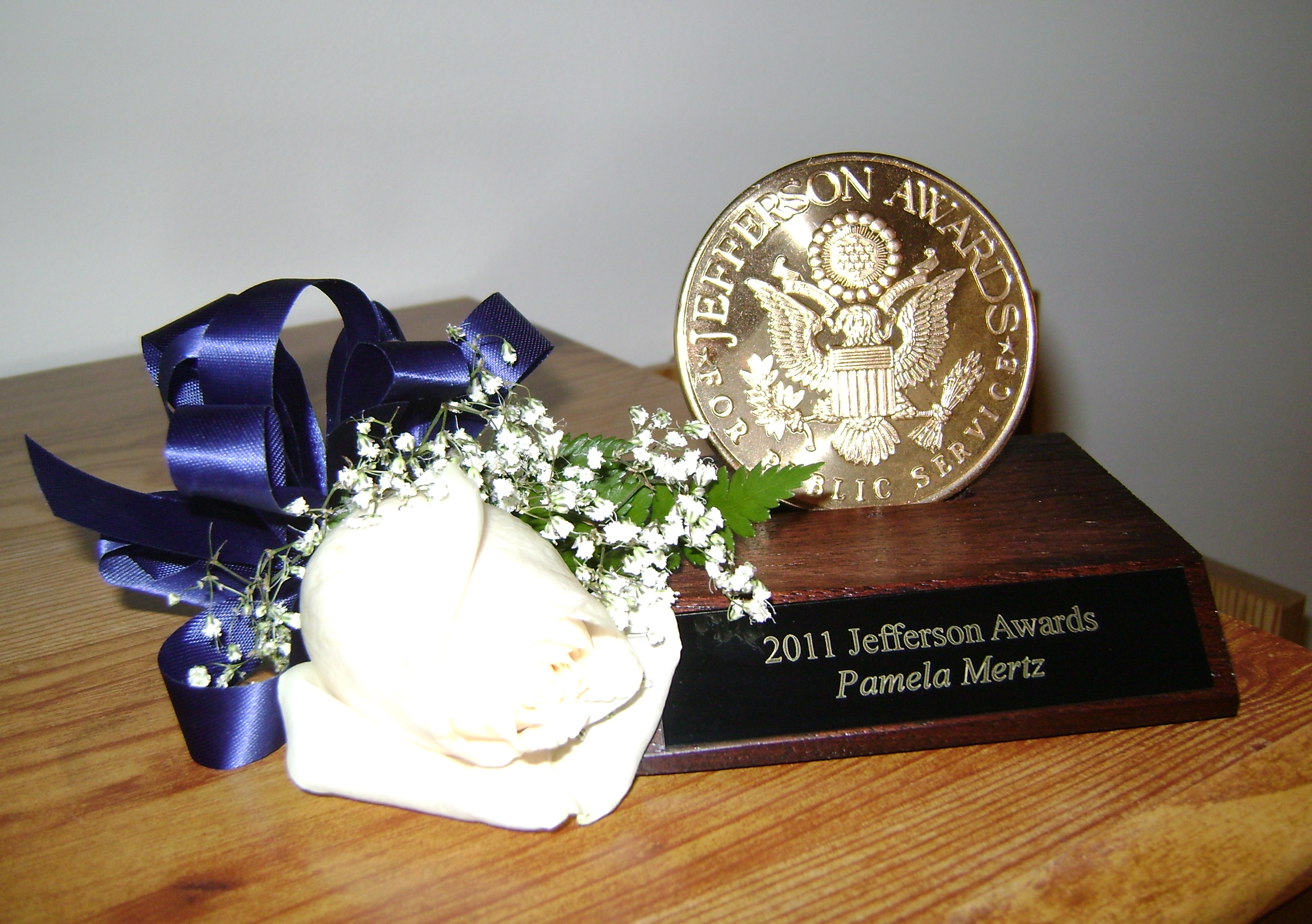 I was a little reluctant to post this information here, but some friends encouraged me to do so. Last Monday, April 4, I was honored at an awards ceremony for the Jefferson Awards. These awards were begun in 1973 in the United States by Jacqueline Kennedy Onassis, U.S. Senator Robert Taft Jr. and Sam Beard.
The Jefferson Awards annually celebrate America’s commitment to public service. Recognizing both the famous and the unknown, individuals and organizations, the young and old, the awards reflect one of the founding ideals of our nation, that of contributing toward the larger good.
In our local area, the focus is on ordinary, non-famous people doing extraordinary things. My sister Kimberly nominated me for work I have done to raise awareness and tolerance of stuttering. She submitted an essay about my visiting schools to talk about bullying prevention, advocating in the media by having articles published and appearances on radio and television, and the podcast I started last year giving women who stutter a space to share their stories.
Of hundreds of nominations, 18 of us were chosen as finalists. I was then notified that I was chosen as one of 7 Jefferson Award Medalists. One of the Medalists was chosen to attend a ceremony in Washington DC in June to represent the Capital Region of NY. That person is a man whose son committed suicide at the age of 18, and his efforts since to raise awareness to schools, teens and parents. I was honored and touched to be part of this elite group of 7. The others were working to improve and raise money for important social causes.
I was chosen as part of that field for bringing a local voice and face to stuttering, and for giving women all over the world an opportunity to share their stories. Thank you to all of the women who have so beautifully and courageously shared your stories. Together, we have showed the world that we do have stories that need to be heard.
Thank you also to my sister for having the courage to nominate me for recognition for something that was always a taboo topic in our family. And thank you to my friends and family who attended the ceremony and cheered me on and made me feel so special.
Thank you to Claudia for immediately forwarding the details to the National Stuttering Association. They have posted this information on their page as well, which made me proud.
And thanks to my friends and listeners who encouraged me to post this here on my main page. They reminded me doing so is not bragging, rather it is inspiring. And the best way for regular readers/listeners to know that this special honor even occurred.
Let It Be
Posted on: April 7, 2011
- In: Posts
- 7 Comments
I found myself responding to someone who was thinking out loud about stuttering. She said, “I just don’t get it.” I mused she probably was referring to, “Why is stuttering so unpredictable?”
The variability and complexity of how we sound, how we feel, how one day it’s one way and the next it is completely different is quite amazing. To me, anyway. There are some who will surely find ways to describe stuttering that does not include the adjective “amazing.”
For a long time, I tried to figure things out – why this, why that, why some people react one way, why others say dumb things, why sometimes I am like an open book, and other times, I find myself with heat on my face and my heart thumping. I stopped trying to figure it out.
It is so much easier to just let things be the way they are going to be. It sounds simplistic. Perhaps it may even seem to minimize the struggle of stuttering for some.
I have an embroidered framed art piece of one of my favorite sayings, “It Is What It Is”. I used to think that even thinking that about stuttering or my reaction was a “cop-out”. Some things are just going to happen and life will go on. I have determined that to be a fact.
No matter how hard I try to analyze or rationalize or convince myself otherwise, some days I am going to stutter a lot and feel tense, and some days I am going to hardly stutter at all.
I think sometimes its harder to just relax and let my natural self be. I had become so used to making excuses, rationalizing, over-thinking, obsessing about everything. It’s what I did, all of the time. That was when I considered myself very covert about my stuttering.
Now, to just relax and be, really BE, sometimes I have to remind myself of just that – that who I am is really OK. Screw everyone else who doesn’t think so.
Yes, this is hard to do in a (perceived) judgmental world, but I guess I just have reached the point where all the needless worrying about how I will sound or what someone will think is just not so important anymore.
Just like the song says, “Let It Be”.
Clowning and Fluent Stuttering
Posted on: March 3, 2011
- In: Posts
- 11 Comments
Today’s post is inspired by new friend Anna, who was featured in the January 2011 edition of the Toastmaster magazine. She was also a featured guest on “Women Who Stutter: Our Stories”, in Facing The Monster – Episode 44.
Anna contributed some great comments on the most recent episode featuring Nina G – Standing Up. Anna notes the importance of “fluent stuttering”, which is a term described by Van Riper in the classic stuttering book, The Treatment of Stuttering.
Someone once told me, “if it’s any consolation, at least your stuttering is easy to listen to”. I remember thinking, “why did she have to add the disclaimer phrase, if it’s any consolation?” To me, it sounded like she was paying me a compliment, but framing it as a negative, as if we are not ever supposed to say something positive about stuttering. Well, Anna de-bunks that and more!
I want to share Anna’s recent comments about “fluent stuttering” and how it can be attained by focusing on “the outside” rather than “the inside”. I like to think of that as quieting our inner self-talk!
Pam,thank you for yet another wonderful pod cast. Nina is another example (one is you) of a person who has something that I call “fluent stuttering”. This means speaking confidently and passionately, without avoidance and fear. The difference with this kind of stuttering from “typical stuttering” – that which can be monotone, deliberate, struggled, or covert speech (I had this too) – is that such fluid stuttering is easy to listen to. In a while you stop noticing the stuttering just as you stop noticing a bit of an accent or some other different speaking pattern.
Speaking openly, expressively, without holding back is a very real goal. I myself aim for total fluency, but if I end up with fluent stuttering instead, I will be just as happy. By the way, I also learned a lot when I enrolled in a clown class – I am not performing on a real stage, but the whole approach to performing – learning how to interact with an audience and feeling confident on stage – is very valuable.
One great thing I learned in clown school is about directing your attention outward. We have lots of exercises to make sure that we focus on the outside rather than staying inside our heads. We, people who stutter, are usually all inside our heads – watching ourselves, anticipating stuttering, trying to figure out listeners’ reaction etc.
Having your attention concentrated on the outside allows you to enter the state of fluency and freedom of fear. The moment you go inside your head (I wonder how I am doing, do they like me?), you get tense and nervous. Nina’s confidence on stage indicates that her attention is out there, she is connected to her audience. This is what makes Nina and others so fluent, despite stuttering. Fluent stuttering sounds strange, but it is a real phenomena and one that everyone can learn how to do.
I just loved Anna’s thoughts and honesty, especially sharing that she took classes at Clown school. How exciting is that? What do you think of Fluent Stuttering? Can you see yourself doing that and being happy with it, as Anna suggests? Let us know your thoughts!
 Make Room For The Stuttering
What people are saying!