Archive for the ‘Posts’ Category
2014 ISAD Conference
Posted on: September 12, 2014
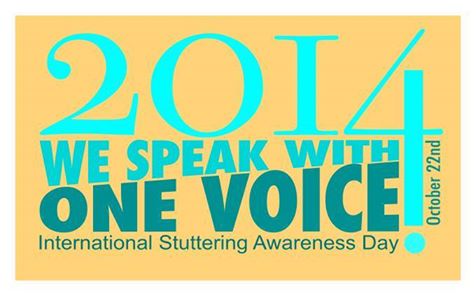 This year’s International Stuttering Awareness Day (ISAD) online conference begins on October 1, 2014 and runs for three weeks through October 22, 2014.
Authors will present papers on a variety of topics relating to stuttering – attitudes and feelings, therapy techniques, research updates and personal experiences.
Presenters are a mix of people from the international stuttering community – people who stutter, family members of people who stutter, clinical therapists and scientific researchers. This is an exciting conference where different voices from all over the world are heard.
This will be a treasure trove of information on stuttering, and you will have the opportunity to interact with the contributors and ask questions of professionals in the field.
Plan to check out the conference and plan to learn a lot. Spread the word!
Reflections Of Us
Posted on: September 2, 2014
What do you think of this? Being around other people who stutter is like seeing a reflection of our self. We see ourselves in other people who stutter.
Maybe when you are around other people who stutter, you think to yourself, “oh, that’s how I sound.” Maybe you’re OK with that. Maybe you are not.
Maybe it makes us feel vulnerable when we’re around other people who stutter.
Other people may remind of us ourselves, both the parts we love and the parts we don’t love quite as much.
I’d love to hear your thoughts on this.
Finishing For Us
Posted on: August 26, 2014
- In: Posts
- 4 Comments
How many times has this happened to you? You’re in a conversation with someone, either someone you know well or someone unfamiliar. You’re going along fine with what you are saying and then it hits – a big block.
You get stuck and nothing comes out. You feel helpless and the moment feels like an hour. Your mouth is open and nothing is happening. Or sound is coming out but not the word.
And then your listener tries to help and finishes the word or sentence for you. Maybe they even got it right.
Or maybe they get it wrong, and say something not even remotely close to what you were actually going to say.
How does this make you feel? What do you do?
When this has happened to me, sometimes I feel angry. Angry that the block has happened in the first place and that someone has seen what I look like when I get stuck. I imagine it looks awful, but I’m sure in reality it doesn’t.
I also might feel angry if the listener has finished my word and they guessed wrong. I do one of two things: finish what I was going to say anyway and move on, or move on and pretend like nothing happened.
I don’t like to do that – pretend nothing happened, because something did. I got stuck in a block and someone reacted to it.
I wish I had the guts to acknowledge my feelings when this happens but I often don’t. I don’t like to draw more attention to my stuttering.
What about you?
The Importance Of Control
Posted on: August 15, 2014
I wrote a post on Loss of Control five years ago! And it still rings true today. I want to share parts of that post in today’s blog post.
Probably one of the most helpless feelings a person can have is that feeling you get when you lose control when speaking. You probably know what I mean.
My stomach feels like its going to bottom out, my chest gets tight, and my heart starts to pound so hard it feels like everyone can hear it. And my face heats up, I feel a lump in my throat and then my eyes start to well up. If the feeling lasts longer than a few seconds, my eyes spill over.
I feel loss of control when I get embarrassed, because these reactions happen automatically and involuntarily. I also feel loss of control when I get angry, or sad. I always felt like I should be able to control my reactions to feelings. Almost all of the same physical reactions occur.
I used to feel I had some control over my stuttering. Fairly early, I began to know which words or sounds I might stutter on, and concentrated on switching words or doing the avoidance thing. That stopped working for me long ago.
I started feeling more in control when I dropped most of the covert stuttering and just let natural stuttering out. Since not fighting so hard to not stutter, I have felt pretty controlled with my easy, relaxed repetitions.
But sometimes my speech is messy. I can’t predict stuttering moments like I used to be able to, and I feel more tension and lack of control.
I often feel helpless, especially when around someone new or who is impatient.
Even though I tell myself I don’t care what others think, I still sometimes feel the sting of judgment and fear rejection.
What do you think? Do you feel out of control when you get really stuck in a stuttering moment? Does this feeling ever go away?
Body Language And Stuttering
Posted on: August 6, 2014
- In: Posts
- Leave a Comment
I just finished reading a great article in my Toastmasters magazine on the importance of body language when speaking, whether to one person or a large group.
As a Toastmaster, I know the importance of body language. It helps us to convey feelings and emotions and shows our level of confidence. People pick up on our non-verbal cues and then often know how to react or respond.
As I read and reflected on body language, it made me wonder how it relates with our stuttering. I posed this question on an online forum for women who stutter and got some good responses.
Several said something similar – standing with pride. Friend Amey writes: “Shoulders back, head up, eye contact. Keeping this posture during stuttering can be liberating. It rips down stereotypes of us being scared and curled up in a ball.”
Amey goes on to say that seeing a proud person who stutters is powerful. It conveys confidence. She says, “Watch me stutter!”
What do you think? Is body language important to keep in mind about our stuttering? Can you feel pride while stuttering?
Building Confidence
Posted on: August 1, 2014
I participated in a great conversation this week about ways to build confidence if you stutter. During a Stutter Social chat, a young person asked how some of us more “seasoned stutterers” deal with the anxiety of stuttering in certain speaking situations.
Some people shared their experiences from speech therapy, some shared from their perspective on acceptance and two of us talked a little about Toastmasters.
The following are some of the ideas that we shared about building confidence. Maybe you’ve tried some of them. Maybe you’ve got a suggestion to add.
- Don’t obsess or rehearse before hand. That increases anxiety and decreases spontaneous conversation.
- Consider advertising and letting listeners know that you are a person who stutters.
- Try using voluntary stuttering to help you gain some control during the speaking situation.
- Seize opportunities to speak, such as Toastmasters clubs or other speaking forums. Practice helps reduce anxiety and build confidence.
- Remind yourself that you have as much right to be in that speaking situation as the next person, that your voice deserves to be heard.
- If someone interrupts you, calmly let them know you’re not finished speaking yet and then proceed to complete your thoughts, no matter how long it takes.
What do you think? Do you have anything to add?
Breathing Is Just Breathing, Right?
Posted on: July 24, 2014
- In: Posts
- 3 Comments
One of the most popular posts on this blog, the one that gets the most visitors, is a post titled Breathe In, Breathe Out, that I wrote on April 15, 2010. I think it’s so popular because people who stutter are often looking for techniques that can help to manage stuttering.
The program that focuses most on breathing is the McGuire program. This program stresses the use of costal breathing, where students are taught diaphragmatic breathing techniques. Graduates of the McGuire method practice breathing techniques daily in order for speaking to sound natural.
When I attended speech therapy a few years ago, one of the techniques that the student clinicians taught us was “full breath.” This was part of traditional fluency shaping therapy.
For me, I always found it difficult to concentrate on my breathing and trying to speak at the same time. Both are automatic, things I do without thinking. I breathe with ease. Sometimes I speak with ease, sometimes I struggle when I speak.
When I block, I can sometimes feel myself run out of air and feel breathless. That can be such a helpless, out-of-control feeling. But I still don’t want to take the time to stop and think about breathing and speaking on a full breath.
To me, breathing is just breathing and shouldn’t require extra, specific thought. I’m curious – what do you think?
Little Moments Are A Big Deal
Posted on: July 8, 2014
- In: Posts
- 4 Comments
 I just returned from the NSA annual conference in Washington DC. This year’s conference had a record number of 975 attendees, one third of whom were first timers.
I met a lot of new people and connected with friends that I really only see once a year.
It was a great experience. I co-facilitated several workshops and attended several that pushed me out of my comfort zone.
The best workshop I was part of was the First Timer’s Orientation. I co-facilitated this with friends Landon and Lott. Over 200 people came to the workshop, where they had the chance to meet and interact with each other. I met some of the people I had called in advance of the conference.
Some of my favorite moments:
16 year old Jeremy came and introduced himself and his parents to me. Jeremy told me that he and his speech therapist have used articles from this blog and some of my YouTube videos in his speech therapy sessions. Jeremy was thrilled to be at his first conference and had set as a goal for himself to speak at an Open Mic session. He came and told me about it afterward and said it was a success and that he felt great.
Rehan, who I corresponded with pre-conference, came up to me and said he was glad I had been so honest in my introduction during the workshop by saying that it can be overwhelming and scary to introduce yourself to strangers. He acknowledged that he was feeling nervous about doing that, as he has never introduced himself to so many people. After the conference, he told me he had met many people and was grateful for the opportunity to stay in touch during the year. He also said in an email:
As per my thoughts … well, wow. It was way beyond my expectations. I didn’t really know what to think going in to it, but when I got there and [tried] to introduce myself only to have people patiently wait for my name, I knew I was in the right place. I was definitely apprehensive about continuing to go up to people and introduce myself, but everybody was just so friendly about it! I stuttered, they stuttered, and it was fine!
Natalie came up to me one of the first evenings and introduced herself to me. We had talked on the phone before the conference and she recognized me from some YouTube videos. Natalie had traveled to the conference alone from Maine and was nervous about what to expect. Here is an excerpt from an email Natalie sent me the day after the conference:
Pam, you are a lovely person and I want to thank-you for all that you did for me at the conference. You may not think it was much, but simply being kind, talking to me when I first got there, inviting me out with you and others, calling me before the conference and just being around really made me feel at ease. You are an asset to the stuttering community.
I also met Rohan, who was one of our keynote speakers. I had the opportunity to speak to him before the conference as well, so it was pretty cool to meet up and talk a bit during the conference and then hear his amazing speech about “making things happen” and “no excuses.”
There were so many other amazing moments, but these are an example of how little moments can easily add up to a really big deal.
Embracing Our Uniqueness
Posted on: June 29, 2014
- In: Posts
- 3 Comments
I’ve been working on a talk I will give at a workshop this week at the annual NSA conference. It’s about being memorable and using what makes us different as an asset.
I’ve talked about this before on this blog – the idea that stuttering makes us memorable. My talk for the workshop centers on the premise that if we have something that makes us stand out, why not use it to our advantage?
Stuttering is unique. It applies to only 1% of the population. It makes us different. We stand out because of it. Is that a bad thing?
I remember when my sister told me about six years ago that she was jealous that I stuttered and she didn’t. I had to really wrap my brain around that at the time.
But it makes sense. In today’s world, we need to be remembered in order to get ahead.
Why not use what makes us unique? What do you think?
Pay Attention To Shame
Posted on: June 23, 2014
- In: Posts
- 3 Comments
Last night in a Stutter Social hangout, a small group talked about shame and fear, and how both can still have a grip on us as adults who stutter. While stuttering may get easier as we mature, those pesky feelings can hold on and do a real number on us.
We were talking about the times when we as adults get laughed at or someone makes a joke about our stuttering. Three of us were participating in this discussion, and we all had examples of when this has happened.
One guy mentioned that when this happens, he feels like punching the person who is so insensitive. He gets all tight and angry, but doesn’t actually act on the desire to lash out. He said he actually doesn’t do anything but feels vulnerable and ashamed.
I mentioned that I sometimes feel ashamed as well, when someone laughs or teases and I don’t do anything, for fear of drawing more attention to the matter.
We discussed how it’s important to pay attention to this shame.
When we feel shame, it’s usually a sign that we need to do something – take action – to rid ourselves of the shameful feelings.
I shared that when someone laughed at my stuttering recently and made a joke, I let it bother me for a few days. Then I decided to email her and let her know it bothered me. She apologized and explained she was unaware she had made me feel uncomfortable. I felt better after doing something and not just letting the feelings eat at me.
What do you think? Do feelings of shame ever creep in? What can you do to lessen those feelings?
From A Kid’s Perspective
Posted on: May 30, 2014
- In: Posts
- 5 Comments
I had the wonderful opportunity two weeks ago to speak to 9th graders about my stuttering and how it has impacted my career. I really should say that I “took” the opportunity to speak about stuttering.
You see, I was invited to speak to the students about my career as part of their annual Career Day. Since it was on May 15th and during National Stuttering Awareness Week, I felt I needed to weave my stuttering story into my talk. I find I can no longer talk about my career without also talking about stuttering.
I took a pretty big leap of faith that this would be OK and I faced stiff competition. The students were also going to be hearing from people who do cool things with science and who get to design video games for a living. One guy even brought a robot.
But I decided to talk about how my career has changed over the years and how being open about my stuttering has helped make me memorable.
Yep! I talked about being memorable and used stuttering as an example. I reminded the kids that we all have “something” – mine just happens to be stuttering. Being successful includes shifting whatever the something is that we maybe don’t like and turning it into an asset. I shared how that mindset shift has helped me come to terms with my stuttering and “use” it in a way that people will remember.
It’s important in job interviews to “stand out from the crowd” in some way. I have done that by openly disclosing that I stutter and by openly stuttering.
The kids were great. I had to do my presentation 6 times to 6 different groups, so I was tired by day’s end, but the kids were engaging and asked lots of good questions. They were curious about stuttering. Some mentioned that they have a sibling or cousin who stutters. Their questions were thoughtful.
One girl came up to me after class and told me that she has a brother who stutters and she was very glad I had come in to talk to their class. She gave me a hug.
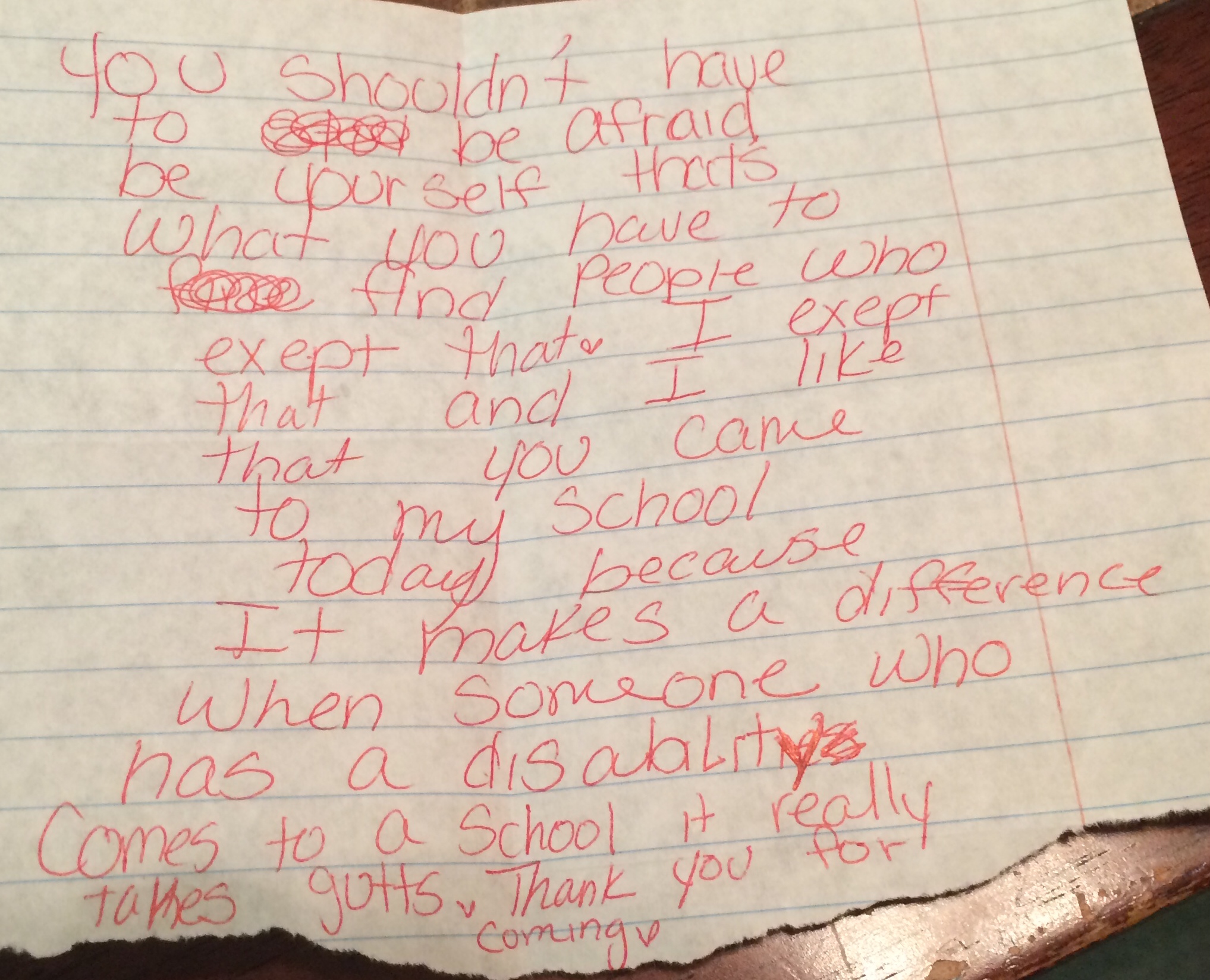
Another girl came up to me in a different class and gave me the below note. It brought tears to my eyes. I definitely believe I made the right decision to talk about stuttering that day. Any time you can go and talk to kids about stuttering, differences, tolerance and respect, do it. It makes a difference.
2014 Stuttering Awareness Week
Posted on: May 12, 2014
This week marks National Stuttering Awareness Week. It is an opportunity for the 1% of the population that stutters to raise awareness and educate the 99% of the population that doesn’t stutter.
We get to let people know how unique we are and that stuttering is just a different way of communicating.
To me, it’s very important that we approach stuttering awareness from a positive perspective. Note that I said that we get to let people know how unique we are.
It’s easier to bring up stuttering in a positive way, instead of introducing it as a disorder, which immediately implies something negative.
This week, I have been asked to be a speaker at a Career Day at a local high school. I will be talking about my career, how I got here, educational and experience requirements. I’ve decided I am also going to talk about stuttering during my presentation, which I will give 5 times, to 5 different classes.
On reflection, I felt that I couldn’t talk about my career without also talking about stuttering. And it perfectly worked out that the presentation is scheduled this week, right smack in the middle of National Stuttering Awareness Week.
I’ll be honest and admit that I’m a little nervous about talking about stuttering in my talk on Career Day. I am worried about how it will be received and whether the high school kids will be interested. But I’ve committed to it and have begun incorporating bits of my personal story into my career presentation.
I am going to trust myself that my talks will go well and that I will educate kids on a new experience.
What will you do to mark National Stuttering Awareness Week?
I recently read Ellen-Marie Silverman’s book Mindfulness & Stuttering: Using Eastern Strategies to Speak with Greater Ease. To put it simply, this is a book about change. A good book about change!
Silverman introduces how mindfulness can help us reduce the fear we associate with stuttering (or always have.) Reducing the fear of stuttering allows us to speak with less struggle, even if we stutter as we speak.
Silverman offers a clear and simple definition of mindfulness. She offers that mindfulness is a process of attending calmly, without judgement, to what we are thinking, feeling and doing in the moment.
“The more mindful we become by attending to what is rather than anticipating what might be or regretting what was, the more capable we are of creating the change we want.” In the case of stuttering, that change is to speak with less struggle, less tension and, as the title of the book suggests, with greater ease.
Silverman reminds us repeatedly, through this easy-to-read book, that mindfulness is a process that requires practice and dedication, even if it is only for a short period of time. I liked learning that I could practice mindfulness even for only 5 minutes at a time.
Mindfulness helps change how we think about stuttering, if we allow ourselves to be present in the moments of stuttering. For me, being present in the moment of stuttering was always difficult. In my very covert days, I was constantly worrying about what the listener might think of me. I also found that I wasn’t listening to my communication partner because I was rehearsing what I was going to say next. I wasn’t paying attention. I clearly wasn’t mindful.
Being present with our stuttering is the key to how mindfulness can help us change our stuttering. We can change how we react to our stuttering and become kinder and gentler with ourselves. When we practice mindfulness, our stuttering becomes easier, which is the goal.
Mindfulness is a process that can be learned. With dedicated practice, mindfulness can help us make changes in our lives and make our stuttering easier.
Making stuttering easier with a practice that can be done anytime, anywhere, is definitely worth exploring.
I recommend readers get Ellen-Marie Silverman’s book and learn about a way to manage stuttering that can last a lifetime.
The Truth About Stutterers
Posted on: April 11, 2014
- In: Posts
- Leave a Comment
Check out this great article (by Susan Scutti) that appeared yesterday in Medical Daily, titled “The Truth About Stutterers: Can Everyone Who Stammers Overcome The Condition?” I’m quoted toward the end of the article!!
What afflicts four times as many males as females while affecting roughly three million Americans overall? Stuttering. Among the five percent of children who stammer for six months or more during early childhood, the majority naturally outgrow this communication disorder while others continue to struggle with this problem long term. A person is considered a stutterer when their fluency or flow of speech is broken by repetition (ma-ma-ma-maybe), prolongations (ffffor real), or unusual stops in the middle of a phrase or sentence when no sound is produced at all. In the struggle to communicate, some people may make odd faces or move their bodies in a strange way.
Experts believe genetics may contribute to the condition since nearly 60 percent of those who stammer have a family member who does as well. Children with a developmental delay or some other kind of language learning problem are also more likely to stutter. Other more subtle issues may also contribute to the development of this communication disorder. Recent neurological research, for instance, has revealed that the brains of people who stutter may be wired slightly differently and for this reason they may have trouble planning speech. Some believe that family dynamics may impact a child’s ability to communicate fluently yet, according to the Stuttering Foundation, those who stutter are no more likely to have psychological or emotional problems than those who do not. One recent study found that stuttering preschoolers did not have innately different temperaments than those who did not stutter. Emotional trauma, then, should not be considered a root cause of stuttering.
According to speech experts, the best prevention is early intervention yet as the story of the English king, George VI, which was dramatized in the movie, The King’s Speech, even late treatment can be a life-changer — the king was in his 40s when he met the famous speech therapist, Lionel Logue.
A beautiful story well-worth repeating is that of the voice of Darth Vader, otherwise known as James Earl Jones. Few people know that Jones was once a stutterer and from early childhood through high school, he found it difficult to speak. Yet he calls one man, the poet Donald Crouch, “the father of my voice.” A former college Professor and contemporary of Robert Frost who retired to a farm near the Michigan town where Jones lived, he discovered there was a need for educators in the area so he decided to teach at the nearby agricultural high school.
Within his classes, Jones often remained as silent as possible until the day Crouch discovered his student liked to write poems. “One day I showed him a poem I had written,” Jones wrote in an article about his teacher, “and he responded to it by saying that it was too good to be my own work, that I must have copied it from someone.” To prove his authorship, Jones recited the poem in front of the entire class and somehow made it through to the end without forgetting a word … and also without stuttering. With Croach’s help, Jones continued to practice speaking aloud and over time his confidence grew.
Just because some people, famous or not, have improved their abilities, is learning how not to stutter truly within everyone’s reach? Unfortunately, not. A review of more than 100 studies on adults concluded that 60 to 80 percent of all cases show significant improvement as a result of treatment. “My only regret on my long journey is that I courted that fickle mistress called fluency for too long instead of simply searching for a voice with which I was comfortable,” wrote Vince Vawter, 67, a lifelong stutterer and writer. Acceptance, rather than change, is key for many. “To be honest, there is still a small part of me that has not accepted my stutter – that is trying to fight the stutter,” wrote Dhruv Gupta. “And if I stutter at all today, it is because of that part.”
“Dealing with our stuttering, managing it and eventually thriving in spite of it, necessitates speaking about it openly and honestly,” wrote Hanan Hurwitz, who learned that encouragement from others mattered more than figuring out which treatment worked best. “In a world that still largely does not understand stuttering or the experience of the person who stutters, the safe environment of a support group is a lifeline.”
Although support was key to others, they found it lacking in the ready-made groups. “I felt uncomfortable when I attended stuttering support groups where I was the only woman, or one of only two women in a group dominated by men,” wrote Pamela Mertz for the International Stuttering Awareness website. “I often felt that the men were focusing on finding fluency, or trying techniques, or looking for a solution, where I was more interested in talking about how I felt. Talking about how it felt to feel less attractive, talking about how my self-esteem had been affected, talking about my confidence being eroded, talking about how it felt to try and hide my stuttering for so long and slowly coming to terms that trying to hide it wasn’t working anymore.” In search of a women-only group, Mertz went on to host a podcast catering to women wanting to share their stories.
For more real life people discussing this problem, watch the YouTube video below:
 Make Room For The Stuttering
What people are saying!