Author Archive
The Disability Question
Posted on: October 14, 2015
- In: Posts
- 2 Comments
The International Stuttering Awareness Day (ISAD) online conference is going on right now and can be found here.
I have a paper in the conference this year addressing the issue of whether stuttering is viewed as a disability. And who gets to make that call, the individual affected by stuttering or society?
I relate some of my experiences with talking with high school students who noted my stuttering as a disability even though I had never articulated it as a disability myself. I find it interesting that I’ve also had a boss who referred to me as having a disability when I don’t really consider myself disabled.
However, I have “ticked off” the disability box on applications and questionnaires because technically, stuttering is covered by the Americans With Disabilities (ADA) Act of 1998 and 2010.
I would love your thoughts on The Disability Question.
What do you think? Do you consider stuttering a disability? Who gets to make that determination?
It’s All About The Kids
Posted on: October 9, 2015
- In: Posts
- 3 Comments
I just recently returned from a trip to the west coast, that included a weekend in Tempe, Arizona for the 2nd Annual National Stuttering Association Regional Fall Conference.
The regional conferences are similar to the national conferences except that they are on a much smaller scale. 104 people attended this event in Arizona, making it a very intimate gathering where you actually got to know and talk with one another.
There was a mix of adults who stutter, parents, kids and teens and some SLPs. I had a great experience at the workshops, which focused on communicating with ease, managing anger and successful speech management. There was also a great Open Mic session where people told very personal, inspiring stories.
But the best part for me was seeing young people embrace the experience and totally blossom in the presence of other people who stutter. That almost always happens at stuttering conferences but it was magnified this time since it was such a small group.
Young people like Aiden, Diego and Regan felt comfortable to get up and speak to the whole group several times and they shared such pearls of wisdom. They talked about it being OK to stutter, that if you stutter, you’re not alone and that together, we are strong. These are mottoes of the NSA, but to hear them come out of the mouths of babes, so confidently and convincingly, was so inspiring.
Young people who stutter today are fortunate to interact with adults who stutter and vice versa. We adults got so much out of the kid’s confidence and were reminded that if they can speak up and advocate for themselves, then we certainly can too.
Young Regan, 11 years old, really impressed me. She has the self-assurance and sense of humor of a much older teen and clearly feels comfortable in her skin. Her mom was thrilled that they were able to attend their first conference. I fully expect Regan to one day be in a leadership position for the NSA. The kids are our future and it seems like we’ll be in great hands.
Delving Deeply – Episode 147
Posted on: September 29, 2015
 Episode 147 features Mona Maali, who hails from Austin Texas. Mona was the chapter leader of the Austin National Stuttering Association (NSA) chapter for four years, and was named the NSA Adult Chapter Leader of the Year in 2010. Presently, Mona is a bookseller at an independent book store in Austin.
Mona also compiled, edited and published a book called Turning Points, which features the stories of many people from the Austin NSA chapter.
Listen in as we discuss parts of Mona’s story, where she honestly and courageously shares her journey both with stuttering and ADHD. She has lived with ADHD as long as she has with stuttering and both have had a profound impact on her life.
We discuss whether Mona thinks there is a connection between stuttering and ADHD. Mona shares that both disorders are highly stigmatized and often the individual is “blamed for” having the disorder. Mona didn’t receive help for either stuttering or ADHD while growing up.
The second half of our conversation focuses on how the book, Turning Points, came to be. It was a two year process of gathering other people’s stories and at the same time overcoming and delving deeply into Mona’s own personal journey.
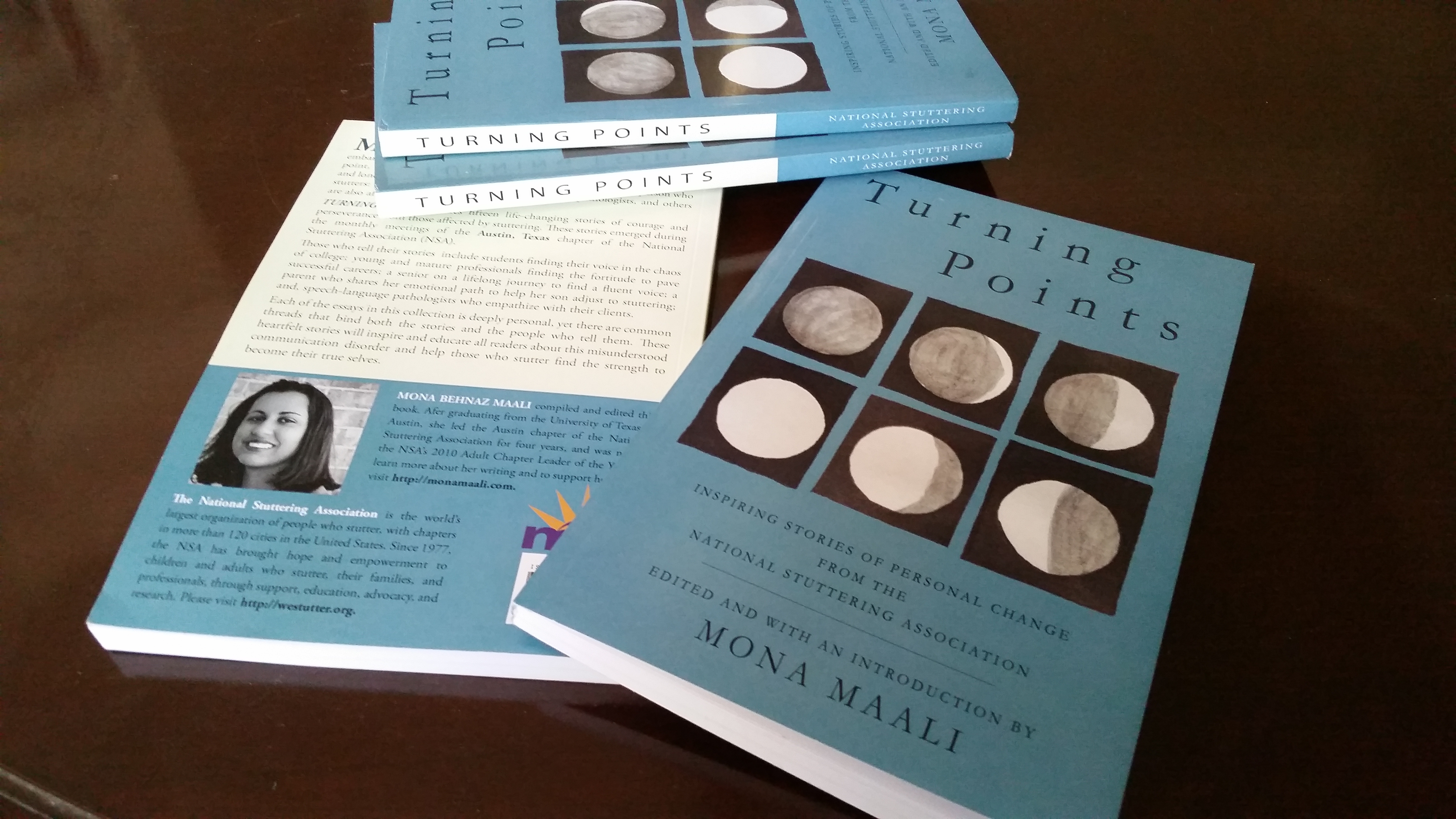 Mona shares quite eloquently why she didn’t include her own story, and how she feels very hopeful to have published a book. She is very pleased with how it turned out. You can purchase the book at Amazon or at the NSA online store.
Today’s music is credited to ccMixter.
ISAD 2015 Coming Soon
Posted on: September 24, 2015
- In: Posts
- Leave a Comment
 Every year, International Stuttering Awareness Day (ISAD) is marked on October 22. It is a day when people who stutter all over the world participate in events and activities that raise awareness about stuttering and educate the non-stuttering public.
The International Stuttering Association also sponsors an annual online conference. From October 1 through October 22, a variety of presentations are available for people to read, watch or listen to, all with the goal of learning more about stuttering.
Both people who stutter and speech professionals contribute papers, audio and video that conference attendees can participate in and engage with the author. There is a discussion option where people can leave comments with the authors and get feedback or questions answered.
There is also an “Ask The Expert” section of the conference where speech professionals volunteer their time to respond to specific questions asked by anyone in the stuttering community or general public.
It is always a great conference, with enlightening topics from people who stutter themselves and professionals.
Don’t miss it! There’s something for everyone. The conference starts next week, Thursday October 1, 2015. I will have a paper in the conference this year. I hope you visit, read and leave your feedback.
Episode 146 has been removed from the podcast line-up on September 26, 2017, at the request of the guest.
This has been the case with several other women over the past years. When people are job searching, they don’t want to be “Googled” by an employer and found to be associated with stuttering.
That is the case with the guest that was on this episode. She doesn’t want to be “outed” by the internet as a person who stutters.
That is certainly understandable in a world that still discriminates against stuttering and where workplace outcomes are not always favorable for people who stutter.
I’m hopeful that this will change, though the efforts of stuttering advocacy associations such as the National Stuttering Association and the International Stuttering Association.
Using Speech Techniques
Posted on: August 27, 2015
- In: Posts
- Leave a Comment
I am not a fan of using fluency shaping techniques. When I participated in speech therapy about 6 years ago, I was really resistant to the traditional techniques that would theoretically make my speech more fluent. I felt like the therapist was trying to “fix me” and I didn’t need fixing, then or now.
But lately, I have been feeling quite self-conscious when answering the phone at work and stuttering on the same word, every time. I’ve been helping to answer the phones more over these summer months because we are short staffed and we all pitch in to help.
When we answer the phone, we state the name of our school building so that the caller knows they have reached the right building. It’s a three word name, and I always stutter on the third word. Every single time. And it’s been bothering me that I stutter like that identifying our school name.
I can’t quite identify why it’s making me feel uncomfortable, because if I stutter later in the conversation, it doesn’t really bother me. It must just be something about those introductory words that I want to be able to say smoothly and confidently. Maybe it doesn’t feel confident to stutter on the same word every time.
So, I’ve been using a prolongation technique on the first letter of the third word, so I can slide into it without repeating the letter/sound. It’s working, as long as I concentrate and remember to do it. I am not feeling as self-conscious when answering the phone.
What I am feeling like is a little bit of a hypocrite. I have not wanted to use fluency techniques because I am comfortable with myself as a stutterer. But here I am, feeling uncomfortable and resorting to a technique.
Hopefully, I’ll get over this quick. Have you ever experienced conflicted emotions about using fluency techniques?
What We Want Everyone To Know
Posted on: August 21, 2015
- In: Posts
- Leave a Comment
The Mighty did a nice piece, in conjunction with the National Stuttering Association (NSA,) on truths people who stutter want people who don’t stutter to know.
The NSA asked the question on their Facebook page and asked people to respond. The Mighty used those quotes in the piece they wrote up. They even created graphics and attributed the quotes to the people, like me, who responded.
Check out the piece here – Eight Truths People Who Stutter Wish Everyone Understood. They did a great job!
This Is Me – Episode 145
Posted on: August 11, 2015
Episode 145 features Bernice Gauci, who hails from the tiny Southern European island country of Malta. It is underneath Sicily, Italy.
Bernice is 24 years old and is a mental health nurse also studying for her Master’s degree in Family Studies. She is president of the newly formed Stuttering Association of Malta (SAM.)
Listen is as we discuss workplace stuttering and being open with colleagues. We also discuss how Bernice has reached her level of acceptance of stuttering. Her mom introduced her to a speech therapist who challenged her to think of stuttering as a gift. In fact, Bernice did a news interview on stuttering after the launch of SAM, where Bernice talks about how stuttering is indeed a gift. You can read this article here.
We also discuss the recent IFA Congress in Lisbon, Portugal, which Bernice attended. She talks about how she felt she was in a society for people who stutter, where she could just “stutter along.”
And we talk about the Stuttering Association of Malta, whose goals include having kid’s days and reaching out to parents. Bernice hopes that SAM will get more media coverage so that awareness of stuttering can be increased in Malta.
The podcast safe music used in today’s episode is credited to ccMixter. Feel free to leave comments or ask questions, for feedback is a gift.
Building Empathy In New Ways
Posted on: August 7, 2015
- In: Video
- Leave a Comment
A friend from the National Stuttering Association and Stutter Social, David Resnick, recently gave a great TEDx Talk on using technology to build empathetic resonance. I’ll let him explain in his talk exactly what that is.
I was thrilled to see another TED Talk where someone openly stutters and still communicates beautifully and effectively. Of course, my thrill was enhanced by the fact that I know David!
And it was great to see Stutter Social featured and explained. I have been a Stutter Social host for two years now and I love it. The sense of community from a virtual stuttering support group certainly does build empathy.
Enjoy David’s talk! It’s great!
Avoidance Spill Over
Posted on: August 6, 2015
People who stutter tend to be very good at avoiding. We avoid speaking situations in which we fear we’ll stutter. We avoid certain words and switch to words we can say without stuttering.
For a long time, as I’ve written before, I was extremely covert and avoided situations where I’d be vulnerable and exposed as a person who stutters. I always had the fear of being negatively perceived or judged or labeled.
As I’ve gotten older, I find that I don’t care as much about my stuttering and am largely open about it. I stutter openly, without apology, and feel I am living a much more authentic life, at least as far as stuttering goes.
But what I’ve found is that avoidance has seeped over into other parts of my life. I’m sure many of you have found this as well. How could it not? Practicing stuttering avoidance for many years becomes such a strong habit that it almost seems to become default behavior.
What am I talking about? Well, I find that I avoid difficult conversations. I avoid conflict. I sometimes avoid change. I sometimes avoid making decisions. I sometimes avoid being too assertive at work, for fear of rocking the boat and being perceived or judged negatively, much like when I was covert and avoiding stuttering.
I’d like to say that I have transcended all of this now that I am overt with my stuttering but I can’t. I keep noticing pockets of avoidance that I am positive relates to my stuttering. This is something that I am continually working on. I am mindful of when I seem to be avoiding something big and acknowledge that it’s happening.
Acknowledging avoidance is only half of the battle. The other half of the battle requires action and courage. I’m working on both. How about you?
Episode 144 features return guest Briana Pipkin who hails from Dallas, Texas. Briana is 24 years old, and is looking to transition in her work to become a classroom teaching assistant. She had been a speech therapist assistant but really wants to be in a classroom setting.
Briana was on the show three years ago and wanted to come back on so she could stutter more openly, something she’s been working on over the last several years.
Listen in as we talk about interview preparation, covert stuttering and advertising stuttering. This episode focuses a lot on the recent conference of the National Stuttering Association, and about an advertising workshop that Briana attended.
We also talk about work, feared stuttering situations and transitioning from covert to overt stuttering.
The podcast safe music used in this episode is credited to ccMixter. Feel free to leave comments or ask questions, for feedback is a gift.
Don’t Ever Give Up – Episode 143
Posted on: July 23, 2015
Episode 143 features Samantha Temme-Raberding, who hails from Toledo, Ohio, where she lives with her husband and one “fur-child.” Samantha is a SLP, currently working in a skilled nursing home.
Listen in as Samantha shares how she chose her profession and acknowledges that she considered careers that would require the least amount of communication. Samantha also discusses her years of avoidance and the anxieties and fears that had to be later undone.
The majority of this episode focuses on Samantha’s journey toward becoming a SLP and the lack of support and even negativity she faced in graduate school because she stutters. She chose speech pathology because she thought she’d be more accepted than other careers, but found that not to be the case.
Samantha shares that it was “highly suggested” that she participate in intensive therapy while in grad school, which interfered with her clinical work. Comments were made to her such as, “It’s a shame this career requires so much talking. Have you ever thought of going the research route?”
She was also told that her disfluency would take away time needed to spend with clients, and that she ranked in the top 5 of most severe stutterers a professor had ever heard.
Samantha’s story of perseverance is compelling and inspiring. She wants to shout out Marilee Fini who was an amazing mentor and support through her grad school experience.
The podcast safe music used in this episode is credited to ccMixter.
 Make Room For The Stuttering
What people are saying!