Posts Tagged ‘stuttering’
Being Curious – Episode 196
Posted on: March 5, 2019
 Episode 196 features Yuka Fukuoka who hails from Tokyo, Japan and presently resides in NYC in the United States. Yuka is a professional designer by day and on weekends she works on app development to benefit people who stutter and increase awareness of stuttering for people who don’t.
Listen in to this great conversation and hear what Yuka is up to. While in Japan, she worked on a “wearable device” that allows fluent people to experience what it actually feels like to stutter. And here in the USA, she is developing a prototype app for people who stutter to practice speaking situations that also create anxiety for stutterers.
We talk about workplace stuttering, preparing for job interviews, whether to disclose stuttering or not, and using your stuttering as a strength. We also discuss the importance of changing mindsets about stuttering and breaking down biases.
Finally, we give a shout out to SMBC, a financial powerhouse with a location in NYC, who offered mock interviews to people who stutter. High level managers served as interviewers and talked about how helpful it was to openly talk about stuttering at work. Yuka attended this event and found it extremely helpful.
The music used in today’s episode is credited to ccMixter.
- In: Posts
- Leave a Comment
I have been reflecting a lot on the value of being authentic in all of my places. I have been reading and boning up on being courageous at work.
I came across this great Forbes article called The Importance of Being Courageously Vulnerable at Work.
The author, Patrick Williams, a leadership coach, asks, “Is there a gap between who you say you are and how you reveal yourself in the world of work?”
We all have things we hide due to shame, embarrassment, guilt or even unexpressed dreams we may have given up on, and we often put those in our shadow. Williams challenges us to acknowledge and own your (shadow) or it will own you.
This really resonated with me. I try to be authentic at work, as I truly believe it invites others to do so as well and then stronger relationships are forged.
I have been actively involved in the National Stuttering Association for about 12 years now. I am proud to share that a workplace advocacy initiative that I’ve been championing for over a year has launched. We Stutter @ Work is ambitious, new and requires that people who stutter be willing to be open and stutter nakedly at work.
I do that. I stutter openly and nakedly at work. It’s OK. People are listening to what I say and not how I say it. Occasionally I might get unsupportive remarks or reactions when I stutter on the phone. I usually say something, like “Oh, I stutter. No biggie, right?” I don’t apologize. I used to, years ago. I never do today. There’s nothing to apologize for.
The workplace is no longer the 9 to 5 we used to view it as. It’s at least one-third of our daily life. We are “human beings”, not “human doings.” More of our “being” needs to be present in the workplace, and we should encourage others to do so as well. It makes workplaces better, stronger and helps people feel like they belong. Right?
What do you think? Have you had any experiences where you’ve been courageously vulnerable at work? How did it make you feel? Do you and can you stutter openly at work?
Stuttering Reset – Episode 195
Posted on: February 12, 2019
Episode 195 features return guest Aileen Quattlander, who is presently living in Washington, DC. Aileen was a guest way back in 2010, when she was a senior in high school and looking forward to heading off to college the next year. It was such fun catching up with Aileen and hearing her perspectives on where her life has gone since she was 17.
Aileen works in accounting in a real estate investment firm. She enjoys being a part of the stuttering community she has found with the DC Chapter of the NSA. She started out in the stuttering community with FRIENDS and now enjoys being part of and contributing to both life changing organizations.
Listen in as we discuss how important it has been for Aileen to seize opportunities and not let stuttering limit her the way she felt it did when younger. As an adult, she really wanted to do a reset on how much stuttering had impacted a lot of her decisions.
We talk about disclosure, handling negative reactions from listeners, and stuttering in the workplace. Aileen talks about job interviews and what she learned from being asked to lead a new hire orientation training at work.
We wrap up talking about how being vulnerable really invites others to share more about themselves, thus building meaningful relationships.
I loved this conversation with Aileen. It was so meaningful to catch up with someone who greatly inspired me when I first met her and continues to do so today with her courageous vulnerability.
Episode 194 features Adrienne who hails from San Jose, California. Adrienne is a 4th grade teacher who loves traveling, karaoke and yoga.
Adrienne discovered her passion for teaching after having some amazing experiences all over the world. She has taught English in Jordan, Spain and Korea. Empowered by her success, Adrienne enrolled in a graduate program to earn her Master’s degree in education.
Stuttering was challenging for Adrienne in grad school and she says that a one year program took three years to complete. She talks about the misunderstandings and bias she discovered that exist about stuttering.
Listen in as we discuss disclosure, securing accommodations in college and her first experience at a NSA conference. Adrienne plans to attend her second conference this year and wants to help out with first timers.
The music used in today’s episode is credited to DanoSongs.
New Days To Make A Difference
Posted on: December 31, 2018
- In: Posts
- Leave a Comment
The last day of the year offers an opportunity to reflect on where we have been and where we are going. It’s a chance to leave behind that which made us unhappy and focus on the good we can do and what will make us happy with all the new days we have coming with the new year.
If you have never thought of this in regards to your stuttering, I challenge you to do so. We have a whole new year, 365 days with which we can have a good relationship with our stuttering and pay that forward to others who stutter. Especially those who may not be far along on their own journey.
Quite a few years ago, I realized that I can use my stuttering for a purpose. I am comfortable enough with my own stuttering that I can share my experiences with others. I can show that stuttering does not have to define us and it can in fact be seen as the part of our whole that makes us unique and special.
For years, I did not believe that anything about me was unique and special. I hated myself and therefore had a very poor self-image. A lot of that was reinforced by messages that I had received, and not just about stuttering. Society just did not show much love to fat girls with bad skin who also talked funny.
But now I am at a point in my life where I am comfortable in my own skin and see those things about myself that make me special. It’s important now that I share that with others who might not be there yet.
A whole new year awaits for me to make a difference. I am excited with the opportunities that await to inspire change and make a difference for someone, or maybe more than just one person.
You can too. Find a way to get involved in the stuttering community. Share your story, help with a project with your local stuttering support group, dare to do something that you thought you couldn’t because of your stuttering. You can make a difference.
Peace Of Mind – Male Episode 26
Posted on: November 27, 2018
 Episode 26 of this occasional male series features Andy Fitzenrider who hails from Seattle, Washington. Andy has worked for eighteen years in the Identification Unit of the Seattle Police Department.
Listen in as Andy shares about some of his speech therapy experiences and why he was drawn to engage in therapy as an adult. He talks about “wishing he knew back then what he knows now.”
We also talk extensively about a program that Andy uses and has done outreach for called Speech to Speech. This is a service that anyone with a speech disorder can use. A live “Communication Assistant” answers your call and you let the person know where you wish to call. The assistant will stay on the line with you and repeat as much or as little of your speech as you would like to the person you are calling. The assistant may explain at the call onset that you are a person who stutters and then not say anything else, if that’s all you want or need.
Andy says this service has brought him peace of mind and has helped him to not fear the phone as he once did. The service is free for anyone to use and any carrier will work. See below video for more information.
Music used in today’s episode is credited to DanoSongs.
Hidden In Plain Sight
Posted on: November 20, 2018
- In: Posts
- Leave a Comment
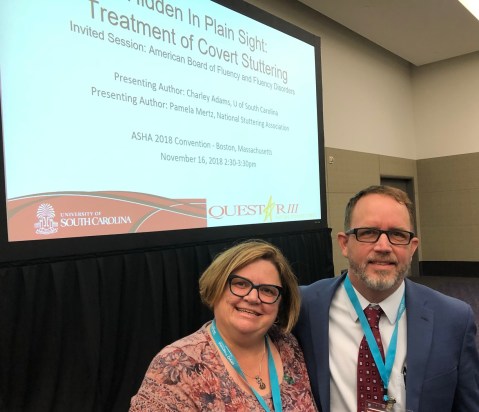
I participated in the conference of a lifetime this weekend. I was so lucky to have been able to attend the 2018 ASHA National Convention held in Boston, MA. I was an invited speaker of the American Board of Fluency and Fluency Disorders along with good friend and guardian angel, Charley Adams, PhD, CCC-SLP from South Carolina. Together, we delivered a presentation called “Hidden in Plain Sight: Treatment for Covert Stuttering.”
We both felt it was extremely important that we talk to current and future SLPs about the importance of “treating the right thing” when it comes to working with people who covertly stutter. Because for covert stutterers, it’s not the possible stuttered word that is the problem. It is the complex layers of shame, guilt, paralysis, and fraudulent identity that must be peeled away and processed that is the the real problem and challenge.
Charley and I only had one hour to convey a whole lot of information to an audience mixed with eager, young graduate students and established clinicians and researchers in the field. We chose to tag team and alternate anecdotal story telling with clinical strategy suggestions. It worked. I must say we were engaging, funny and drove our points home.
I talked extensively about how covert stuttering robbed me of my personality and I knew it, but like the Stockholm Syndrome, I stayed in that bad place for thirty years. I shared details about “pretend Pam” and what it was like when “real Pam” finally emerged. At one point, I said something like, “real Pam stutters openly now with little shame and she’s a damn good communicator.” At that, the audience rose to their feet and gave a standing ovation. I got choked up and felt my heart swell. It was such a proud moment.
I had doubt that I actually would be able to get to Boston and deliver my part of the presentation. I have not felt well for many weeks and I actually took a month of sick leave off from work, something I have never done. But getting to this convention was immensely important to me and I decided to be upfront, share my situation and ask for help. Charley was there for me, every step of the way, as were others.
The ASHA Convention was the largest I have ever attended. It was intimidating and overwhelming to be among so many people. It was reported that this convention had the most attendees ever – over 18, 000. With few exceptions, everyone was a professional in the fields of speech and hearing. Everyone had impressive letters after their names and I didn’t. But I’m indeed an expert on my stuttering and that’s one of the key messages that I really wanted to convey to the audience.
It’s important to listen and respect the lived experience of people who stutter and don’t assume that professionals have all the answers. It doesn’t always work that way.
Chasing After – Episode 193
Posted on: November 12, 2018
Episode 193 features Hannah Dunn, who hails from San Antonio, Texas. Hannah works as a Senior Lead Supervisor at Marriott Reservations Center, which is a call center. It is so inspiring to chat with someone who stutters who intentionally works at a call center answering phones all day and likes it and is good at it.
Hannah is very interested in getting the National Stuttering Association San Antonio Chapter back up and running to a thriving level. After attending her first NSA Conference this past July in Chicago, Hannah feels empowered and confident to lead the chapter back to greatness.
Listen in as we chat about self advocacy, proving to others that “she can” when she’s been told that “she can’t” and how she doesn’t run away from things, but rather chases after them.
Hannah talks about how wonderful it was to meet in person people she had only met online. She gives shout outs to Steven Kaufman, the girls from the San Diego Chapter who had a room adjoining hers and Doug Scott, who introduced her to Rosie Brown before the conference so she had a connection and got questions answered.
It was so much fun chatting with Hannah and getting to know her. We’re going to see big things from Hannah over the years.
Music used in today’s episode is credited to Bensound.
Episode 192 features 19 year old Grace McMahon who hails from Long Island, New York. Grace attends SUNY Geneseo in beautiful western New York. She is a sophomore studying psychology with the hopes of one day being a therapist or counselor.
I loved having Grace on today’s episode. I met her at my first FRIENDS conference back in 2008 when Gracie was 9 years old and it turns out that conference was Grace and her mom’s first one too. I saw Gracie grow up for the 5 years I attended FRIENDS conferences and she was a spunky, feisty 13 year old when I last saw her. I knew her as Gracie in those days.
I have followed Grace over the last few years through mom Stephanie’s updates of her superwoman daughter on Facebook. So imagine when I saw Grace herself on her video response (see below) and saw how beautiful and grown she is. It was a given that we connect so that we could catch up and Grace could share her amazing story.
Listen in as we talk about Grace’s simple message about stuttering that she hopes to share with the world, what she has learned about self-advocacy and how much happier you can be when you let go of what you hate and just accept it as a part of you that makes you “you.” Grace also comments on the notion that we have to “stop stuttering” in order to be liked, as conveyed in part in the “Steve Harvey” video below and Grace’s response video.
The whole time I was chatting with Grace I had this big grin on my face and could feel my heart swelling with so much pride, that I know her, and for what she’s doing to lead change in the stuttering community. This one will move mountains, you just wait and see.
Music used in today’s episode is credited to Bensound.
The Many Faces Of Stuttering
Posted on: October 22, 2018
- In: Video
- 2 Comments
I love this video that Vikesh from Australia created with the many faces and voices of people from all around the world just simply saying “I have a stutter.”
This wraps us the three week long celebration of ISAD 2018.
Sometimes, short and simple is more than enough.
Go Into The Abyss – Episode 191
Posted on: October 16, 2018
Episode 191 features Mara Ormond, who hails from eastern Maryland, where she, her husband and 5 year old daughter Lula have been for about a year. Mara has moved around a lot, but identifies DC as “where she’s from.” Mara is a leadership coach, helping people with workplace and life issues. She’s also an avid swimmer.
In this episode, we focus on the many new situations in Mara’s life and how she has to stay on top of making room for stuttering in her life.
We explore how harmful hiding stuttering can be to one’s self image and psyche, and even physical health, as Mara notes. We also talk about how spending so much time hiding hinders development on all counts – career, emotional and social.
When you don’t go through regular adolescent and young adult experiences, like active socializing and making friends, because of fear of stuttering, you miss out on becoming self actualized. Sometimes we don’t even realize that we’ve missed those opportunities until well into adulthood.
And we spend time dissecting shame – probably one of the core issues with stuttering. Mara shares an important “aha” moment – when she realized that “everyone feels shame.”
Listen in a to great conversation that once again dives deep into how complex stuttering really is. It was wonderful getting to know Mara better through this conversation.
Music used in today’s episode is credited to Bensound.
 Make Room For The Stuttering
What people are saying!