Archive for the ‘Posts’ Category
Presenting: Writers Who Stutter
Posted on: July 28, 2018
- In: Posts
- Leave a Comment
I promised two weeks ago that I would offer a short summary of a few of the powerful, especially meaningful workshops that I attended just for myself at the recent National Stuttering Association conference in Chicago. I say “just for myself” because as usual I did find myself busy at the conference helping lead a few workshops and helping with other things. It took me two weeks to write this because I’ve been busy and I needed time to process how wonderful some of these workshops were.
So it was important to me to attend a few sessions that I was just a participant and could enjoy the experience facilitated by others. One such workshop that I found profoundly important was “Writers Who Stutter” which was presented last year and again for the second time this year. I couldn’t attend last year because of a schedule conflict so I was excited and intrigued to see what they might offer.
“They” were people who stutter who all happen to be women and immensely enjoy writing. In fact, they started a “writers who stutter” Facebook group within the last year and encourage others to participate and share some of their pieces with each other. These women – Elizabeth, Jaymie and Chani – all express themselves exquisitely in writing and in voice too. They have all been guests on my podcast and are great storytellers.
Since I didn’t get to attend last year, I wasn’t sure what to expect. And it was a 9:00am workshop, which honestly I choose to skip most of them in favor of squeezing in some needed rest, which you don’t get much of at these conferences, so you take it when you can get it.
As preparation for this year’s version of the writer’s who stutter workshop, the facilitators offered a warm-up writing exercise through the Facebook group. They offered a “writing prompt” used from last year and asked participants to write a six word story about stuttering. I was thinking, “yeah, right, like that’s possible.”
But I thought about it and offered my thought to the group. “Stuttering is about me, not you.” The facilitators commented right away that they loved it and even asked permission to use it in some other way. So, I was hooked and knew I’d find time to go to that workshop in Chicago. Even if it was at 9:00am.
I’m so glad I did! Elizabeth, Jaymie and Chani talked about the important of our writing voice and how it becomes part of our identity. I could so completely relate with that. For years, because I stutter, I often found the only way I could express myself was through writing. I believed the voices in my head that said my voice wasn’t worthy of being heard.
But with writing, the words would flow, fluently and fluidly. I remember in the early days of this blog, I recall writing things but don’t recall the actual process of typing them. The words just sort of magically flew from my fingertips and often just appeared on the screen and I’d stare incredulously and wonder how did those words appear. And sometimes those pieces were my best writing and didn’t need any editing. It was amazing to me to see that unfold time and time again.
It still happens once in a while. Like right now, I am not thinking any thoughts as I type this, but somehow the words are coming together, so effortlessly and fluidly filling the page,.
And I think that was the point of the writers who stutter workshop, at least to me anyway. It may not have been the facilitator’s main premise at all. But my take-away was that we should respect the identity we create as writers and go ahead and let stuttering inform our stories and what we choose to write about. Stuttering experiences provide rich, compelling stories that belong to us, the community that stutters. And we need to have a space to do just that – write and create and share and get feedback and write some more.
This workshop gave attendees a chance to break into small groups and write a bit on a prompt that we were given to get us started. Then we could share within our group if we wanted. Or not. Maybe we just wanted to soak in the experience and keep our musings private. Then the last fifteen minutes or so of the workshop brought the smaller groups back together to share out and process as a whole and see the beauty of our creations, our identities and the power of our voices – both in writing and voiced out loud.
How lucky I was to attend that workshop. It reminded me how many of us who stutter have often gravitated to pen and paper to express ourselves. Because that often felt better, right and eloquent like we think we aren’t. But we’re wrong! We are eloquent both in writing and in voice. When the two collide and we’re given a space to explore that, great things happen.
Thank you Elizabeth, Jaymie and Chani for staying true to you and sustaining your group for a year and giving writers who stutter a place to realize our words are worthy, no matter which way we choose to express them.
I look forward to next year’s version of this workshop.
The Stuttering Monologues
Posted on: July 9, 2018
- In: Posts
- Leave a Comment
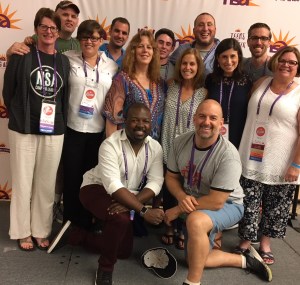
There is so much I want to say about the recent National Stuttering Association conference that just wrapped up in Chicago, Illinois this weekend. I am going to write later in the week about a couple of deeply important workshops that I attended that opened up dialogue that some people may not be used to.
But I feel compelled to write just a bit about The Stuttering Monologues, which was a performance I coordinated with 12 people and that we performed at the closing ceremony on Saturday July 7. I got the idea to create a version of stuttering monologues back in 2012 after watching a local performance of The Vagina Monologues, written by Eve Ensler. Ensler created her Vagina Monologues as an activism vehicle for women to be able to voice their concerns about consensual and non-consensual sexual experiences. Women of all different ages, races, sexual orientations and other differences let their voice be heard.
I envisioned that the same could be done with our stuttering stories. I presented the inaugural Stuttering Monologues as a workshop at the NSA conference in 2012 in Tampa. It was hugely successful – one of the most attended sessions, with standing room only. I brought it back again the following year, in Scottsdale in 2013. Again, the session was a stand-out, with a wall in the workshop room needing to be opened in order to accommodate people.
I wanted to bring it back to the conference again, but felt waiting a few years to keep the experience fresh was best. This seemed right, 5 years later and in Chicago. The NSA Executive Director asked me what I thought about presenting it to the whole conference as part of fully attended closing ceremony. We could make that work, right? What was done the previous two times in 75 minutes would now need to be done in less than 30 minutes.
I embraced the challenge. I had already lined up my presenters for the 2018 version of the Monologues when I learned we would do them at the closing and everyone would need to come in at under 2 minutes. That’s a big challenge for people who stutter. One person freely admitted that sometimes it has taken him fully two minutes to just say his name.
But we did it and to enormous success. We heard deeply moving, authentic stories about fear, shame, priorities, kindness and the human condition. It was funny, gut wrenching, inspiring and real all rolled up in one neat, 26 minute package. We heard monologues titled, “Dear Diary,” “You Don’t Know What You Don’t Know,” and “Heartbeat.” All rang true and we somehow managed to capture the diversity of our stuttering community through the unique voices we heard.
I had some people come up to me afterwards saying it was the best part of the conference. That the short stories were so powerful and riveting that everyone should hear something like this that so perfectly captures the complexity of stuttering. A long time member’s husband came up to me and said for him it was the best part of the conference. He said it was moving, emotional and powerful and that he could tell a lot of work went into it to make it look so seamless. That meant so much to me.
This was a labor of love. Not everything went perfectly. Some people didn’t come to practice sessions, some waited until the 11th hour to submit titles and bios and two people bowed out throughout the planning process. But it worked. Authentic voices were raised and eager ears listened to the stories that are all of us.
Changing The Way We Speak
Posted on: June 15, 2018
 I came across something in the “Notes” section of my phone from three years ago. I obviously felt it was important enough to write down. I’m not sure what lead me to read it again this week, but it really spoke to me.
“For years, we have gone to speech therapy to change the way we speak to make it more comfortable for others. We shouldn’t have to do that anymore.”
This brought back memories of when I participated in speech therapy for the first time as an adult about ten years ago. It was traditional fluency shaping therapy with the goal of changing the way I spoke. I greatly resisted this, without even knowing I was resisting!
I found it hard to learn the “targets” and even harder to demonstrate them. It felt mechanical and clinical and I couldn’t figure out why this wasn’t working for me. I also began to feel like I was failing and I wasn’t used to failing at anything. The harder I tried to “shape my speech differently” the more I failed to do so.
Finally, I realized that the reason I wasn’t succeeding with using fluency targets was because I didn’t want to use them. I felt like creating a different way to speak really just made me covert again. And more importantly, it felt like creating a different way to speak was more for the benefit of others than for me. It seemed like I was working at changing my speech so that listeners wouldn’t be uncomfortable and so that I wouldn’t have to explain why my speech was different than the norm.
People had told me I should try to be fluent when going for job interviews and giving presentations at work. But inside, I felt like that was taking my voice away, and I had been taking my own voice and hiding it away for years. This was the beginning of my personal realization that I didn’t want or need to be fixed and that I didn’t need to conform to be like everybody else.
We don’t need to make people feel more comfortable when listening to stuttering. We all need to just be patient and present communication partners.
Have you ever considered why you participated in speech therapy? A friend recently mentioned that his employer “made him” attend speech therapy sessions because a client was having difficulty with his stuttering. Thoughts?
Talking And Talking And Talking
Posted on: May 14, 2018
Well, last week was a very busy one for me. Like I mentioned in my last post, I had several opportunities to talk about stuttering and hopefully raise awareness in my little corner of the world.
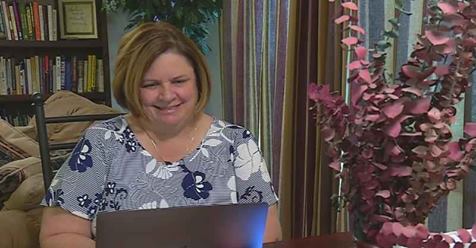
Last Monday, I was a guest on a local media production’s podcast where they interviewed me about stuttering. They sent me the link a few days later and I was really happy with how it turned out. The interviewers had done some prior research and asked me some great questions. Take a listen if you’d like. (Although that is an awful picture of me! Ugh!)
On Wednesday, I had the chance to “tell” my story at a 25th anniversary celebration of the Interfaith Story Circle, which is a local group here in Albany, New York that focuses on the power of storytelling. I was so delighted to have my story about women who stutter sharing their stories included in their celebration event.
And on Thursday last week, my podcast was featured on one of our local news channel’s segments highlighting women. That was such an exciting experience, as being on TV is a big deal, at least to me anyway. Fortunately, I was more photogenic in this clip here.
http://wnyt.com/news/pamela-mertz-podcast-for-women-who-stutter/4902733/?cat=11883
Stuttering Awareness Week 2018
Posted on: May 7, 2018
- In: Posts
- Leave a Comment
Hey everyone! It’s that time of year again! Here in the United States, it’s National Stuttering Awareness Week. In fact, it’s the 30th anniversary of this special week. In 1988, the second week in May was declared as National Stuttering Awareness Week.
Two individuals that were involved in what was then the National Stuttering Project (NSP) were the driving force behind making this happen. Paul Castellano and Barbara Hubbard Koval, with the support of their NSP chapter, pitched the idea to their local Congress members in 1986. Eighteen months later, in 1988, President Ronald Reagan signed the proclamation making the second week in May National Stuttering Awareness Week and it’s been commemorated every year since then.
While I believe that every day should be used to raise awareness for stuttering, this week is a great opportunity to talk about stuttering to people who don’t stutter and try to get some media attention to bring it into the spotlight. Many people involved in what is now the National Stuttering Association (NSA) contact the media to get people talking about stuttering. Here are some good ideas from the NSA on what you could do!
I am really psyched that I have two media opportunities this week. Tonight I am going to The Sanctuary For Independent Media which is local for me and will be a guest on their live podcast. I am excited that they were interested enough to bring someone on to talk about stuttering.
Tomorrow morning, I will be interviewed by a local TV reporter for a segment on her Today’s Women which airs weekly on the local evening news. The piece will run on Thursday evening. I was a guest on her show seven years ago, and she is doing a follow-up with me about stuttering in general and the growth of my podcast. I’m definitely excited.
What can you do to raise awareness about stuttering?
Stuttering Live On Stage
Posted on: April 30, 2018
- In: Posts
- Leave a Comment
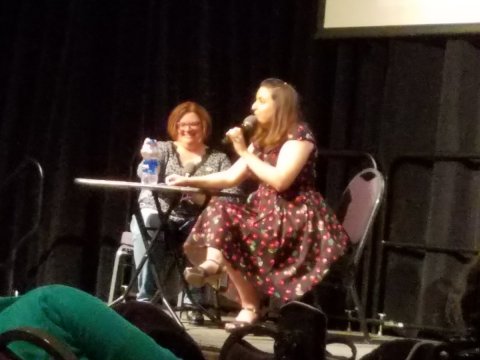
I had the amazing experience to interview Nina G, a stuttering stand up comedian this past Friday night on stage after she performed her routine. Nina has been featured several times on my Women Who Stutter podcast and has numerous YouTube videos showcasing her comedy and disability rights activism.
When Nina told me she had booked a gig at the University at Albany, right in my backyard, I was excited to get to see her and immediately planned for that weekend. But then Nina let me know that she wanted me to interview her live for my podcast. I was beyond excited but also naturally nervous.
A few days before Nina’s performance, we spoke by phone to map out a game plan for Friday’s show. Nina shared that it was her plan to have me live interview her on stage as part of the performance. I had not figured on that. I thought I would just be interviewing her after the show. So, I prepared some questions that I hoped would generate good discussion and crossed my fingers.
Well, Friday’s performance was a huge success. There were well over 100 people in the audience and people stayed for the whole show! There were several people who stutter in the audience as well, which was really fun.
Nina performed her comedy routine for about 30 minutes and then invited me on stage for the interview segment. Oh my gosh, it went great. We played off each other and had great dialogue going on. We recorded the audio and hopefully I will be able to use it for a future podcast episode. Nina also video recorded most of it as well.
It was such a great experience. I had never done anything like that before and it was such an adrenaline rush to be up on stage with Nina. After the interview segment, Nina invited me to remain on stage with her as she entertained questions.
After the show, a group of us went to dinner, including the two college students we met who stutter, as well as two other friends who stutter. Six of us closed a local restaurant and talked and laughed for several hours.
Thank you so much, Nina G for inviting me and including me in your show. We did a lot of educating Friday night and helped normalize stuttering.
Sharing Our Stories
Posted on: April 16, 2018
- In: Posts
- Leave a Comment
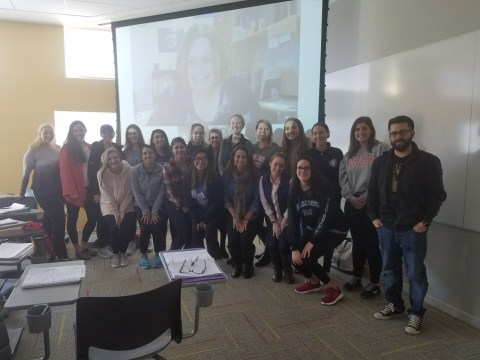
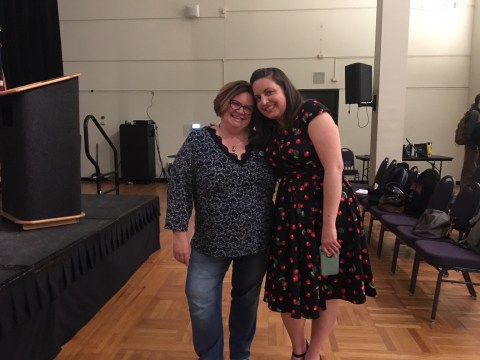
Recently, I had another opportunity to speak to a master’s level fluency class about my experiences with stuttering. Good friend Jill had asked me to guest lecture to the class and cover the piece on covert stuttering.
I always enjoy doing this. I know many other persons who stutter are invited and take the opportunity to share our stories with the people who will be working with us in the future. It’s critical that future therapists understand stuttering from the perspective of someone who has stuttered all their life. You can’t fully understand the stuttering experience just by reading about it.
I found myself talking to the students just briefly about my journey with stuttering, and how essentially I overcame the fears of stuttering to transition from covert to overt. I spent more time talking about lessons I had learned when I was in therapy as an adult and what I thought are the most important things for SLP students to focus on when working with people who stutter covertly.
I talked about being sure that the therapist is treating the right thing. When I was in therapy, I did not want to learn about techniques that would hide my stutter and make me sound more fluent. I needed to stutter, after hiding it for so many years. Understanding what the client needs and wants is crucial for successful therapy. Not everyone is looking for fluency. Many people who stutter want to work on acceptance and have someone affirm for them that stuttering is indeed OK.
I think tomorrow’s therapists really need to wrap their head around that today.
What Would You Do?
Posted on: March 6, 2018
I came across a post in one of the stuttering forums written by a young man who shared that his assistant manager at work has been blatantly mocking his stuttering. This has occurred in front of other co-workers and sometimes in front of customers as well.
The young man wrote that he’s talked to the owner in an attempt to get some assistance. He feels the owner can only do so much as the assistant manager doesn’t do the mocking in front of the owner.
He is considering contacting someone at the corporate level to ask for help in getting the harassment to stop. He worries that may be “too much” and asks if there is anything else that could be done.
I feel for this person. It is utterly disrespectful to be mocked at work by a manager. I remember when this happened to me, many years ago, before I was fired from my job because of stuttering. My director would laugh, slap his face and roll his eyes when I stuttered during meetings. He had no problem doing this in front of others. I felt embarrassed and ashamed and helpless to stop him, as he, after all, was a director and an authority figure. He was also a big guy and I honestly always felt intimidated by him.
I didn’t do anything when he harassed me. I just sucked it up and wound up feeling like crap and let negative self-talk take up space in my head. When I left meetings after such ridicule and disrespect, I would go to a bathroom and cry and then compose myself.
Now, years later, after finding support and empowerment through support organizations such as the National Stuttering Association, I have learned to advocate and stand up for myself. I would feel OK to let an offender know that it is unacceptable workplace behavior and I would attempt to educate about stuttering. I would also not hesitate to involve Human Resource staff so that they too could take steps to eliminate a hostile work environment.
Not everyone is in that place to stand up and confront harassment. You really have to have reached a place of acceptance and self-actualization in your journey in order to advocate for yourself.
So, what would you do? How would you handle this if it was you? What advice might you offer someone facing this type of behavior at work?
I’d love your thoughts.
A Plethora Of Misinformation
Posted on: February 23, 2018
- In: Posts
- Leave a Comment
I am one of the administrators of the Facebook group “Stuttering Community.” There are over 8000 members from all over the world. People use the group for various reasons. Most people come for support. Many are looking for information about stuttering and just as many are looking for quick fixes.
As an administrator, I occasionally see posts that are inappropriate and need to be removed. But largely, the group goes uncensored and people are free to post what they want. We do have basic ground rules that all people are expected to read and follow. They’re pretty common – no talk of politics, religion or sex. Those are pretty much the big three that we ask people to refrain from. It’s a virtual stuttering support group and we try to keep things relevant to stuttering.
We get people who share success stories and frustrations. People then post words of encouragement and share their own stories. We’ve had people post videos as well, which really is a testament to how supported people feel in the group.
One of the trends has always been that people ask all kinds of questions about stuttering causes, treatment, management, support and cures. It’s always interesting to see how many people are really misinformed about stuttering. People come into the group with very little prior factual knowledge and appear to not be doing any research from the many reputable online resources out there.
Utilize those resources. There’s the National Stuttering Association, the Stuttering Foundation, the International Stuttering Association and the British Stammering Association, to name a few. It’s really important to not trust all of the information that you get from people in a Facebook group. People are often perpetuating myths that have long been debunked. There’s a lot of research available to show that stuttering has a neurological and genetic base and that it’s not simply a bad habit that we can break like biting our fingernails.
Social media is here to stay and it’s wonderful that people are finding support in these virtual stuttering communities. But don’t trust everything you read on the internet. People have good intentions but often are misinformed.
Stutter Friendly Workplaces
Posted on: February 9, 2018
I recently got an email from someone wondering if a list exists of workplaces that are “stutter friendly.” Those are my choice of words. The person emailing me described such a workplace as “not scared” to hire someone who stutters and that wouldn’t look down negatively on the stuttering.
I am not aware of such a list but one might readily exist that we could generate just by asking people who stutter where they work. People who stutter who are employed are already in workplaces that have shown that they are not scared of stuttering and value the person’s skills and contributions more than they worry about stuttering.
The person who reached out indicated that she has been looking for work for over two years and can’t get past the interview phase. She believes it’s because of her stuttering. I pondered how to reply to her. She is an IT Engineer so definitely has skills and abilities that make her employable.
I have no list of “stutter friendly” workplaces that I can just forward her. I wanted to be encouraging and helpful so I asked her where she lives and what types of jobs she’s been applying to. I’m hoping she’ll reply back and maybe I will know someone in her field and in her geographic area that might be able to point her to a good job lead with an employer who values both skills and diversity.
It would be really cool if the National Stuttering Association (NSA) could develop a network of employers in the United States who are “stutter friendly” for just these kinds of situations. In my work as a member of the Board of the NSA, I am leading an initiative on employment advocacy which focuses on helping people who stutter manage communication either during job search or after getting the job.
We’re doing some exciting things like offering mock interviews, one-on-one consultations to discuss workplace stuttering and we’re sponsoring a series of webinars on stuttering more successfully at work.
A long-term vision of mine includes having an Employer Stuttering Network where employers would “sign on” with the NSA as “stutter friendly” workplaces. I have thought about this since before I officially took my current role on the NSA Board. I think it can happen, but people would need to be willing to acknowledge that they stutter and share where they work. People who stutter obviously make great employees.
I am going to follow-up with this person who emailed me and try to find a workplace or two in her area that won’t be “scared” to talk to someone who stutters.
Wish me luck!
Casual Chat About Stuttering
Posted on: January 23, 2018
Yesterday I had an appointment with a health care provider I’ve seen for over 3 years. I see him once every other month for a quick maintenance visit. At this visit, we exchanged small talk which included him asking me about my weekend.
I shared with him that I’d been in Chicago for a long weekend to attend a Board meeting of the National Stuttering Association. He asked if I had ever had a problem with stuttering and I told him that I stutter, and that I was sure I had at least once shared that with him. He said he’s never noticed.
He asked me a little about my experience on the Board and what ways I contribute to the organization. As I was talking, he acknowledged that he indeed heard me occasionally stutter and found it interesting that he never really heard it before. I thought to myself that probably that was because he usually does most of the talking and our visits are always really brief.
He went on to say that he has a large family and eight males in the family stutter. He wondered if there was a genetic link. I told him yes, that there is recent and current research that supports a definite genetic influence and that a NIH researcher has even identified three genes for stuttering.
He was fascinated and I took the opportunity to educate a bit more. I shared that the male to female ratio in stuttering is 4:1 male and that most children often stutter during language development but that about 80% recover naturally and that early intervention was key for children who stutter for more than six months.
He asked a few more questions and then we got to the business at hand! It was the longest conversation we’ve had outside the confines of the reason I was there. I was pleased that he shared his family history with stuttering and that we made a little connection about it. We concluded our visit with comments about how it was nice to have had that chat and interesting how stuttering just came up casually after making small talk for a moment.
I believe I educated this doctor while at the same time I shared something personally important to me. Educating and talking about stuttering with the medical community in a positive and non-shameful way is so important. I’m glad I took the opportunity that was presented to me. And I’m glad I was able to answer some questions for him as it was clear that he was lacking education about stuttering despite having so many family members that stutter.
Looking At Yourself Stuttering
Posted on: January 16, 2018
- In: Posts
- Leave a Comment
I am re-purposing this post that I wrote about 6 years ago, about watching yourself stutter in a mirror. I have always had a very hard time with this. I was reminded of this when I saw a friend post about looking at her stuttering as an mp3 file and seeing the breaks and “dead air” in the audio stream.
Several years ago, I facilitated a story-telling circle with a very supportive audience. These were people who understand the value of sharing our stories, as any one story has the potential to trigger an impact on someone else. So this group were wonderful listeners. I felt very honored sharing some of my stuttering stories with them.
It was very empowering for me to tell my stories, especially to an audience of people who do not stutter. And because it was story telling, which is very different from giving a speech, I did not use notes. So I wasn’t quite sure how it would unfold, as I planned to just tell from the heart.
I knew it would be special, so I had a friend record the three stories I told. I wanted to have a record of what I told. I spent a lot of time editing the video clips, as I planned to share my message with others.
It was very hard watching the videos of myself stuttering. It is one thing to hear myself stutter, like when I do the podcasts or even just hear myself talking to others. But to “see my stuttering”, it kind of brought tears to my eyes the first time. I saw how deliberate I was, I saw what my pauses looked like, I saw what multiple-repetitions looked like. A couple of times, I saw one eye squeeze closed when I blocked. And I saw some physical tension.
Watching myself tell my stories and stutter very openly with people I did not know well was very emotional and poignant for me. I wondered as I watched (the video) what the listeners thought as they watched me.
It was not easy watching the first time. But I did watch several more times and it was easier. I caught the point where I almost choked up, but didn’t. And I realized that sometimes I stutter a lot, and sometimes hardly at all.
I don’t think I could ever purposely practice stuttering in front of a mirror. It would be contrived, not real. It would not help me be anymore comfortable stuttering publicly.
It takes a lot of guts to be who you are in the many different areas of our lives. And to look back on those moments and realize just that. Watching myself be myself in front of others can’t be replicated in private with a mirror.
Real life needs us to be ready to be ourselves when it counts. When sharing our gift of self can make a big difference.
- In: Posts
- Leave a Comment
As I have shared over the years, a big part of my job is going around to different schools and giving presentations to high school school students. I work as a recruiter in a career and technical high school and it’s my job to inform 10th graders about training options they have for their last two years of high school. Students can choose to enroll in one of our programs and attend for a half day, while remaining at their own school for the other half of the day.
It’s a great opportunity for high school students. They can take one of our programs for two years and leave with licenses or industry certifications that will enable them to find jobs right out of high school or be more prepared for college.
I love my job. I am out and about a lot meeting with different kids all of the time and giving information that, to some, may be life changing. Many kids struggle with traditional high school so having an opportunity to participate in hands-on training very often is a game changer. Research shows that kids who graduate from career and technical programs also graduate from high school, often at a higher graduation rate than traditional schools.
So I feel very blessed to have this kind of job. But it can be daunting. I am making the same presentation about 60 times over the course of two months. I have it memorized. But knowing and being comfortable with my material does not make it any easier when I find I am stuttering a lot. Which occurs a lot. I am talking about programs with specific course names that I can’t change for something easier to say.
I almost always stutter on the word “Cosmetology.” It comes out “cos-cos-cos-ma-ma-ma-tology.” Sometimes I get weird looks, sometimes kids will snicker or full out laugh.
I also almost always stutter on the words “Construction” and “Culinary Arts.” Those hard “C” sounds get me every time. I’ve been asked why don’t I just advertise to the students that I stutter so I feel more comfortable and to lessen the uncomfortable reactions I get.
I think about long and hard before each school’s slate of presentations. I am not there to talk about stuttering. I am there to talk about the really cool technical training programs we offer. I don’t want to talk about something that I’m not supposed to talk about during these times, even though I could easily talk about stuttering for hours. No, I usually don’t mention stuttering and just “power through” the stuttering moments or blocks. I try not to let it show when I’m bothered by kid’s reactions to my stuttering. I do my best to remain emotionless and neutral.
Maybe this is not the best strategy to take when doing so many presentations. But this is the way I’ve dealt with it for years now, and suddenly advertising and then having to maybe explain myself feels uncomfortable to me.
So, I am sticking with the way I’ve done it. I have 7 more presentations scheduled for this week and then I’ll be done for this school year. I trust I’ll get through them like I have all the others. And if I don’t, and someone says something that makes me really uncomfortable, maybe, just maybe, I’ll find myself being upfront and sharing this part of myself with kids who will most likely be OK with it.
Making A Difference
Posted on: December 7, 2017
- In: Posts
- Leave a Comment
Last Friday I spoke to high school students about stuttering. These students are in an accelerated science class during their senior year. They are studying methods of scientific research and for their neuroscience unit, the teacher invited me in to talk about stuttering. I talked a little about the neurology and genetics of stuttering and a lot about the emotional complexities of a communication disorder.
It was such a pleasure to present to these students. They had so many questions and were truly interested and engaged with what I shared. I didn’t get through half of the formal presentation I had prepared as I just decided to go with the flow of the student’s questions.
Yesterday, the teacher emailed me thanking me again for coming in and included thank you notes from the students. I was touched and overwhelmed with what they had to say. Here’s a few of the messages from the students.
Ms. Pam Mertz, On behalf of the New Visions Scientific Research Program of 2018 I would like to thank you for taking the time out of your morning to come and teach our class about stuttering. It was very beneficial for us all to learn about this speech disorder, as it is one that is often not taught about. It was very interesting to learn about the association between dopamine and blood flow levels in the brain and stuttering.
Ms. Pam Mertz, thank you so much for meeting with us on Friday and introducing us to just a little snapshot of what stuttering is and how you deal with it in your life. I really appreciate that you were comfortable enough to embrace your stutter with us and that you let your powerful and comforting voice show through. I was very interested in how you explained how stuttering does not affect those when singing because a different side of the brain is used. I really do thank you for meeting with us and I hope that we can meet with you again later on this year.
For someone that stutters, it must be pretty terrifying to have a job that has you speak in front of crowds so often. To be able to overcome any fear and do your job is very inspiring, and for you to let down your guard and openly stutter in front of us is very kind. Thanks again for coming and telling the new Visions Class about your lifelong experience with stuttering. I thought the most interesting part was how you met another student that was the only stutterer in her school, and were able to connect to based on shared experiences.
Thank you Pam for taking the time out of your day to come and talk with us and teach us about stuttering. I really enjoyed hearing about how you have overcome your stutter and learned to deal with it. It is very inspiring!! I did not know much about stuttering and I didn’t know how much of a mental toll having a stutter had on a person. Thank you so much Pam!!
Thank you so much for coming in and talking to us about a topic that doesn’t get enough recognition in this world. I really enjoyed hearing your story and the view on the subject from someone who experiences stuttering everyday of their life. You are very brave for stuttering freely and being able to encourage others to follow in your footsteps. Keep moving forward and I hope the world begins to realize how important this is. I found it really interesting how much of a psychological impact it has on a person and maybe the reason is because they don’t know that they have a huge group of people like you that are ready to support them. Thank you again so much for coming in and teaching us, it was one of the most interesting rotations of the year so far.
Pam, thank you so much for taking the time out of your day to speak to us about something that’s very personal to you. I think that it’s great that you made a platform for yourself to speak on stuttering and make the impact that you do on others. When you explained the story about the little girl Kira when you spoke at the one middle school, it shows how much what you’re doing matters. Learning about how certain things can aggravate or increase one’s stuttering was quite interesting and important knowledge. Thank you again for talking to us I really appreciated it!
Ms. Mertz, Thank you for giving of your time to meet with us on Friday. It was very interesting to hear a first hand account of what it is like to live with stuttering. I realized how uneducated about stuttering I was after hearing your presentation. I think so often people are uneducated about it and do not see it as the real problem that it is. Stuttering in itself is a large problem but it causes many other issues like depression because of the stigma surrounding it. It is important that people are educated about it and thank you for educating our class on it.
An Interview About Stuttering
Posted on: December 1, 2017
- In: Posts
- Leave a Comment
I was fortunate to have the opportunity to be interviewed recently by a freelance journalist in the Albany, NY area. He was looking to do a piece on stuttering and wanted to both write an article and produce a podcast.
I got to give a shout out to the National Stuttering Association and shamelessly plug my own work here on this blog. I am very happy with how it turned out, even the picture. Please take a listen when you get a chance – it’s not too long and you can see how I responded “off the cuff” as the interviewer had not sent me the questions in advance!
 Make Room For The Stuttering
What people are saying!