Archive for the ‘Posts’ Category
It’s Not A Trick Question
Posted on: April 1, 2019
- In: Posts
- Leave a Comment
A lot of us who stutter have had to deal with people who react negatively when they hear us stutter. I have had people laugh, mimic, roll or avert their eyes and say things that have made me feel hurt, frustrated and angry.
Over the years, I’ve gotten better at standing up for myself and using tough moments like that to educate the listener, which sometimes actually resulted in listener embarrassment and then apologies. I have also learned to pick my battles and sometimes I just let stuff go, especially if I will likely not see that person again.
Sometimes though I am still shocked when this happens, especially in the case of adults.
A few days ago, I visited my physician’s office for an appointment that they fit me into rather quickly because I was having a serious medical issue. So, I wasn’t feeling well when I went in.
When I was called in by the nurse, she had me go through the routine and stop to get weight before heading to the exam room. As I was putting my stuff down before stepping on the scale, she asked me for my birth date. I always stutter on numbers and have stuttered on my birth date many times. As I began and stuttered on the “tw-tw-twelve,” she started laughing. I was so not in the mood for this. I glanced up at her and continued on with “thir-thir-thir-thirteen,” and she laughed some more and said, “it’s not a trick question.”
I said, “what do you mean? I stutter and I’m stuttering. You’re laughing at me.”
She said. “no, that’s not what I’m laughing at.” I said, “Oh, then what’s so funny?” She said, “you looked confused when I asked you your birth date.”
I said, “I know my birth date. I stuttered on it. I stutter. And that’s when you laughed.” She looked away and said, “that’s not what I meant.”
And then silence. I didn’t say anything else. Neither did she. She didn’t apologize. I wasn’t expecting her to but I guess I did expect to see her register some acknowledgement that she had laughed and made a stupid comment towards a person with a speech impairment.
I felt belittled and disrespected in just that 60 second encounter. I stood up for myself but still walked away feeling like crap. I’m not sure what I could have done differently to feel better about the situation.
Thoughts?
You Never Know
Posted on: March 22, 2019
- In: Posts
- Leave a Comment

I have to share this.
Three days ago I received an email out of the blue from someone I communicated with about stuttering quite a few years ago. We last chatted in 2012.
This is what she said (with just some minor edits)
I have a very important job interview this Thursday for a position that I really want. I have been considering being completely open and honest about my stutter during the interview, something that I have never done before. I know you are a big advocate for being open about our stuttering, so I was hoping you could pass along some wisdom or advice. I am terrified. It’s a corporate position and while they state that inclusion and diversity is a part of their company values, I am so terrified of not getting this job because of my stutter.
I feel like I will be taking a gargantuan risk by letting my interviewer know about my stutter. I am also just simply terrified because I know how “badly” I stutter during high-stress events, and nothing could be more high-stress than this job interview. I would really appreciate any advice or words of encouragement you might offer.
Of course, I emailed her back and shared my thoughts. I asked her to let me know how the interview went.
I heard back from her today. The interview went well and she did disclose that she stutters right at the beginning. She said the interviewer wasn’t phased at all, which she found comforting. In fact, when she asked the interviewer if she had any questions about stuttering, she was a little bummed out that she didn’t because she was ready to be open and share.
I wished her luck on the second round of interviews and asked her to let me know how everything goes. I thanked her too for remembering me and reaching out.
She said she reached out to a couple of friends locally who stutter but also wanted to reach out to me. She said “you are very well known in the stuttering community.” I can’t tell you how good that made me feel.
You just never know. When we talk about our stuttering and share our stories and put ourselves out there, people listen and pay attention and remember.
And that makes a difference. And means a lot.
Being Curious – Episode 196
Posted on: March 5, 2019
 Episode 196 features Yuka Fukuoka who hails from Tokyo, Japan and presently resides in NYC in the United States. Yuka is a professional designer by day and on weekends she works on app development to benefit people who stutter and increase awareness of stuttering for people who don’t.
Listen in to this great conversation and hear what Yuka is up to. While in Japan, she worked on a “wearable device” that allows fluent people to experience what it actually feels like to stutter. And here in the USA, she is developing a prototype app for people who stutter to practice speaking situations that also create anxiety for stutterers.
We talk about workplace stuttering, preparing for job interviews, whether to disclose stuttering or not, and using your stuttering as a strength. We also discuss the importance of changing mindsets about stuttering and breaking down biases.
Finally, we give a shout out to SMBC, a financial powerhouse with a location in NYC, who offered mock interviews to people who stutter. High level managers served as interviewers and talked about how helpful it was to openly talk about stuttering at work. Yuka attended this event and found it extremely helpful.
The music used in today’s episode is credited to ccMixter.
- In: Posts
- Leave a Comment
I have been reflecting a lot on the value of being authentic in all of my places. I have been reading and boning up on being courageous at work.
I came across this great Forbes article called The Importance of Being Courageously Vulnerable at Work.
The author, Patrick Williams, a leadership coach, asks, “Is there a gap between who you say you are and how you reveal yourself in the world of work?”
We all have things we hide due to shame, embarrassment, guilt or even unexpressed dreams we may have given up on, and we often put those in our shadow. Williams challenges us to acknowledge and own your (shadow) or it will own you.
This really resonated with me. I try to be authentic at work, as I truly believe it invites others to do so as well and then stronger relationships are forged.
I have been actively involved in the National Stuttering Association for about 12 years now. I am proud to share that a workplace advocacy initiative that I’ve been championing for over a year has launched. We Stutter @ Work is ambitious, new and requires that people who stutter be willing to be open and stutter nakedly at work.
I do that. I stutter openly and nakedly at work. It’s OK. People are listening to what I say and not how I say it. Occasionally I might get unsupportive remarks or reactions when I stutter on the phone. I usually say something, like “Oh, I stutter. No biggie, right?” I don’t apologize. I used to, years ago. I never do today. There’s nothing to apologize for.
The workplace is no longer the 9 to 5 we used to view it as. It’s at least one-third of our daily life. We are “human beings”, not “human doings.” More of our “being” needs to be present in the workplace, and we should encourage others to do so as well. It makes workplaces better, stronger and helps people feel like they belong. Right?
What do you think? Have you had any experiences where you’ve been courageously vulnerable at work? How did it make you feel? Do you and can you stutter openly at work?
New Days To Make A Difference
Posted on: December 31, 2018
- In: Posts
- Leave a Comment
The last day of the year offers an opportunity to reflect on where we have been and where we are going. It’s a chance to leave behind that which made us unhappy and focus on the good we can do and what will make us happy with all the new days we have coming with the new year.
If you have never thought of this in regards to your stuttering, I challenge you to do so. We have a whole new year, 365 days with which we can have a good relationship with our stuttering and pay that forward to others who stutter. Especially those who may not be far along on their own journey.
Quite a few years ago, I realized that I can use my stuttering for a purpose. I am comfortable enough with my own stuttering that I can share my experiences with others. I can show that stuttering does not have to define us and it can in fact be seen as the part of our whole that makes us unique and special.
For years, I did not believe that anything about me was unique and special. I hated myself and therefore had a very poor self-image. A lot of that was reinforced by messages that I had received, and not just about stuttering. Society just did not show much love to fat girls with bad skin who also talked funny.
But now I am at a point in my life where I am comfortable in my own skin and see those things about myself that make me special. It’s important now that I share that with others who might not be there yet.
A whole new year awaits for me to make a difference. I am excited with the opportunities that await to inspire change and make a difference for someone, or maybe more than just one person.
You can too. Find a way to get involved in the stuttering community. Share your story, help with a project with your local stuttering support group, dare to do something that you thought you couldn’t because of your stuttering. You can make a difference.
Hidden In Plain Sight
Posted on: November 20, 2018
- In: Posts
- Leave a Comment
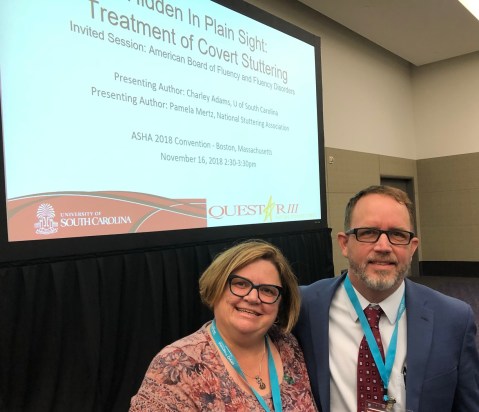
I participated in the conference of a lifetime this weekend. I was so lucky to have been able to attend the 2018 ASHA National Convention held in Boston, MA. I was an invited speaker of the American Board of Fluency and Fluency Disorders along with good friend and guardian angel, Charley Adams, PhD, CCC-SLP from South Carolina. Together, we delivered a presentation called “Hidden in Plain Sight: Treatment for Covert Stuttering.”
We both felt it was extremely important that we talk to current and future SLPs about the importance of “treating the right thing” when it comes to working with people who covertly stutter. Because for covert stutterers, it’s not the possible stuttered word that is the problem. It is the complex layers of shame, guilt, paralysis, and fraudulent identity that must be peeled away and processed that is the the real problem and challenge.
Charley and I only had one hour to convey a whole lot of information to an audience mixed with eager, young graduate students and established clinicians and researchers in the field. We chose to tag team and alternate anecdotal story telling with clinical strategy suggestions. It worked. I must say we were engaging, funny and drove our points home.
I talked extensively about how covert stuttering robbed me of my personality and I knew it, but like the Stockholm Syndrome, I stayed in that bad place for thirty years. I shared details about “pretend Pam” and what it was like when “real Pam” finally emerged. At one point, I said something like, “real Pam stutters openly now with little shame and she’s a damn good communicator.” At that, the audience rose to their feet and gave a standing ovation. I got choked up and felt my heart swell. It was such a proud moment.
I had doubt that I actually would be able to get to Boston and deliver my part of the presentation. I have not felt well for many weeks and I actually took a month of sick leave off from work, something I have never done. But getting to this convention was immensely important to me and I decided to be upfront, share my situation and ask for help. Charley was there for me, every step of the way, as were others.
The ASHA Convention was the largest I have ever attended. It was intimidating and overwhelming to be among so many people. It was reported that this convention had the most attendees ever – over 18, 000. With few exceptions, everyone was a professional in the fields of speech and hearing. Everyone had impressive letters after their names and I didn’t. But I’m indeed an expert on my stuttering and that’s one of the key messages that I really wanted to convey to the audience.
It’s important to listen and respect the lived experience of people who stutter and don’t assume that professionals have all the answers. It doesn’t always work that way.
Not Telling Them I Stutter
Posted on: September 14, 2018
- In: Posts
- Leave a Comment
 It’s that time of year again and I find myself making tons of presentations to high school kids. Right at the beginning of the year, I start off with presentations on sexual harassment prevention to every student in our building, plus four remote sites.
So, I am doing about four 40 minute presentations a day that cover what sexual harassment is and isn’t and also discuss and explain tolerance and respect of differences to ensure we have a school environment free of bullying and discrimination.
It’s a lot to cover and not particularly easy topics to discuss with high school age kids. Talking about anything sexual gets major giggles going and red faces, but for the most part, they go well. It’s amazing – when I feel confident and on top of things, the talks go exquisitely. Everything just flows, I get the kids involved by asking questions and it generally becomes conversational, instead of me standing in front and “lecturing at them,” which I hate and I am sure the kids do even more.
I had an interesting conversation with my friend Annie about this just the other day. I confided in her that I always find this time of year, and these presentations, really stressful. They shouldn’t be at all – I am so good at these now after years of doing them that I can just talk and don’t really even need notes or cues.
But I always worry about what will happen when I stutter and someone notices and laughs. Annie wanted to know why I just didn’t relieve myself of that stress by simply starting off each presentation with a quick “disclaimer” that I stutter and get it out there. I’ve talked about this here before over the years. I never know if I should really do that because I’m afraid of drawing attention to me and away from the topic at hand. I’m not there to talk to the kids about stuttering and I always worry (quite obsessively) about how that will go over.
So I usually don’t disclose or advertise that I stutter at the beginning of my talks. I “hope” that I’ll be largely fluent and that it won’t come up and I won’t have to deal with it. Not the best plan, because then I need to be prepared for addressing reactions when I do have a big juicy block or long repetition in the middle of a sentence. When that happens, I figure I’ll deal with it then.
I would never take this approach with adults. I am totally comfortable letting adults know at the onset of a presentation that I stutter and that I’m OK with it and hope they will be too. But there’s just something about the kids that makes me feel more anxious about turning this talk around and making it about me.
So far, my first four talks yesterday went well – really well, in fact. The kids were super engaged, interacted, asked lots of questions and we had a good conversation in all four classes about current events, like the #MeToo movement.
Maybe I just worry too much.
- In: Posts
- Leave a Comment
Episode 189 features Sigriour Thorlacius, or Sigga, who hails from Reykjavik, Iceland. Sigga is in her second season of being Chair of the Icelandic Stuttering Association and is only the second female to have this role since the beginning of the association in 1991.
Sigga is also a student and is particularly interested in public education and how we are raising our citizens. She has decided to focus in on Adult Education, as adults who return to school at non-traditional ages face stigma and pressures that are very parallel to that which people who stutter face.
This conversation was one of those where we had no clue we would wind up doing such a deep dive. We talked about self advocacy, unintentional authenticity, reacting to other people’s reactions to our speech and the energy drain we who stutter face when we are constantly thinking and listening to our inner head chatter.
We also talked about listening and how people who stutter actually get people who don’t stutter to listen closely to what we have to say.
Sigga also spoke about her experience at the recent Joint Congress in Japan and what participants have in store for the ISA World Congress being held in Iceland in 2019.
The music used in today’s episode is credited to BenSound.
Workplace Stuttering Tips
Posted on: August 24, 2018
- In: Posts
- Leave a Comment
I was instrumental in getting these two videos made for the National Stuttering Association and figured, what the heck, let me share them here. They might help you. They might help employers. They might help a lot of people. So, go ahead and share.
And I’m actually in both of them. Which is kind of cool. So are my friends Katie and Derek. Even cooler. We were all willing to be completely vulnerable.
The first video is something really short you can use to educate your employer before you’re hired – during the job interview stage – and after you’re hired too, to help talk about stuttering at work. Because we know that can be a challenge.
The second video is also really short and to the point. We who stutter get really stressed about job interviews. Preparation can make all the difference. Do some research. You’d be surprised how many people go into a job interview and it’s obvious they know nothing about the company they hope will hire them. Do that research. Show you are interested.
And consider disclosing that you stutter. It will make it so much easier for you and the interviewer. You will feel more at ease and won’t be obsessively thinking what will happen when you stutter. By telling the interviewer upfront that you stutter, you remove that anxiety you have and let the listener know exactly what to expect. It just makes the speaking encounter so much easier and then you can be your cool, calm collected best self at the interview.
Being An Effective Communicator
Posted on: August 22, 2018
- In: Posts
- Leave a Comment
Two weeks ago, I had the amazing opportunity to help out with a “Mock Interview Day” for people who stutter at a globally recognized corporate office in New York City. For the second time, Goldman Sachs offered it’s employees an opportunity to spend a volunteer day helping people who stutter practice job interviews.
I helped an employee who stutters who works at Goldman coordinate participant registration, which was free and open to anyone who could come in person for two practice interview sessions. Goldman had 25 employee volunteers who would each interview two different individuals and provide that all important feedback.
Too often, when we interview for a job and don’t get an offer, we aren’t given any feedback. People who stutter then sometimes automatically conclude it must be because of stuttering. Of course, that might be true sometimes but other times it could be for any number of reasons: lack of experience or education or someone else is just genuinely a better fit.
One of the things we did to help the employee interviewers prepare for talking with people who stutter was we provided a “stuttering overview” session in the morning before the participants arrived. A SLP who stutters, the Goldman employee who stutters and myself presented for a little over an hour on what stuttering is and isn’t, tips for listening, when or if to intervene if the person who stutters really struggles and we all offered a personal perspective on our own stuttering in the workplace experiences. Everybody was extremely engaged and asked thoughtful, important questions. We got a lot of very positive feedback about how helpful that was.
At the end of the day, when we were networking and eating pizza, someone came up to me and asked about whether I’d be interested or able to help provide similar training to his staff. We spoke for about 15 minutes. Out of the corner of my eye, I noticed a Goldman employee waiting patiently to speak with me. I tried hard to acknowledge him, but the person engaging with me wasn’t slowing down anytime soon.
Finally, the Goldman employee got to me. What he waited all that time to share with me blew my mind. He said, “you probably hear this all the time, but you are the most compelling speaker I have ever heard.” I felt my face flush and immediately felt embarrassed. He went on to say that he felt he was a crappy speaker and he was so impressed that I stuttered and still managed to make people want to hear what I had to say. He wanted to know my secret. Truly, I was speechless.
I thanked him and we talked for about a half hour and I encouraged him to check out Toastmasters. We have since communicated by email a few times and he told me has checked out the numerous Toastmaster options available in his area.
So why am I sharing this? I am not bragging, honest. I was embarrassed, but it resonated so I feel I needed to share. We who stutter can be and are amazingly effective communicators. When we remember that it’s not all about fluency but connecting with our listener and saying what we want to say, there’s a lesson here. Even fluent speakers get freaked out about public speaking. Our words count and that’s what people want to hear. We just need to remember that again and again.
When I Stutter
Posted on: August 8, 2018
- In: Posts
- Leave a Comment
 I recently had the privilege to see the documentary When I Stutter, a film by John Gomez. This is a film about people who stutter and portrays how people who stutter actually feel about stuttering, which is not always talked about. It is an honest examination of the sometimes dark side of stuttering, which often doesn’t get explored.
The film is currently making the rounds of private screenings and film festivals. It is being sponsored by colleges and universities that have communications disorders programs and being promoted by the National Stuttering Association.
It is a powerful learning experience for speech language pathologists and students studying to be future therapists. But it also demands and deserves to be seen by anyone who has an interest in the power of people who stutter daring to express themselves no matter how their voice might sound or how long it may take to speak.
That’s what hit home for me. The power of the voices. These are real people who stutter. Not actors portraying people who stutter, which is the sad norm when stuttering even gets a mention today. And we hear from both men and women and people of color, again an anomaly. So the film, by its intentional design, promotes diversity and inclusion.
Listening to the voices and seeing the facial expressions of people like me sharing their stories was visceral. Partly because I knew some of the people, especially the women, Rachel and Jenny, who have both been featured as guests on my podcast, Women Who Stutter: Our Stories.
So, knowing these people made it personal. Knowing the stories as my own made it real. Understanding the dynamics and complexity of stuttering made me nod my head in some parts. And tears welled up easily at other parts.
This is a must see film if you have any interest at all in the human condition. Even if you don’t stutter, you will identify with the shame, isolation and feelings of inadequacy that anyone with something that makes us stand out from everyone else can so easily relate to.
Kudos to John Gomez for bringing this film to light and to the stuttering community and the communities at large that we inhabit. We all have something that makes us different, stand out, unique. It is vital that we share our stories about whatever that is in as authentic a voice as possible. And “When I Stutter” accomplishes this, with grace and respect and actually honors the people who dared to be real with us.
Go see this film. It’s important.
 Make Room For The Stuttering
What people are saying!