Posts Tagged ‘feelings about stuttering’
Is Stuttering Part Of Your Identity?
Posted on: July 1, 2016
- In: Posts
- 3 Comments
When I think of my identity, I think of things like brown hair, blue eyes and being short. I think of the tattoos I have and the fact that my initials spell my name.
I also think of my stuttering when I think of my identity. Stuttering makes me unique. It is very much a part of my identity. People know me for my stuttering. I’ve heard people at work (a school) refer to me as, “You know, the one that stutters.”
Dictionary.com defines identity as a noun: condition or character as to who a person or what a thing is; the qualities, beliefs, etc., that distinguish or identify a person or thing.
So stuttering is one of my qualities, a distinctive characteristic that distinguishes me from other people.
There was a time when I thought stuttering was bad and shameful and I did everything I could to try and hide that part of me, that part of my identity. But I was never truly successful hiding it. It was there, not going anywhere, like my blue eyes are always going to be blue.
This reminds me of an exercise I do when I talk to kids who don’t stutter about stuttering. When explaining what it was like to try and hide my stuttering, I have the kids experience a physical and visual exercise. I ask for a volunteer from the audience and give the child a large grapefruit. I ask her to try and hide it somewhere on her body where it’s not going to show. The audience enjoys the child trying to hide it in her clothes – in her sock, in her pocket, in the hood of her sweatshirt. No matter where she puts the grapefruit, it’s lump can still be seen on the person. Trying to hide it is fruitless! 🙂
Like trying to hide stuttering was fruitless. It didn’t work. Over the years, I’ve grown to accept all parts of my identity, both the things I like and the things I don’t like so much.
Having identity makes us human. It makes us unique. It distinguishes us from the pack. Stuttering is part of my identity and I no longer try to fight that fact.
Getting Healthy – Episode 155
Posted on: May 11, 2016
 Episode 155 features Megan Aldrich, who hails from Keene, New Hampshire. Megan’s mission in life right now is sobriety and getting healthy.
Listen in as we talk about how Megan is starting to tell people she stutters, which is a huge step for her. We talk about covert stuttering, and also dealing with being made fun of for stuttering.
We also discuss Megan’s experience with the Speech Easy device, researching stuttering and the importance of having stuttering resources. Megan and I met through the Stutter Social app and have also been in a hangout together, which was her first time interacting with 8 or 9 other people who stutter.
Megan also shares parts of her story with addiction and recovery, and other health problems she has recently confronted. Megan proudly just celebrated her 4 year sobriety anniversary.
The music used in today’s episode is credited to ccMixter.
Looking At Ourselves Stutter
Posted on: April 5, 2016
- In: Posts
- Leave a Comment
A very courageous poster today made a comment in a Facebook stuttering group about how hard it is to watch himself and other people who stutter on video.
He shares very honestly that he can’t stand to see himself stutter and can’t bring himself to watch other people who stutter either. For him, it’s not a way of desensitization, but rather a form of torment.
This made me think about how hard a time I had when I was asked to make a video of myself stuttering when I did speech therapy some years back. I remember quite vividly how much I resisted doing it. I just did not want to see myself stutter. I felt my stuttering was ugly and I was aware of how I tensed up when I blocked and I just did not want a video reminder of that.
My speech therapist at the time really wanted to deconstruct my stuttering with me and felt strongly that viewing my stuttering was the best way to do it. She also wanted to be able to “count” my stutters as part of required data collection for her class. I hated that too, as I felt it made me nothing more than a piece of data to be collected and not really a person who just happens to stutter.
It took me the whole semester to allow her to record me doing a very short monologue where I hardly stuttered at all. Even looking at that with her, with very little stuttering, made me feel self-conscious and embarrassed. I just didn’t like to see myself on video. I didn’t believe it could be helpful.
Fast forward, about 9 years later, and I find I am one of the people posting a video of me talking and stuttering in some of the Facebook groups. Something I never thought I could or would do, now I am doing with ease and posting publicly on the Internet. Wow!
What’s changed? Mostly, my attitude. I have reached a point in my life where I am OK with my stuttering and feel that I can help educate and raise awareness about stuttering. I am OK with looking at myself and hearing myself on video. I think most of this comes with maturity and experience and a good dose of “I don’t give a crap.” 🙂
I am in awe of all the members in the stuttering groups who have taken a risk to post videos of themselves talking about their story with stuttering. Some of them have acknowledged that they are new to the community and have never met another person “in real life” that stutters. Through posting video stories, people are seeing and hearing other people who stutter and I think that it’s great to lessen feelings of isolation, which are common for people who stutter.
I’m glad that the poster had the guts to share how he really feels about seeing stuttering. It certainly gave me pause to reflect on where I’ve been and where I am at now.
I’m curious what you think. Have you ever seen a video of yourself talking and stuttering? How did it make you feel? Would you be willing to post a video of yourself in a stuttering forum on the Internet?
Book Review: First Person Shooter
Posted on: March 29, 2016
- In: Posts
- Leave a Comment
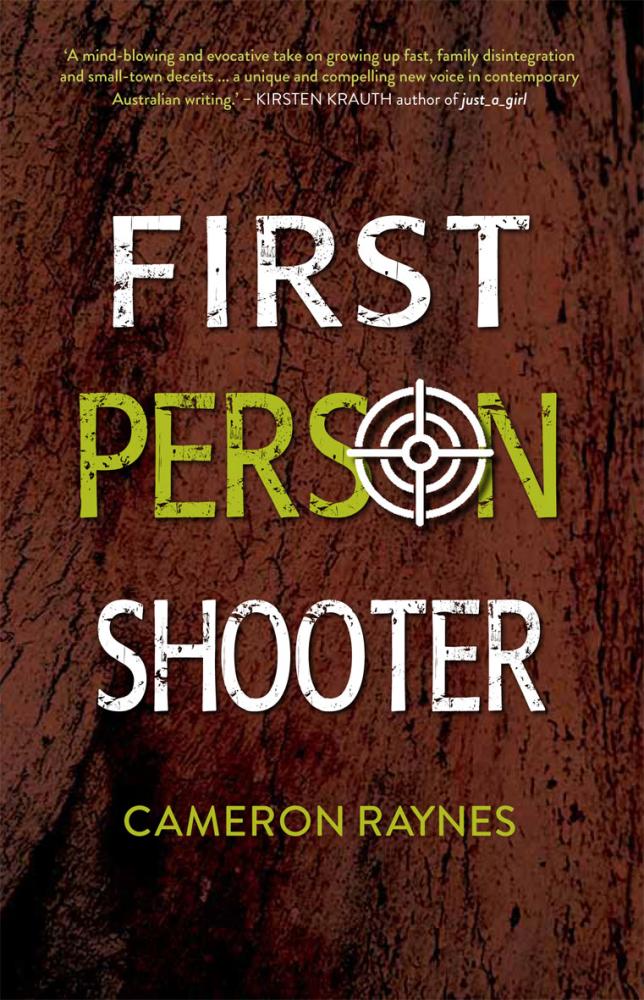 A member of the global stuttering community from Australia reached out to me and asked if I would read his new book. I was delighted, as I always enjoy reading about stuttering.
I recently read “First Person Shooter,” written by Cameron Raynes, a person who stutters. The book is a young adult novel, with some adult themes. The book is narrated by young Jayden, a 15 year old boy who stutters. Jayden is addicted to video games and has a crush on his best friend Shannon.
The story is pretty intense, loaded with characters who all have their own story. Jayden and his father are surviving after losing his mother 12 years earlier. Shannon’s mother is due to be released from prison. Jayden is constantly trying to outrun a couple of school bullies. He has a part-time job at a meat shop and looks in on his neighbor, a disabled veteran. The town is bracing for violence from Pete, who is looking to exact revenge for the murder of his father. And Jayden’s beloved dog is dying.
There is a great deal I could focus on in this gritty coming of age story. For the purposes of this blog, I’ll focus primarily on the stuttering. Stuttering is not always portrayed well in the media and the arts, so I was eager to see how the author incorporated it into the story.
The first thing I’ll say is the stuttering experience is beautifully handled. It is obvious that the writer has first hand experience with stuttering. He nails Jayden’s struggle with having much to say, but feeling unable to express himself the way he wants. Jayden has a love of poetry but can’t make his own words flow.
Jayden shares many real and poignant feelings about his stuttering, which at 15, he realizes will be with him for life. Early on, he reflects that “to speak is to be human,” inferring that perhaps he doesn’t always feel human because of the way he talks. When he speaks, his words are ugly. He escapes these feelings by getting lost in his video games.
Jayden also thinks that deep down, something is wrong, that he is broken inside. That is not unusual for a teen who stutters to feel. I sure felt defective when I was his age and often wondered, “Why me?”
Jayden also describes the dread of sitting in class and having the teacher go around the room and know that he is not going to be able to get out of speaking. He speaks of scanning ahead, which is a trick that many people who stutter use to avoid stuttering. In class, he has also tried being funny, to draw attention away from his stuttering, which doesn’t always work.
Jayden has a circle of friends who accept him. Several of them have also been picked on by the school bullies, so they are a small group with commonalities. Jayden appreciates his friends because he can be himself and not be consumed by the constant worry of how he will sound and how they will react.
Throughout the story, Jayden dreads an oral poetry presentation he must do before the end of the school year. Anyone who stutters can empathize with Jayden’s terror of having to speak and stutter for a prolonged period of time. It can be a harrowing experience for an adult, and this is an adolescent dealing with the cruelty of teens. Jayden gets through the experience and closes the door on another school year.
I highly recommend this book for teens or adults who stutter and anyone for that matter. It is well written, with an honest, believable character who stutters. The author lets us into Jayden’s head and we get how tough stuttering can be. Most fluent people don’t really “get” stuttering. Raynes masterfully weaves Jayden’s stuttering into a story that is dramatic, intense and satisfying. You feel for the kid and applaud his tenacity and courage on many fronts. You’ll have to read it yourself to know what I mean. And I hope you do.
Comedy And Stuttering
Posted on: March 15, 2016
- In: Posts
- 5 Comments
I recently had the opportunity to attend a comedy show, headlined by Drew Lynch, a person who stutters. Drew was featured on last season’s reality TV show, “America’s Got Talent” (AGT.) Drew did stand-up comedy on the TV show and wound up finishing the talent competition in second place.
Drew did not grow up as a stutterer. He claims he began stuttering a few years ago, after being injured in an accident. He was hit in the throat by a softball and began stuttering. He had aspirations to be an actor and decided to try his hand at stand-up comedy when fate intervened and he was injured.
I remember last year when Drew was on AGT. A lot of people in the stuttering community did not find him funny and did not think it was cool to make fun of stuttering. Audiences laughed at his stuttering jokes and the way he made fun of himself. He almost always laughed himself after telling a joke.
I found him to be funny and his humor appropriate, but was only seeing him in 3 minute segments.
When I heard he was coming to my hometown to headline a comedy show, I was very interested in seeing him perform. I wondered how he would handle performing for a longer stretch. And I wondered how my hometown audience would react to a comedian that stutters.
My sister had asked me to go with her to the show, which was a surprise, as I didn’t think she would be interested in seeing someone who stutters. She and I don’t talk about stuttering. It’s always been a taboo topic in my family and continues to be so, even though I am very open and public about my stuttering.
So we went to the show and had a great time. There were two opening acts, one which was very funny and the other was just OK. Neither of them stuttered! 🙂
When Drew came out to perform, he immediately started with a joke about stuttering. He laughed and the audience laughed. Drew went on to perform for almost an hour, which I marveled at, given that it’s a long time and a lot of material to remember for the performance.
His material was not all stuttering related. He had funny jokes about every day life which the audience enjoyed. About half of his material was related to stuttering, and making fun of his own stuttering. I think his willingness to poke fun at himself and laugh at his own jokes and funny stories gave the audience permission to laugh. And laugh they did. It appeared everyone in the packed room was having a great time.
I posted something about having attended this comedy show on Facebook. Several people commented that it is not good to laugh at stuttering, because it opens the door for anybody to laugh at stuttering.
I say that most people can appreciate the context and will not laugh at someone stuttering just because they happened to laugh at a stuttering comedian.
After the show, Drew stayed around to meet and greet fans and signed autographs and took pictures. The line was so long, which was a great sign that the audience had enjoyed Drew’s performance. I did not stay to talk to him, although I really wanted to let him know that I stutter too.
Turns out, after my sister drove me back to my car, she went back and stood in the line to get an autograph and a photo. Guess she really enjoyed the performance.
So, what do you think? Is it OK to laugh at someone who stutters when they are telling jokes and making fun of their own stuttering?
Stinking Thinking
Posted on: March 8, 2016
I recently asked a question on one of the Facebook stuttering forums. I was interested in what people think about when stuttering. So I posed the question, “What do you think about during a moment of stuttering?”
I was amazed by the number of responses. This question drew about 40 comments.
And guess what? Most of them were negative. People shared that what they think during a stuttering moment is usually tied to shame.
Here’s a sampling of the responses.
Embarrassment.
“I should have kept quiet.”
“I’m thinking about what the other person is thinking.”
“Panic, panic, panic.”
“My mind goes blank.”
“When will this be over?”
“Scanning my brain for words I can substitute.”
“Please just let this moment end.”
“Why do I bother?”
“Uh oh, too late.”
“Here we go again.”
“How stupid I sound right now.”
“I hope my face isn’t getting red.”
What do you think? What goes through your mind when you are in a stuttering moment? Is there anything we can do to change the way we think so that it’s not negative or shameful?
I am definitely guilty of wondering what the other person is thinking when I’m stuck in a block. I wish I could get myself to think, “it’s OK, I got this.”
Stutterer Wins The Oscar
Posted on: February 29, 2016
- In: Posts
- Leave a Comment
“Stutterer” won the Oscar last night at the Academy Awards for best live action short film. It was up against 4 other short films and clearly moved audiences. The Academy got it right by bestowing the award on “Stutterer.”
Have you seen it yet? It is only 12 minutes long and you can buy it from YouTube and make it part of your personal library.
The stuttering community is abuzz about the film, with people offering mixed feelings about how the character’s stuttering was portrayed. People are also talking about how they feel about another character with “flawed” communication being the one to interact with the stutterer.
The film really helps put into perspective the whole notion of imperfections.
Do check it out when you can.
 Episode 151 features Nora Sadik, who hails from Urbana, Illinois. Nora is a Master’s student at the University of Illinois at Urbana-Champaign. She is studying environmental engineering with an emphasis on water quality in the developing world. She enjoys creative activities such as painting and cooking and also enjoys live music.
Nora shares that she has always had a pull toward human health. She’s had a drive to help people, but it’s really the people helping her.
Listen in to a great conversation that covers a lot of ground. We talk about how women don’t take as many risks, that we’re perhaps wired to be cautious and protect ourselves. We relate that to women who stutter, and talk about protecting ourselves based on who we are and our feelings about stuttering.
We talk about thinking about what the other person is thinking about us when we are in conversation. We create fear, which can be consuming and exhausting.
And we talk about Nora’s experience as a Keynote speaker at a conference for girls called “Authentic Voices.” She shares that her talk was about her journey toward self-acceptance with her speech and how self acceptance of any challenge we have is important to empower girls.
The music used in today’s episode is credited to ccMixter.
- In: Posts
- Leave a Comment
Spoiler alert!!!!
I recently went to see the short film “Stutterer,” which was shown as part of five short films nominated for Oscars in the live action category. It is exciting to see another film about stuttering up for an Academy Award. Hopefully it will ignite stuttering awareness.
The short film is only 12 minutes long, but packs a punch. On opening, you see the main character, Greenwood, struggle to speak on the phone. Later in the film, we see Greenwood’s father make the phone call for him.
The film conveys how much of a struggle it is for Greenwood to speak, yet in his head, the words flow eloquently and effortlessly.
He is lonely, because he is terrified of communicating with anyone. He is studying sign language and pretends to be deaf so he can communicate without having to speak verbally.
The crux of the film centers around a relationship he has with a beautiful girl he has met online. He can communicate with ease as he types out witty responses to this girl.
But soon she wants to meet in person. She writes him suggesting a meet up, as she is planning a visit. This brings him to a panic, and he doesn’t respond to her right away.
She assumes his non-response means that he doesn’t want to meet. Finally, after much delay, he gets up the courage and writes to her saying he’d like to meet if she was still interested.
When they meet, he discovers she is deaf and communicates through sign language.
The short film was deeply satisfying and left me wanting more. I wanted to see what became of their meet up and if they started dating. I wanted to see if he got up the courage to seek out speaking situations despite his severe stutter.
I felt the character’s stuttering was very realistic, as was his fear of negative social reactions and judgement.
My concern is the portrayal of sign language as a viable alternative to speaking. I worry that stutterers will see this film and get the idea that using sign language to avoid speaking is OK. That’s not the message we should send to the stuttering community, especially young people who have not yet found their voices.
The film is a romance and really doesn’t aim to raise stuttering awareness. But maybe the title will do the trick and get people talking about stuttering which always provides a good opportunity to educate and raise awareness.
The Power Of Disclosure
Posted on: January 13, 2016
- In: Posts
- Leave a Comment
In one of the stuttering groups, a woman recently shared her experience with disclosing her stutter to a guy she liked. She was surprised that he was actually OK with it.
She thought he was going to reject her because she stutters. She further shared that she felt so much more comfortable knowing that he knows. They have gone on a couple of dates and are enjoying their new relationship.
Disclosing that we stutter has so many benefits. Like this woman shared, it made her feel relieved that her partner knew. She didn’t have to work to keep it hidden, like she said she had done in the past.
Trying to hide stuttering is a lot of work. I know, as I did it for years. I was always tense and afraid that I’d be exposed as a stutterer and people would think less of me as a person. Or would reject me. That was always my biggest fear – rejection.
So I switched words, avoided speaking and pretended to be a shy introvert, something that I am not. I felt such relief when I stopped trying to hide my stuttering and just stuttered openly and actually talked about it.
People’s reactions were surprising to me at first, just like the woman in above’s anecdote. Most people didn’t care – it was like disclosing that I am left-handed. So? There’s nothing wrong with being left-handed, just like there’s nothing wrong with stuttering.
And many people already knew that I stutter, which was a big surprise. I always thought that since I didn’t talk about it and worked so hard to hide it, that I of course no one knew I stuttered. Wrong!
Disclosing that we stutter also lessens anxiety, as we are not so fearful that we are going to be found out. And disclosure also often leads to a real connection with another person. By being brave enough to disclose, often another person will share something personal about themselves and before you know it, a connection is formed.
Finally, disclosure that we stutter opens the door to questions. Often, we’ll find that people are very interested in learning more about stuttering and will ask questions. They were just waiting for us to signal that it was OK.
Disclosure can be powerful. It can open doors for us that we thought maybe were closed. And that brings good things to life.
The Stare Factor
Posted on: December 7, 2015
It’s that time of year. Restaurants and bars are very busy, with people getting together for the holiday season. People are often very close to you when you are ordering food or drink, just because the places are busier than at other times of the year.
Has this ever happened to you? You’re placing your order at the bar and stuttering extremely well. It’s loud at the bar, so you are speaking a bit more loudly than usual, so stuttering loudly. As you are trying to remain composed, you are aware that the person next to you is staring at you with great interest.
Your face turns red, as you are aware that the person is probably trying to figure out what the hell is happening next to him. You can read his facial expression. You can see a “WTF?” spread across his face. What do you do?
I usually don’t like to draw more attention to myself when stuttering publicly like this, but sometimes “the stare factor” demands some type of response.
Resist the urge to say something smart, like, “do you want to take a picture? It will last longer.” That’s childish. I used to say that when I was younger when I would get angry when someone was obviously staring at me or a friend when we were out. Not necessarily for stuttering, but for just about anything.
As an adult, when this has happened to me, I’ve reacted several ways. I’ve said or done nothing, just dealt with the embarrassment, got my order and moved away. That is not very satisfying, however, and sometimes leads to negative self-talk.
One way I’ve dealt with this is when I turned to the “starer” and very calmly said, “haven’t you ever heard anyone stutter before? It’s OK, I’m OK, thanks for the concern.” That caused the “starer” to get a little embarrassed, which was not my intention but allowed me to be assertive and not left feeling embarrassed myself.
What about you? Has this ever happened? How have you responded? It can be extremely annoying when this happens but we can have the upper hand and leave the situation with our dignity intact if we can figure out a good comeback. Let me know your thoughts.
Using Speech Techniques
Posted on: August 27, 2015
- In: Posts
- Leave a Comment
I am not a fan of using fluency shaping techniques. When I participated in speech therapy about 6 years ago, I was really resistant to the traditional techniques that would theoretically make my speech more fluent. I felt like the therapist was trying to “fix me” and I didn’t need fixing, then or now.
But lately, I have been feeling quite self-conscious when answering the phone at work and stuttering on the same word, every time. I’ve been helping to answer the phones more over these summer months because we are short staffed and we all pitch in to help.
When we answer the phone, we state the name of our school building so that the caller knows they have reached the right building. It’s a three word name, and I always stutter on the third word. Every single time. And it’s been bothering me that I stutter like that identifying our school name.
I can’t quite identify why it’s making me feel uncomfortable, because if I stutter later in the conversation, it doesn’t really bother me. It must just be something about those introductory words that I want to be able to say smoothly and confidently. Maybe it doesn’t feel confident to stutter on the same word every time.
So, I’ve been using a prolongation technique on the first letter of the third word, so I can slide into it without repeating the letter/sound. It’s working, as long as I concentrate and remember to do it. I am not feeling as self-conscious when answering the phone.
What I am feeling like is a little bit of a hypocrite. I have not wanted to use fluency techniques because I am comfortable with myself as a stutterer. But here I am, feeling uncomfortable and resorting to a technique.
Hopefully, I’ll get over this quick. Have you ever experienced conflicted emotions about using fluency techniques?
 Make Room For The Stuttering
What people are saying!