Archive for the ‘Posts’ Category
Fluent Or Fluid
Posted on: July 28, 2016
I participated in a great conversation yesterday with people who stutter from around the world, in a Stutter Social group video chat. The discussion started out with one person asking for tips about giving presentations. He had one coming up at school and was nervous that his stuttering would interfere with his ability to do a good job.
Several people offered suggestions, such as practicing, trying not to read verbatim from notes and advertising that you stutter before beginning the presentation. One person suggested that he try and be as fluent as possible. He talked about practicing speech techniques daily in order to achieve fluent speech.
I couldn’t pass up the opportunity to chime in that I thought this was an unrealistic goal. People who stutter are going to stutter and we should not strive for fluency. In my opinion, that often results in feelings of disappointment and failure, which just exasperates our stuttering.
Instead, I suggested that we aim for being fluid while communicating. Being fluid can be described as having or showing a smooth and easy style. That’s what I shoot for when I am giving presentations.
My years of Toastmasters training helped me build excellent speaking skills, which I use every day. I’ve grown comfortable with eye contact, gesturing, vocal variety, and speaking without using notes. I became a much more fluid speaker when I began to focus on what I was saying and trying to convey. In other words, I wasn’t trying to be perfectly fluent.
I am a more natural and comfortable speaker when I move easily from topic to topic with good transitions and flow. I am more fluid when I am very comfortable with what I am talking about so that I don’t need to use notes.
You can stutter and be a very effective communicator. Stuttering doesn’t have to interfere with the message you are conveying. As the name of this blog implies, you can make room for the stuttering by being fluid, going with the flow, being comfortable when speaking and enjoying the experience.
Making room for the stuttering will help lessen any anxiety you have about trying to be perfectly fluent. That’s just not going to happen for people who stutter.
Six Degrees Of Stuttering
Posted on: July 18, 2016
- In: Posts
- Leave a Comment
Six degrees of separation is the theory that everyone and everything is six or fewer steps away, by way of introduction, from any other person in the world, so that a chain of “a friend of a friend” statements can be made to connect any two people in a maximum of six steps.
I think the same theory exists in the stuttering community. Last week, I had the opportunity to meet so many wonderful people from all over the world at the joint conference of the National Stuttering Association (NSA) and the International Stuttering Association (ISA) in Atlanta, Georgia.
I did not get a chance to meet everyone I wanted to at the conference, but I feel I am just one introduction away from meeting those who I didn’t. I met Keisuke from Japan and he introduced me to another friend of his from Japan. Keisuke and I will work together on the board of the ISA and will likely really get to know one another. We had some trouble communicating because his English is not strong but we are connected through stuttering.
I met Bruce and John from Australia and felt an instant connection with both of them. We talked and laughed like we were old friends, but in fact we had just met. And it was great to meet Cameron, also from Australia. He is the author of the book, “First Person Shooter,” which I read and reviewed for this blog several months ago. When I finally met Cameron, I felt like I already knew him.
I have been in contact with Nancy from Western Australia who was going to come to the conference but her plans changed at the last minute. We had a chance to meet last night through Stutter Social – for the first time, she joined in the group video chat and we finally met and talked, and again, I felt like I’d already been connected to her.
It’s funny how connected we all are in the stuttering community. Technology has allowed our worlds to become much smaller and we connect through social media and Skype and Google Hangouts and it feels like we already know each other.
I can’t wait to continue to be introduced to more and more members of the community and share our similar stories. It is special to be so inter-connected with people world wide.
Being Part Of A Tribe
Posted on: July 14, 2016
 Seth Godin in his book “Tribes” writes:
“A tribe is any group of people, large or small, who are connected to one another, a leader, and an idea. For millions of years, humans have been seeking out tribes, be they religious, ethnic, economic, political, or even musical (think of the Deadheads). It’s our nature.”
People who stutter are connected. That is never more evident than at a stuttering conference.
I just returned from the National Stuttering Association‘s 33rd annual conference, which was held this year in Atlanta, Georgia. The conference was held jointly with the International Stuttering Association‘s World Congress For People Who Stutter, so there were people at the conference from all corners of the world. We came together 825 people strong to celebrate the connection that we have with each other – stuttering.
First timers to the conference and veterans alike all feel an instant connection when they meet someone else who stutters. We feel an incredible sense of community, empathy, freedom and vulnerability. Sharing these feelings and connections together makes us a tribe, at least as far as I’m concerned. And I like being a part of this tribe.
I feel full and whole when I am with other people who stutter. I feel gratitude when other people “get me” without me having to fully explain myself or how I feel about stuttering. A new friend I met at the conference, Dustin, put it quite simply and well: “I’ve never felt more human.”
This was my 11th consecutive conference and I felt the same emotions and sense of family that I did at my very first conference in 2006. I met a lot of first timers this year, who got to experience the life changing impact that being part of a tribe, or community, has on us. I heard first timers comment that they felt instantly loved and connected upon entering the mix.
And I heard veterans reflect on how amazing it is to catch up with old friends and meet new ones as well. I seized that opportunity – I hung out with friends from previous conferences but also made it a point to meet and interact with as many new people as I could. It was so gratifying to meet people in person that I’d already “met” online in the many stuttering communities, which are also our tribes.
I am at my best when I am with my stuttering community. I feel the sense of belonging and wholeness that I don’t feel in other parts of my life.
The workshops, keynote speakers, and conversations in the hotel lobby and bar, and over dinner, were priceless. But more so was just the general sense of community and being with my tribe. That sense of community was palpable and hung in the air.
It was a great conference. I feel a little “let down” now that I’m home but writing and reflecting always helps me, as does carrying my tribe in my heart.
Is Stuttering Part Of Your Identity?
Posted on: July 1, 2016
- In: Posts
- 3 Comments
When I think of my identity, I think of things like brown hair, blue eyes and being short. I think of the tattoos I have and the fact that my initials spell my name.
I also think of my stuttering when I think of my identity. Stuttering makes me unique. It is very much a part of my identity. People know me for my stuttering. I’ve heard people at work (a school) refer to me as, “You know, the one that stutters.”
Dictionary.com defines identity as a noun: condition or character as to who a person or what a thing is; the qualities, beliefs, etc., that distinguish or identify a person or thing.
So stuttering is one of my qualities, a distinctive characteristic that distinguishes me from other people.
There was a time when I thought stuttering was bad and shameful and I did everything I could to try and hide that part of me, that part of my identity. But I was never truly successful hiding it. It was there, not going anywhere, like my blue eyes are always going to be blue.
This reminds me of an exercise I do when I talk to kids who don’t stutter about stuttering. When explaining what it was like to try and hide my stuttering, I have the kids experience a physical and visual exercise. I ask for a volunteer from the audience and give the child a large grapefruit. I ask her to try and hide it somewhere on her body where it’s not going to show. The audience enjoys the child trying to hide it in her clothes – in her sock, in her pocket, in the hood of her sweatshirt. No matter where she puts the grapefruit, it’s lump can still be seen on the person. Trying to hide it is fruitless! 🙂
Like trying to hide stuttering was fruitless. It didn’t work. Over the years, I’ve grown to accept all parts of my identity, both the things I like and the things I don’t like so much.
Having identity makes us human. It makes us unique. It distinguishes us from the pack. Stuttering is part of my identity and I no longer try to fight that fact.
Accepting Acceptance
Posted on: June 22, 2016
We hear so much about acceptance in the stuttering community. It is important that we accept ourselves, perceived flaws and all, if we want others to accept us as we are.
Acceptance is one of humanity’s most basic needs. If you think back to psychology courses you took, you’ll likely remember Maslow’s Hierarchy of Needs. Love and belonging (or acceptance) is right smack in the middle of the needs that all human beings need in order to lead a fulfilled life.
It takes courage to accept acceptance into our lives. We live in a society where we are constantly bombarded by media images of perfection and many of us hold ourselves up to those images, aspiring to achieve goals that may never be achieved.
To truly accept yourself, you must have the courage to present yourself to the world as is and be proud of who you are.
People who stutter often have tremendous difficulty with acceptance. We feel different, we sound different, we are different. There are very few role models for us who stutter openly in the media. What images we have of stuttering in the media are often infused with negativity or comedy.
So it’s no wonder we might struggle with accepting acceptance. It’s not something that comes easily and for some people who stutter, they may never fully accept acceptance. They may strive for fluency and constantly be on the lookout for the next greatest program, therapy or medication that promises to eliminate stuttering. They want to live up to those media images of perfection, where no one stutters.
Accepting acceptance doesn’t mean that we can’t still explore ways to manage or improve our speech. We may be interested in stuttering more comfortably and with less tension. That’s not a sell out to acceptance. It just means that we want to be the best that we can be with what we have.
It took me years to allow acceptance into my life. I was ashamed of stuttering for so long, because of all of the negative external messages that I internalized. For me, it was and still is a journey. Shame still creeps in occasionally and it’s in those moments that I actively remind myself that I am good, that I am whole, that my difference is OK and that I am enough. I think when I do that, I’m accepting acceptance.
What do you think of accepting acceptance? Have you?
That Space Between
Posted on: June 9, 2016
- In: Posts
- Leave a Comment
What goes through your head during that space between words when you are stuttering? You know what I mean, that often long pause that creates space between two words while you are having a block.
Is it something that you think about? I have. Not often because my blocks aren’t too long, but every once in a while I get one that seems long and definitely creates that space.
I often feel anxious, as it isn’t natural to have long pauses between words. Even when that is done intently by a speaker for emphasis, that space is often not as long as one created by a stutterer.
Sometimes I think to myself, “Oh no, not now.” Or I think, “What are they thinking?” I try to re-frame my thoughts and sometimes think, “Oh good, a moment to catch my breath.” Especially when I am presenting, I can use that space to compose myself and prepare for the fluent word that inevitably comes after the space.
Fluent people probably never give this a thought.
Remember To Breathe
Posted on: June 4, 2016
 It always surprises me to hear one person who stutters advise another person who stutters to remember to breathe when facing a stressful speaking situation. It’s not something like remembering to turn off the coffee pot before leaving the house. For that, you have to consciously focus on the act of walking over to the coffee pot and powering it off.
Breathing isn’t like that. There’s isn’t an “on-off” switch that we need to remember to push. It’s not mechanical. Breathing comes automatically. We do not think about doing it. We just do it. Like the Nike slogan. The human body comes equipped with the innate ability to do that which keeps us alive. Unless of course we are injured or gravely ill and mechanical breathing is indeed needed for breathing.
So why then do we often hear people reminding us to breathe? I often get annoyed when people who don’t stutter offer me that advice. Like I have a choice. Like there is a button to push. As if “just breathing” was enough to stop stuttering.
It’s not that easy. Stuttering is a neurologically influenced disorder which interrupts the normal flow of speech. Breathing, which we already do without thinking about it, does not improve our stuttering.
I see and hear this a lot in the stuttering community. Someone will post on a forum that they are nervous about an upcoming job interview and ask for advice. Inevitably, someone will write, “remember to breathe.” That thought doesn’t enter my mind when I am faced with a challenging speaking situation. I am usually thinking about a strategy I can use to lessen repetitions or to get out of a block. Breathing isn’t a trick to pull out of the speech tool bag.
Why do you suppose people who stutter offer this advice to other people who stutter? Is it because they can’t think of anything else?
Amazing Communication Skills
Posted on: May 16, 2016
For years, I believed that stuttering could not be used in the same sentence as effective communicator. The two did not equate. Stuttering to communication was like a bull in a china closet – not going to work.
But ever since I joined Toastmasters and practiced public speaking and realized that I could communicate effectively, things changed. I began to believe in myself as a communicator and others did too. I’ve been asked to speak to many groups about my stuttering journey, something I never imagined myself doing when I was younger.
Last week, I had the opportunity to speak to a high school science class about the neurobiology of stuttering.The students were a great audience and asked thoughtful questions. They also provided me with great feedback.
These are just a few of the comments students emailed me the day after the presentation:
“Listening to you speak was amazing. You’re so confident and knowledgeable on the topic and it was truly inspirational.”
“Your ability to conquer your fear of stuttering was inspiring. I wish I had your amazing communication skills.”
“I truly admire the courage it took for you to present to us! You are an inspiration and I hope you know what a great communicator you are!”
It was so gratifying to talk to these kids and have them share that they think someone who stutters can still be a great communicator.
We CAN be great communicators. Remember, there is so much more to effective communication than being fluent. Speaking regularly and getting feedback proves that.
Stuttering Awareness Week 2016
Posted on: May 9, 2016
- In: Posts
- Leave a Comment
This week is National Stuttering Awareness Week in the United States. It’s an opportunity for people who stutter to talk about stuttering to those who don’t, to educate and raise awareness.
There are many ways to advertise and promote stuttering awareness. Here are a few.
1. Consider wearing a stuttering awareness tee-shirt, wrist band or lapel pin to work or out in the community. If people ask about it, mention you stutter and take the opportunity to explain what it is and how it feels.
2. In your office, display posters or a coffee mug that says something about stuttering. (These items can be found in the store at the National Stuttering Association.)
3. Consider contacting a radio station and asking if you can make a public service announcement (PSA) about stuttering.
4. Read blog posts or articles or literature about stuttering to educate yourself more about stuttering. Great free resources are available at The Stuttering Foundation.
5. Stutter openly this week. If you are usually covert about stuttering, try to give yourself permission to stutter openly. Be open if people have questions about your speech.
This week I am speaking to a high school senior class that is specific to scientific research and public health. I will be addressing my personal experience with stuttering along with talking about the neural and genetic basis of stuttering. I have asked the class to read an article about stuttering research so we can discuss it during my presentation.
I have also submitted a brief article to my local newspaper about how important listening is when engaging with someone who stutters. I am hoping it will be published this week.
What will you do this week?
The Stuttering ID Card
Posted on: April 11, 2016
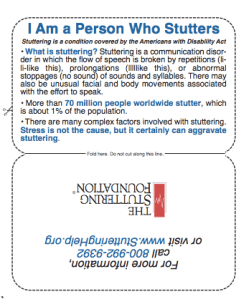 Up to this point, I’ve been quiet about the Stuttering ID Card that has been created by the Stuttering Foundation for people who stutter to carry in their wallet. This card was created in response to an incident that occurred at an airport where a person who stutters claims to have been detained because of her stuttering.
When I first heard about it, I did chime in on Twitter to say there is going to be hundreds of people who stutter coming through the airport in July for the annual conference of the National Stuttering Association. But I’ve been quiet since, as there has been no word from the airport about what happened and there is always two sides to a story.
The young woman has garnered a lot of attention in the stuttering community. She has written articles for the Huffington Post and was also featured in The Mighty.
Recently, I saw that the American Speech-Language-Hearing Association wrote about the ID card on their blog, The ASHA Leader.
So, now, two prominent organizations have advocated that people who stutter carry this card when going through customs at airports, to help explain that they stutter.
I wouldn’t feel comfortable carrying this card. I don’t need a piece of paper to state that I stutter. I can tell people that myself, if it becomes necessary. Sometimes, it’s very obvious that I stutter, sometimes not so obvious. There are times when I feel comfortable advertising that I stutter and times where I am not.
I’m curious. How do you feel about this? Would you carry this card with you when traveling?
Looking At Ourselves Stutter
Posted on: April 5, 2016
- In: Posts
- Leave a Comment
A very courageous poster today made a comment in a Facebook stuttering group about how hard it is to watch himself and other people who stutter on video.
He shares very honestly that he can’t stand to see himself stutter and can’t bring himself to watch other people who stutter either. For him, it’s not a way of desensitization, but rather a form of torment.
This made me think about how hard a time I had when I was asked to make a video of myself stuttering when I did speech therapy some years back. I remember quite vividly how much I resisted doing it. I just did not want to see myself stutter. I felt my stuttering was ugly and I was aware of how I tensed up when I blocked and I just did not want a video reminder of that.
My speech therapist at the time really wanted to deconstruct my stuttering with me and felt strongly that viewing my stuttering was the best way to do it. She also wanted to be able to “count” my stutters as part of required data collection for her class. I hated that too, as I felt it made me nothing more than a piece of data to be collected and not really a person who just happens to stutter.
It took me the whole semester to allow her to record me doing a very short monologue where I hardly stuttered at all. Even looking at that with her, with very little stuttering, made me feel self-conscious and embarrassed. I just didn’t like to see myself on video. I didn’t believe it could be helpful.
Fast forward, about 9 years later, and I find I am one of the people posting a video of me talking and stuttering in some of the Facebook groups. Something I never thought I could or would do, now I am doing with ease and posting publicly on the Internet. Wow!
What’s changed? Mostly, my attitude. I have reached a point in my life where I am OK with my stuttering and feel that I can help educate and raise awareness about stuttering. I am OK with looking at myself and hearing myself on video. I think most of this comes with maturity and experience and a good dose of “I don’t give a crap.” 🙂
I am in awe of all the members in the stuttering groups who have taken a risk to post videos of themselves talking about their story with stuttering. Some of them have acknowledged that they are new to the community and have never met another person “in real life” that stutters. Through posting video stories, people are seeing and hearing other people who stutter and I think that it’s great to lessen feelings of isolation, which are common for people who stutter.
I’m glad that the poster had the guts to share how he really feels about seeing stuttering. It certainly gave me pause to reflect on where I’ve been and where I am at now.
I’m curious what you think. Have you ever seen a video of yourself talking and stuttering? How did it make you feel? Would you be willing to post a video of yourself in a stuttering forum on the Internet?
Book Review: First Person Shooter
Posted on: March 29, 2016
- In: Posts
- Leave a Comment
 A member of the global stuttering community from Australia reached out to me and asked if I would read his new book. I was delighted, as I always enjoy reading about stuttering.
I recently read “First Person Shooter,” written by Cameron Raynes, a person who stutters. The book is a young adult novel, with some adult themes. The book is narrated by young Jayden, a 15 year old boy who stutters. Jayden is addicted to video games and has a crush on his best friend Shannon.
The story is pretty intense, loaded with characters who all have their own story. Jayden and his father are surviving after losing his mother 12 years earlier. Shannon’s mother is due to be released from prison. Jayden is constantly trying to outrun a couple of school bullies. He has a part-time job at a meat shop and looks in on his neighbor, a disabled veteran. The town is bracing for violence from Pete, who is looking to exact revenge for the murder of his father. And Jayden’s beloved dog is dying.
There is a great deal I could focus on in this gritty coming of age story. For the purposes of this blog, I’ll focus primarily on the stuttering. Stuttering is not always portrayed well in the media and the arts, so I was eager to see how the author incorporated it into the story.
The first thing I’ll say is the stuttering experience is beautifully handled. It is obvious that the writer has first hand experience with stuttering. He nails Jayden’s struggle with having much to say, but feeling unable to express himself the way he wants. Jayden has a love of poetry but can’t make his own words flow.
Jayden shares many real and poignant feelings about his stuttering, which at 15, he realizes will be with him for life. Early on, he reflects that “to speak is to be human,” inferring that perhaps he doesn’t always feel human because of the way he talks. When he speaks, his words are ugly. He escapes these feelings by getting lost in his video games.
Jayden also thinks that deep down, something is wrong, that he is broken inside. That is not unusual for a teen who stutters to feel. I sure felt defective when I was his age and often wondered, “Why me?”
Jayden also describes the dread of sitting in class and having the teacher go around the room and know that he is not going to be able to get out of speaking. He speaks of scanning ahead, which is a trick that many people who stutter use to avoid stuttering. In class, he has also tried being funny, to draw attention away from his stuttering, which doesn’t always work.
Jayden has a circle of friends who accept him. Several of them have also been picked on by the school bullies, so they are a small group with commonalities. Jayden appreciates his friends because he can be himself and not be consumed by the constant worry of how he will sound and how they will react.
Throughout the story, Jayden dreads an oral poetry presentation he must do before the end of the school year. Anyone who stutters can empathize with Jayden’s terror of having to speak and stutter for a prolonged period of time. It can be a harrowing experience for an adult, and this is an adolescent dealing with the cruelty of teens. Jayden gets through the experience and closes the door on another school year.
I highly recommend this book for teens or adults who stutter and anyone for that matter. It is well written, with an honest, believable character who stutters. The author lets us into Jayden’s head and we get how tough stuttering can be. Most fluent people don’t really “get” stuttering. Raynes masterfully weaves Jayden’s stuttering into a story that is dramatic, intense and satisfying. You feel for the kid and applaud his tenacity and courage on many fronts. You’ll have to read it yourself to know what I mean. And I hope you do.
Comedy And Stuttering
Posted on: March 15, 2016
- In: Posts
- 5 Comments
I recently had the opportunity to attend a comedy show, headlined by Drew Lynch, a person who stutters. Drew was featured on last season’s reality TV show, “America’s Got Talent” (AGT.) Drew did stand-up comedy on the TV show and wound up finishing the talent competition in second place.
Drew did not grow up as a stutterer. He claims he began stuttering a few years ago, after being injured in an accident. He was hit in the throat by a softball and began stuttering. He had aspirations to be an actor and decided to try his hand at stand-up comedy when fate intervened and he was injured.
I remember last year when Drew was on AGT. A lot of people in the stuttering community did not find him funny and did not think it was cool to make fun of stuttering. Audiences laughed at his stuttering jokes and the way he made fun of himself. He almost always laughed himself after telling a joke.
I found him to be funny and his humor appropriate, but was only seeing him in 3 minute segments.
When I heard he was coming to my hometown to headline a comedy show, I was very interested in seeing him perform. I wondered how he would handle performing for a longer stretch. And I wondered how my hometown audience would react to a comedian that stutters.
My sister had asked me to go with her to the show, which was a surprise, as I didn’t think she would be interested in seeing someone who stutters. She and I don’t talk about stuttering. It’s always been a taboo topic in my family and continues to be so, even though I am very open and public about my stuttering.
So we went to the show and had a great time. There were two opening acts, one which was very funny and the other was just OK. Neither of them stuttered! 🙂
When Drew came out to perform, he immediately started with a joke about stuttering. He laughed and the audience laughed. Drew went on to perform for almost an hour, which I marveled at, given that it’s a long time and a lot of material to remember for the performance.
His material was not all stuttering related. He had funny jokes about every day life which the audience enjoyed. About half of his material was related to stuttering, and making fun of his own stuttering. I think his willingness to poke fun at himself and laugh at his own jokes and funny stories gave the audience permission to laugh. And laugh they did. It appeared everyone in the packed room was having a great time.
I posted something about having attended this comedy show on Facebook. Several people commented that it is not good to laugh at stuttering, because it opens the door for anybody to laugh at stuttering.
I say that most people can appreciate the context and will not laugh at someone stuttering just because they happened to laugh at a stuttering comedian.
After the show, Drew stayed around to meet and greet fans and signed autographs and took pictures. The line was so long, which was a great sign that the audience had enjoyed Drew’s performance. I did not stay to talk to him, although I really wanted to let him know that I stutter too.
Turns out, after my sister drove me back to my car, she went back and stood in the line to get an autograph and a photo. Guess she really enjoyed the performance.
So, what do you think? Is it OK to laugh at someone who stutters when they are telling jokes and making fun of their own stuttering?


What people are saying!