Author Archive
No, I Didn’t Forget Where I Work
Posted on: August 17, 2017
Yesterday I answered the phone at work and stuttered on the name of the school I work at, as I often do. The caller immediately laughed and asked, “Did you forget where you work? Do you really wish you were at the pool?” For an instant, I felt that sinking feeling I get when I’ve been made fun of and I sensed my shoulders tighten and my face flush.
I sighed and then quickly said, “No, I stutter. Sometimes that happens.” The caller then gasped a little and apologized. She then paused and proceeded to tell me where she was from and what she wanted. She was from one of our district’s schools and needed some information which I was able to help her with.
She thanked me and apologized again. When we were done with the call, she wished me a good day and apologized a third time.
When I got off the phone, I was pissed. Not how I handled it, but that it happened. It still stuns me that grown adults react this way when someone stutters. I know she probably had no clue that I was a stutterer and thought she was making a joke. But still, not knowing who is answering the phone, a professional should not laugh like that and make matters worse by asking a dumb question.
I was happy I advocated for myself (and others!) by stating that I stutter and that stuttering happens sometimes. I feel she may have been embarrassed and I did not intend to embarrass her, but simply wanted to explain what she was hearing and that I hadn’t forgot where I worked.
I know this has happened to many of us who stutter. How do you react?
Teaching About Stuttering
Posted on: August 14, 2017
- In: Posts
- Leave a Comment
I had a wonderful opportunity to teach employees at a Fortune 500 company in NYC about stuttering last week. Three of us from the National Stuttering Association (NSA) spent about 90 minutes teaching basic stuttering 101 to employees who had volunteered to conduct mock interviews with people who stutter.
George, Chaya and myself (all three of us people who stutter) presented about what stuttering is, what it isn’t, whether there is a cause and cure, the variability of stuttering, common misconceptions, stuttering and effective communication and why people who stutter make good employees.
George had organized the “Mock Interview Day” at his workplace and had 15 people who stutter signed up to participate in interviews with company employees. The day included training the employees on interacting with people who stutter, 2 mock interviews for each candidate, feedback for the candidates, a panel discussion on differences and coming out in the workplace and networking.
The primary reason this day was so successful was that the employees were genuinely interested and receptive to learning about stuttering and for giving people who stutter the opportunity to sharpen their interview skills in a supportive environment.
Several employees that I spoke with mentioned how helpful it was to have learned some basic information about stuttering before doing the interviews. They found it very impactful to hear from people who stutter who were able to share facts and personal experience.
I was thrilled to have been part of the day. I love talking about stuttering to whoever will listen and we had a great audience on this day. The interview candidates felt it was a great day and they appreciated the time people took to make the event a success.
Over pizza at the end of the day, one woman who stutters approached me to talk . She was raving about how helpful the interviews were to her. She said she felt inspired to do something similar at her workplace to “give back.” We brainstormed a bit and left it that she was going to talk to someone in her HR department and I was going to follow up with her with an email early in the week. How inspiring is that? I would love to see future events held at companies all over. Such learning took place.
As I traveled home on the train, I reflected on how lucky I am that I “get to” talk to people who don’t stutter and teach them about the experience. Teaching people one person at a time creates a world that better understands stuttering. I am so happy to be a part of this.
Stuttering Is Variable
Posted on: August 8, 2017
- In: Posts
- Leave a Comment
I was talking to a friend of mine recently and she asked me about the different types of stuttering. I was intrigued by what she meant so asked her to elaborate. She said she has heard other people stutter and it’s very different than mine. She wanted to know why there were such differences.
I gave her the short answer – stuttering is variable. Severity of stuttering differs among individuals who stutter as does the impact of stuttering. A person can have a severe blocking type of stuttering and stutter or block on almost every speech attempt but it doesn’t bother them at all. Then you can have someone with a very mild stutter who is mortified every time they hear themselves stutter.
I told her there are also covert stutterers – those who clearly stutter but go to great lengths to hide it so they can appear as fluent. I told my friend that I did this for about 30 years and was absolutely miserable from the extra energy it took to hide and the feeling that I was being fraudulent by not letting my true self be seen. I also told her about the terror I always felt that my secret would be found out. She wondered how I managed for so long, and I told her about the various tricks that people who covertly stutter use to not stutter.
I told her about word substitution, little tricks like coughing, getting a running start, saying “ah” or “um” a lot or just plain choosing silence. I explained it was a lot like mental gymnastics to keep that up,
Stuttering is also variable for an individual. Fluency can vary significantly over the course of a day, hour, minute and depending what kind of speaking situation the person is facing. I can be very fluent for 30 minutes and then, seemingly like a drop of a hat, can’t get a word out. I’ll start blocking or repeating words or syllables and express frustration and even display some secondary behaviors, such as squeezing my eyes closed.
For some people who stutter, fatigue, stress and time pressure can increase their stuttering. And if a stutterer feels compelled to hide their stuttering, it can get generally more pronounced. The harder you try not to stutter, the more you’ll stutter.
My friend was amazed that I knew so much about stuttering and the different ways it can be seen and heard. She wanted to know where I learned all this.
I simply said, “I’ve lived it. Personal experience is the best teacher.”
Workplace Advocacy
Posted on: July 26, 2017
Yet another good workshop I attended at the recent NSA conference in Dallas was on workplace advocacy for those who stutter. The workshop was facilitated by two individuals who are working on a committee with me to increase workplace advocacy efforts and reduce the stigma of stuttering in the workplace. Hope is a speech language pathologist and a candidate for a doctoral degree and John is a person who stutters who has had great success in the workplace.
The workshop focused on audience discussion about what ideas we as a community have for reducing stigma around stuttering in the workplace. People came up with a lot of good ideas that our NSA committee will try to implement over the coming months.
The workshop also provided some statistics on stuttering and labor market outcomes. Both men and women who stutter made at least $7,000 less in annual earnings than men and women who don’t stutter. For women who don’t stutter, some evidence indicates the gap in earnings may be as large as $18,000. Those are big differences and certainly warrant increased workplace advocacy efforts.
The most common suggestion people made in the workshop was around networking. People who stutter believe that our networks will help us find jobs and that is true. Everyone, stutterer or not, should talk to people they know in the field, get references and recommendations and use networks such as LinkedIn to help with the job search process.
But I think there is more that needs to be done around workplace advocacy for stuttering. My vision is that employers understand stuttering and teach employees about stuttering just as they do about other differences in diversity and inclusion training. My hope is that the NSA will become a resource and support network for employers, not just for employees that stutter. More to come on that as our committee continues to expand our vision and sink our teeth into tangible outcomes for advocacy.
What are your thoughts on workplace advocacy for people who stutter? Do you think employers will find it useful to receive guidance and training from the NSA? How do you think we should go about doing that?
Stuttering And Social Justice
Posted on: July 14, 2017
- In: Posts
- Leave a Comment
 One of the great workshops that I attended at last week’s NSA conference was one facilitated by Kim Block on “Stuttering Community and Social Justice.” Kim asked the audience thought provoking questions about the group identity of the stuttering community and if we even have a group identity.
She got us thinking about the intersections between various segments of the stuttering community, such as people who stutter, speech and medical professionals, stuttering organizations, media and our allies. Kim asked us to do an exercise imagining the stuttering community as a business and how the different “departments” are linked together. She asked if we work together or in isolation as silos.
That bit about the silo got me thinking. Do the various entities in the stuttering community really work together? We know that the media does not always portray stuttering in a positive light. How could people who stutter, SLP’s, schools and our allies work together to influence the media to convey stuttering positively to the fluent world? In my humble opinion, I think that more people who stutter need to speak out and help educate those who do not stutter. That’s something that we as a community need to keep working on, since many people who stutter don’t like to expose that they stutter.
Kim’s workshop went on to challenge us to think about the elements of social justice: equality, oppression, resources and human rights. Do we have equality in the mainstream world? Do we have equal access to resources like speech therapy and self-help support groups? Are we discriminated against in schools and the workplace? Do stuttering organizations have equal access to fundraising like other organizations do?
The workshop was very well attended for the last slot of the last day. People shared good ideas and the questions spurred good conversation. Kim concluded with her final thoughts which all members of the stuttering community should heed. We are all advocates, we are all group interventionists, we are all connected which gives us opportunity and power.
It’s up to us, the stuttering community, whether and how we use that power. There are opportunities to raise awareness, which would lessen discrimination and misinformation. Members of the stuttering community have to seize those opportunities.
Hide And Speak: Covert Stuttering
Posted on: July 10, 2017
- In: Posts
- 4 Comments
I just returned last night from the 2017 NSA annual conference held in Dallas, Texas. I spent a week with some of the bravest, most resilient people I know. I’ve got lots of special moments to reflect on and share, but thought I’d start by providing a recap of the workshop good friend and SLP Charley Adams and I facilitated. We titled it – “Hide and Speak: The Allure of Covert Stuttering.”
We both wanted to explore the reasons why some people who stutter choose to hide and keep on hiding, even when it perhaps jeopardizes their authenticity. We started out loosely defining what covert stuttering is, and Charley led us through the life cycle of stuttering. This was a good primer for some of the people who were at the conference for the first time.
We then talked about escape behaviors, or what we actually do to hide our stuttering. Then we discussed secondary behaviors and the tricks we use to appear fluent. Later we talked about the degrees of covertness we may have and ways to gradually “drop the C” and aim to move from covert to overt.
One of the highlights of the workshop was an exercise I used in a previous workshop on covert stuttering. People were asked to pair up with a partner and each pair was given a copy of a one minute monologue to read to each other. On the bottom of the page was a large letter “O” or “I.” This signified that anywhere in the monologue that the reader ran across a word with the letter “O” in it, they couldn’t say it, but rather they had to replace it with a word with similar meaning and that also didn’t have the letter “O” in it. Then the other person in the pair had to do the same thing regarding the letter “I.”
It was an eye-opening exercise for people, especially for those in the room that did not stutter. People shared that they felt anxious, frustrated, drained, exhausted and that some gave up and didn’t finish reading. People who stuttered described the same reactions. The exercise was designed to illustrate how mentally hard it is to constantly have to switch words and think of other ones that made sense in the context of what was being discussed. All agreed that it was a valuable teaching tool.
Many people shared their experiences with hiding and we talked about how seductive hiding successfully can really be. People who covertly stutter often feel a thrill when they get away with not being exposed as a stutterer and it sets up as a pattern that is continued.
It was a great workshop. Charley and I got a lot of very positive feedback afterwards, and it definitely spurred good conversation and a different way of understanding covert stuttering. We also had over 120 people in attendance, which was an outstanding turnout.
Throughout the week and next week, I will share more about some of the special conference moments and provide an overview of other workshops.
Next year’s conference will be in Chicago. Start planning now to go. It’s worth it.
Let Me Finish – Male Episode 23
Posted on: June 30, 2017
 Episode 23 of the occasional male series features Ian Mahler, who hails from Salt Lake City, Utah. Ian is married and stays busy with three girls. He is also a full-time receiving manager for a large wholesale club. Ian works long days, usually 10-11 hours a day.
Listen in to a great conversation as we discuss acceptance, mindfulness techniques, and self confidence.
One of the things Ian does to advertise that he stutters is that he adds a line in his professional email signature that he is a person who stutters. He also has a line that reads #LetMeFinish. If someone cuts him off, he always finishes talking so that the person has to hear him anyway.
We wrap up the conversation talking about resilience and empathy.
The music used in today’s episode is credited to ccMixter.
Stand Up – Episode 170
Posted on: June 20, 2017
 Episode 170 features Pooja Vijay who hails from New Delhi, India. By day, Pooja is an academic, working as a researcher at a university think tank. She is an engineer. By night, Pooja does stand up comedy, and gets introduced as a stuttering comedian.
Pooja considers herself very lucky to have two jobs that she loves. For she does think of her stand up comedy as a second job. She got started at an Open Mic and got a good response and has been at it ever since. Both of her jobs involve lots of interacting and talking with others. She says we have to “keep speaking and doing our thing.”
Listen in as we discuss how Pooja has managed her stutter, resources for therapy and self-help in India, and how she feels stuttering is just a different way of speaking. She says stuttering is just part of her, like other diversities.
Pooja gives a shout out to fellow comedians Nina G and Drew Lynch, who inspired her to try comedy and keep at it.
The music used in this episode is credited to ccMixter.
Talking To SLP Students
Posted on: June 7, 2017
- In: Posts
- Leave a Comment
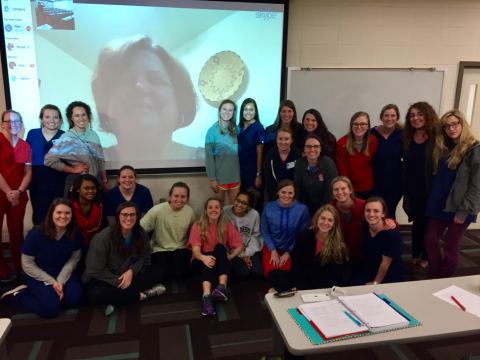
I don’t know why I didn’t post this sooner, but below is a group picture of me after speaking to a graduate stuttering class at the University of Mississippi in March of this year. OK, I’ll admit, I just kind of found the photo and thought it deserved a place on the blog!
It is so important for people who stutter to speak to the next generation of speech language pathologists. Students can’t learn about the experience of stuttering from text books. They have to talk to and listen to real people who stutter who live the experience every day.
On this day, I spoke to the students about my journey from covert to overt stuttering. It was a powerful experience for me, and hopefully them too!
On Resilience
Posted on: June 5, 2017
- In: Posts
- Leave a Comment
People who stutter are some of the most resilient people I know. Stuttering teaches us to brush off those moments when we’re stuttering really “well” and go right into the next speaking situation.
A friend of mine has been struggling with her stuttering lately. She has been feeling self-conscious and sort of “over thinking” the stuttering moments she has encountered. I asked her the other day what happens when she stutters – how do listeners react?
She replied that they don’t react – that they don’t seem to care. So we talked about that, why people don’t seem to care when they hear us stutter. It can be any number of reasons. They’re preoccupied with something, they’re not really paying attention, or they just don’t hear the stuttering. I reminded her that close friends of hers really don’t hear her stuttering. They hear her and her message.
That’s one of the things we need to keep in mind about stuttering. It helps us to be resilient. Every single one of us, stutterer or not, has bad moments and days. Resilience is the ability to shake those moments off and keep moving forward. Resilience helps us develop the “thick skin” we need to advocate for ourselves and be sure our voice is heard.
Resilience helps us through difficult times, relationships and at work. All of us fall flat on our face sometimes. We fail a test, we say the wrong thing to a partner or we miss an important deadline at work. Those of us who are resilient can get up from the floor, brush ourselves off and continue on. I’m convinced that stuttering helps builds that resilience that we all need.
What do you think?
Please Mom, No Talking Tonight
Posted on: May 18, 2017
- In: Posts
- Leave a Comment
There was a very thought provoking post made on Facebook this week from a parent. It seems her teenage son asked her not to speak at a school parent meeting they were attending. Specifically, the boy told his mom that when she “twitches,” she looks weird. When mom asked her son what he meant, he said she twitches when she stutters. Needless to say, she was embarrassed and mortified.
There were dozens of replies to mom’s post, most in support of her and hoping that she was OK. Some, like myself, offered reassurance that teenagers are embarrassed by everything their parents do, but that this issue should be talked about.
Other comments focused on the disrespect of the boy, suggesting that he be punished for what he said. Many then disagreed with those comments, feeling the moment should be used as a talking point and teaching opportunity.
As we know, talking about stuttering can be difficult. Often, it’s the “elephant in the room,” never getting talked about. People are embarrassed to talk about differences or challenges, or feel they risk making things worse by bringing “it” up. Stuttering is complex, as it’s an emotionally charged issue, not just a physical impediment. As we see from mom’s post, she was mortified and embarrassed by what her son said.
But deeper than what he said, mom was probably embarrassed by what her son may think of her. Mom may now be wondering how long her son has felt this way and why it never came up before. Mom may now become even more self-conscious of her stuttering, if she wasn’t already before.
It really struck me how many people responded to this post. I wonder how many times this kind of conversation has occurred between parents who stutter and their teenage children. Or hasn’t. It speaks to me to the reason we should be as open as we can about stuttering. Parents of fluent children should be sure to have open discussion about differences and that stuttering is just the parent’s way of talking.
This very open conversation on Facebook reminded me of a NSA friend, Stacey, who has quite a severe stutter. She is parent to a teenage daughter. The daughter has never been embarrassed by her mom’s stuttering, as they have had open conversations about stuttering since the child could talk. She think’s it’s normal that her mom stutters and isn’t bothered by it, even as an infamous teenager.
What do you think? How would you have reacted had this been your son making this comment to you? How can we use stuttering as a teachable moment?
Stuttering Awareness Week 2017
Posted on: May 9, 2017
- In: Posts
- Leave a Comment
The second week of May is designated as National Stuttering Awareness Week in the United States. This week was declared by Congress in 1988, through the dedicated advocacy work of persons who stutter.
It is a week where people who stutter speak up and out and educate those who don’t stutter about stuttering. It’s also a week to raise awareness about a communication disorder that only affects 1% of the population. That may seem like a small number, but it amounts to over 3 million Americans. That’s a lot of people who share stuttering.
If there’s one thing I’d like people who don’t stutter to know about stuttering it’s this: Stuttering is so much more than what comes out of our mouth. The repetitions and blocks only last moments. The underlying feelings of shame, guilt and fear can last years and can greatly impact our self esteem and world view.
If you encounter someone who stutters for the first time and you’re not sure how to react, use good judgement and react and listen just as you would to any speaker. Be patient, respectful and maintain eye contact. When you look away, the person who stutters feels uncomfortable and awkward and it may even make the stuttering moment worse or longer.
If you don’t understand something we’ve said, ask us to repeat it. Keep in mind that things like job interviews and public speaking create anxiety for the person who stutters, just as it would for a normally fluent speaker.
I am posting things about stuttering on my Facebook page all this week and also wrote a letter to the editor of the local newspaper that was published on Monday. What will you do to raise awareness about stuttering? If we who stutter don’t do it, who will?
Laughing At Stuttering
Posted on: May 2, 2017
- In: Posts
- Leave a Comment
 I went to see Drew Lynch, a comedian who stutters, this past weekend. This is the second time I have seen him perform live. He put on a great show and his jokes and stories were genuinely funny.
He didn’t make all of his stories about stuttering. In fact, he only talked about stuttering twice, and poked fun at himself for stuttering just once. The rest of his stories were about other funny things and he stuttered while telling, of course, because that’s what he does.
This time I was at the show with a friend who stutters. She enjoyed the performance as much as I did. Neither of us felt uncomfortable laughing at someone who stutters, nor were we uncomfortable with the audience laughing. And laugh they did! The audience appreciated Drew’s comedy and his story telling. Everything was spot on, especially Drew’s timing, since it’s not always easy for a stutterer to “get” the punchline right.
After the show, my friend and I waited in line to meet Drew and get a picture. I was excited about this, as I had not waited to meet him the last time I saw him perform. When I went up to meet him, I told him I stuttered too and that I greatly enjoyed the show. I told him about the National Stuttering Association , which he didn’t seem to know about. I asked him to consider speaking at a NSA event or conference sometime. He enthusiastically said he would consider it and told me to get in touch with his assistant.
Then we hugged and posed for a photo. I’m glad I got to meet him and glad I enjoyed the show. I’ve come a long way with how I handle seeing and hearing someone else stutter. Years ago, I would have winced and been offended with people laughing at someone who stutters. Now, I take it in stride and just enjoy good comedy for what it is.
Don’t You Want To Be More Fluent?
Posted on: April 24, 2017
- In: Posts
- 9 Comments
This past Saturday I gave a presentation about covert stuttering to a group of mostly speech language pathologists and students studying to be SLPs. This was for the the New York State Speech Language Hearing Association. I spoke about my journey from covert to overt stuttering and how SLPs can best support people who covertly stutter.
There was a lot of interest in how and why I went from covert to overt and there were quite a few questions during my presentation. I also had a few activities for the group to do which illustrated covert stuttering. I quickly realized I had too much material and was going to run out of time. As the group wanted to ask questions, I allotted the last half hour for just that, and ditched the rest of my formal presentation.
An older woman asked me a question toward the end. She didn’t identify herself as a SLP, but I’m pretty sure she was. She prefaced her question with, “You’re not going to like this but . . . ” and then asked the question. She asked, “Don’t you want to be more fluent? Wouldn’t you benefit from speech therapy?”
I was kind of floored. Here I had been talking for almost 90 minutes about how liberating it had felt to finally come out of the stuttering closet and how I was happy with who I was. I responded honestly and said that speech therapy wasn’t a goal of mine. I was most interested in being a comfortable and effective communicator and that I think one can be even with a stutter. I also said that I enjoyed public speaking more than I ever have and that I think I stutter fluently and that was enough for me.
She didn’t offer a response to my response but did come up to me at the conclusion of the presentation and thanked me and even gave me a hug. As did others. That felt great. One other SLP and professor came up to me and also hugged me and said that I was “almost there” with my effective communication. That kind of bothered me, but by that point, I was feeling really good and proud about my presentation.
What do you think? Has anyone asked you if you want to be more fluent? Do you think I answered the question well?
 Make Room For The Stuttering
What people are saying!