Archive for the ‘Posts’ Category
National Stuttering Awareness Week
Posted on: May 9, 2010
- In: Posts
- 4 Comments
This week is National Stuttering Awareness Week in the United States, specifically from May 10 – May 16, 2010. (It was proclaimed as such in 1988 by President Ronald Reagan). May also happens to be Better Speech and Hearing Month. So this is our week to talk about stuttering, raise awareness and educate others who may not understand the stuttering experience.
For the last three years, I have tried to do something “public” to help spread the word about stuttering. In 2007, I was a guest on my local area’s NPR station during this week to talk about stuttering.
In 2008, I got the chance to appear on a public television station’s health channel to promote stuttering. Later that year, I got to do a similar community television program for our local library. They aired it continually during October, to mark International Stuttering Awareness Day.
In 2009, I wrote an article about stuttering and had it published in the Albany NY daily newspaper, The Times Union. I also had a blurb about stuttering run in the weekly “Check Up On Health” column right before stuttering awareness week.
This year, the features editor for the health column at the Times Union, Jack Leadley, ran my small piece again yesterday to remind people about what stuttering is, some tips for listeners, and links for support and resources.
And I will be a guest again on Albany’s NPR station’s program “The Round Table” with host Joe Donahue on Tuesday May 11, 2010 at 10:35am. Here’s the station and channel information. I am looking forward to coming back on NPR radio, and gratified that they find it important enough to dedicate some air time to stuttering awareness.
I will point to the link when WAMC posts it, probably by the next day.
What will you do to spread the word and raise awareness about stuttering? One of the best things we can do is talk about our stuttering openly and often.
Need Ideas- Name New Podcast
Posted on: May 5, 2010
- In: Posts
- 4 Comments
Coming soon to this blog – a new podcast section dedicated to the unique perspective of women who stutter. Daniele Rossi from Stuttering Is Cool encouraged me to consider facilitating a podcast just for women who stutter. The more I thought about it, the more I grew excited about it. I believe there is an audience. Danny even suggested it might fill a niche, since we don’t believe there are any females podcasting about the women’s stuttering experience.
I have also shared this with a few friends in the stuttering community, who agree this will be a good segway from my blog. Women who stutter may feel somewhat isolated with our thoughts and feelings, as the stuttering community is predominately male.
I ask readers to be patient as I get this off the ground. Danny is mentoring me, as uploading podcasts will be new for me. But talking about stuttering is not, so I am excited about the prospect of giving women a forum to discuss their views, and giving female listeners a place to go where the content is specific to our experience of stuttering.
I have already recorded two great conversations with two diverse ladies. I hope to have the first one posted here by week’s end. I am open to suggestions for what to name this podcast. I want to keep it attached to this blog, for I firmly believe that we all make room for our stuttering in some way.
My first thought was the tag line – “Women Who Stutter – What We Think”.
What do you think? If you have any suggestions for a catchier title, please let me know. And please stay tuned. I think we may be on to something here. The podcasts will also be freely available in iTunes. (Thanks to mentor Danny!)
The Prickly Feeling Rises Up
Posted on: May 4, 2010
- In: Posts
- 5 Comments
My good friend Lisa from the UK sent me this story about an experience she just had, about how avoidance makes her feel. I think some of us can relate.
I am a covert stutterer and have been since I was 8 or 9 yrs old. My aim in life has always been to keep this horrible part of me hidden, even when it meant sacrificing the person I wanted to be. I have always “settled” for second best in relationships, jobs and life.
About 2 years ago, I did think I could finally accept my stuttering. As my marriage fell apart, my stuttering severity increased, and I thought I had done a good job managing for a while. However, my old habits are now creeping back.
For example, something happened yesterday that left me feeling terrible about myself. I was faced with one of those typical situations of mine involving having to find something “hard to say” from a shop.
I decided to sort my garden out. I have always relied on a friend’s husband to do the grass, but he wasn’t around and my girls were desperate to play in the garden.
As I went to use my trimmer, I noticed that the cable cartridge had run out and as my grass was high, I needed to use this before I used the mower. I knew going to the DIY store was inevitable. I did text 2 of my friends but they didn’t have one. I wrote down what I needed as in the make and serial number and off I went to the shop.
I sat in the car in the car park and the usual thoughts went through my head. How can I ask for what I need and switch words if needed? This is always the same for me for any shopping trip that is out of my normal routine.
I headed in and started to look up and down the aisles for some indication of where this item might be. I have often looked for something for over half hour rather than ask where it is. I would go home without it saying it was “out of stock” and try to get the next person who I knew was going to the store to pick it up for me.
I found the aisle quite quickly and started to track down my item. Then I hit a problem – my item code had two options on the shelf, with an ‘a’ or ‘b’ after the numbers. Now, I could see a person stocking shelves and I almost considered asking him, but that sick, “prickly” feeling I get when faced with asking someone something rose up inside me and panic started setting in.
I decided to take both of them. I could always get someone to return the extra one. I got to the checkout and scanned for the older person at the tills. If I do have to speak and happen to stutter, I find older people, mainly women, are not that bothered by my stuttering.
This time it didn’t work. When I got to the till, the woman stated that I only needed one of these depending on the trimmer, and that I just needed to decide how dense the grass was that I was cutting. My heart was pounding now. I just wanted the items. I could figure this out for myself when I got home, but this woman was not giving in.
I managed to tell her that it was quite thick grass, so I’d still take both (and boy did I stutter). She seemed taken aback with this and gave me this very sympathetic look, which I hate. . . and then, she called her colleague over to ask his opinion.
There are now about 5 people behind me, as it was very busy. She asks her colleague and he asks what sort of grass I am cutting. Before I can even try to get out the word, she jumps in with the answer, along with “the look” again. Now I am close to tears. I hate this experience, I just wanted to pay and get out of there.
He suggests I take ‘b’ , just in case, then asks if I have the original casing, as this is a refill. Then, I just lost it. I told him ”yes I have the casing and this one will be fine and thanks for his help”. At this point, I was stuttering my ass off and I just wanted out of this hellish situation.
I will never forget the look on his face. He then mumbled something and hastily began serving someone else. The woman put my item through and I finally left.
I felt like crap and got upset in the car, because I stuttered and people heard me. I know the easiest option would have been to ask someone in the first place and not care what I sound like, but I just can’t do that. So I put myself through all this and feel horrible for a few days.
I’m sure lots of other stutterers, especially coverts, can relate to this. Right?
I needed/wanted to share just how stuttering and avoidance affects my life every single day.
Can anyone relate to this? Have you had similar experiences?
Yes, Avoidance Can Backfire!
Posted on: April 30, 2010
- In: Posts
- 2 Comments
There are many reasons why we should not avoid words we think (or know) we will stutter on. One reason is that our often useful little trick of avoidance can actually backfire. It did for me yesterday in school with my mentor group.
Let me explain. This month’s theme was career development. As a career counselor, I have a game called “The Job Keeping Game”. It’s a board game with dice, scenario cards, a point system, blah blah. Kind of elaborate and not really good for a large group. I have 20 in my group.Twenty 16- year-olds, seventeen of whom are boys.
So I decided we would just use the job scenario cards and review a few of them. It would generate discussion, I hoped! I only had 40 minutes, so I figured we might get to do a few, if everyone felt like talking and participating. They did not – they were being silly and giggly, more than usual.
I asked the kids to volunteer to read the scenarios one at a time. Then the group would comment on what they thought, what could have been done differently, etc. I noticed right away as I was talking and explaining what would we do, that I was stuttering really well! Lots of repetitions. Just what I needed with these antsy kids during the last period of the day.
One question was about what you might do if you noticed a co-worker wasn’t getting his work done, and when approaching him to see if he was alright, you smell alcohol on his breath.
Well, that set off a bit of an uproar, because the kids said you can’t smell alcohol on someone’s breath, that they have been taught that by their criminal justice teacher who was in the circle with us. She started defending what she meant, and after a few minutes, I tried to reign them back in.
To be on the safe side, I said something like, “well, after ascertaining that the co-worker may have been drinking” . . .
Before I could finish, the kid sitting next to me, who had not said a word, suddenly perks up, and says, “What the heck is that? That’s not a word. I’ve never heard of it.”
The other kids pipe in, “yes, it is a word, just because you have never heard it,doesn’t mean it’s not a word”. Then they start arguing with the kid. In my head, I am thinking, “oh brother, I used ‘ascertain” because I was sure I was going to stutter on what I meant to say ‘determined’. Maybe they’ll just drop it”. Nope – no such luck!
The kid who suddenly woke up turns right to me and says, “well, what does it mean? What the heck is ‘ascertain?” I thought for a minute and couldn’t think of anything else, so I said “determined”, except it came out, “da-da-da-da-determined”, just like I had tried to avoid saying. No one said anything right after that for what seemed an eternity, but it was really only 30 seconds.
I gathered myself and asked who wanted to read the next one. Another avoidance! I just avoided the whole little side-track and moved on. By that time, we had wasted about 7 minutes, which is not a long time, but long enough for me to realize I should have just said what I wanted to say in the first place. Which is what we should always do.
These kids probably won’t remember this little blip even happened. 16-year-old kids have more important things on their minds. I thought about it though, because I was acutely aware of how uncomfortable I was when I realized I had put myself on the hot seat by choosing to avoid.
Moral of the story: Avoid Avoidance!
By the way, today is the last Friday of the month. Friends over at the British Stammering Association (BSA) have declared the last Friday of each month as No-Avoidance Day. We are issued a challenge to not avoid any speaking situation today. None, nada, zilch. Stutter freely and say what you want to say. Even in a circle with high school kids during the last period of the school day!
Do You Hear What I Hear?
Posted on: April 27, 2010
- In: Posts
- 2 Comments
A conversation I just had via email with a fellow PWS just made me think of this line. It is from a Christmas song, one that I used to love when I was younger. I loved the melody, and the fact that each key line was repeated.
The second chorus goes, “Do you hear what I hear? Do you hear what I hear? A song, a song, high above the tree, with a voice as big as the sea, with a voice as big as the sea”.
Most people who stutter probably don’t think of themselves of having a voice as big as the sea. But we do as we keep speaking out and speaking up. Our voice gets louder and louder.
My on-line friend Sarah had recently watched one of my videos and asked me if the stuttering she heard and saw was my usual way of stuttering. I asked her why, and she said because it was so easy and struggle free.
I commented that if that was a compliment, then I was saying thank you. But I also jokingly said to her that I wish I didn’t even do easy and struggle free stuttering. I would of course prefer not stuttering at all. And then I said, just kidding – my stuttering is what makes me “me”.
This brief conversation made me think about perception, which is loosely defined as our understanding or intuitive recognition of something.
Over the last several years, people have commented to me that my stuttering is pleasant to listen to, as it is easy and relaxed. Today Sarah mentions similar and adds that it is struggle-free.
I have never perceived my stuttering like that. I hear my stuttering as interrupted, broken speech, that makes me feel tense and sometimes self-conscious. That’s my perception. Then others perceive it as relaxed, easy to listen to, free of tension. It makes me wonder – do you hear what I hear? How are we perceiving the same utterances differently?
It feels funny to say “thank you” when someone says that to me. Am I supposed to say “thank you”? Are they paying me a compliment?
Or are they just pointing out their perception, as if saying, “well if you have to stutter, at least it’s the nice easy, relaxed kind, that’s easy on the listener”. Are they saying it in comparison to their own stuttering, or stuttering that they have heard if it’s not their own?
Perception! A funny thing. Two people can perceive the exact same thing, sight or sound completely differently. Like the saying, “beauty is in the eye of the beholder’. Or “one man’s junk is another man’s treasure”.
I now may think about this the next time I hear the line in the song, “do you hear what I hear?”
Sarah – “Finally Being Me”
Posted on: April 23, 2010
- In: Posts
- 18 Comments
Note: I invite readers to share how they make room for stuttering in their life. Today we hear from Sarah B – her honesty is powerful. Sarah recently did student-teaching and knows a little something about taking risks! Thanks Sarah!
Stuttering is one word I used to hate. I hated every time I got in a block. A block is when I try to say a word and no sound comes out, and I am not breathing. I felt hopeless and trapped with not being able to say what I wanted to say. I did everything I could to stutter as little as possible every minute of everyday. The easiest way to not stutter was to simply not talk. Not talking meant I couldn’t do things like participate in class like I wanted. I was always afraid my professors would think I didn’t read for class, didn’t care about class, but my fear of talking and having to stutter was greater.
So how do I make room for stuttering in my life? I started by accepting the fact that I am a person who stutters, and I will be for the rest of my life. That might sound obvious to some, but for many years I tried to be a fluent person. Also, I learned that it is OK to stutter. Stuttering is a part of me, just like I have brown eyes and blond hair. This journey of self-acceptance has been rough at times, but I just got to keep trucking along. The support I get from my family and friends is invaluable.
Sometimes when I get into a block I stop and tell the person I stutter. Self-advertising has helped me see that a lot of people don’t care that I stutter and helps me to be more comfortable and OK with my stuttering.
Making room for stuttering means I work to reduce the avoidance. This might be sounds, words, situations, or people. I will confess some avoidance techniques I used to not stutter. B’s are really hard for me most of the time. My last name starts with a B and I eventually just stopped saying it when introducing myself.
I rarely stutter on my first name. Occasionally when introducing myself the person would ask me my last name, and then I would block on the “b” and no sound would come out. When desperately trying to say my last name, a person might say, “What did you do forget your name?” That type of comment would usually ruin my whole day because I felt inadequate and embarrassed from not being able to say my own name.
In restaurants, I really wanted Dr. Pepper to drink, but could only get it if my brother ordered right before me and I could then say, “I’ll have the same.” I knew I wouldn’t be able to say “Dr. Pepper.” I knew I would block hard on the “d” and not be able to get any sound to come out of my mouth. I got Coke instead because I could say that without stuttering. Eventually, I started blocking on the “c” in Coke. I had to switch yet again to a drink I could say which was water. Another avoidance I did was I would NEVER say the word “tomorrow.” I knew I would stutter badly on that word. I would just substitute the actual day of the week.
Reducing avoidance is about facing my fears by ordering that drink I want (not what I can say fluently), making that phone call myself (not my mom), asking a salesperson where something is in the store (not walking around the store for 30 min) etc.
Everyday I have to work on reducing the control stuttering has on my life. Sometimes that means just showing up. Many times I wouldn’t go out with friends because the possibility of meeting new people was way too stressful for me. Consequently, I would stay in my dorm room. Avoiding those situations was my way to avoid not only stuttering, but the feelings of shame, guilt, and embarrassment that I didn’t want to feel.
Making room for stuttering comes down to being the true me. I am a person who stutters and that will always be true. For the first time in thirteen years I am starting to say exactly what I want. It’s the most amazing feeling ever. I feel like I am beginning to finally be me.
Is there anything you would like to share with Sarah? Does her story resonate with you in any way? Please leave comments and thoughts.
Guest Blogger: Tone Tells It
Posted on: April 17, 2010
- In: Posts
- Leave a Comment
** I have asked some of the amazing people I met while visiting the UK to share some of their feelings about this experience. This is the second of several guest posts. **
Friends and feelings – Our meet-up in Milton Keynes UK (Tone from Norway)
I had met Lisa before, when she was brave enough to come visit me in Norway. I was so looking forward to seeing her again it almost hid how nervous I was about meeting everyone else. I felt like I already knew most of the people I was going to meet, because we’ve all talked so much on Skype, Twitter and Facebook. But meeting in person and living together for a week is something completely different. However, Ridwan and Pam turned out to be very similar to what I had imagined, and meeting them was wonderful!
I had also arranged for us to meet Leys Geddes, the chairman of the British Stammering Association (BSA). I got to know Leys about a year and a half ago. I had watched his videos on YouTube many times and found what he said very true and inspirational. Leyes wrote a great paper for ISAD -08 http://www.mnsu.edu/comdis/isad11/papers/geddes11.html about a topic we actually discussed when we met. I commented on this paper, and realized he was the same person from the videos.
I went back to watch, and noticed that someone had made a stupid comment about his video. Now that made me mad, as I’m of the opinion that if you don’t have anything nice to say, keep your mouth shut. Anyway, I wrote back to this silly person in Leys’ defense, and after that, we started e-mailing each other. I asked him a million and one questions about stuttering, because I really wanted to know. And he patiently answered every single one. Great guy, huh?!
I was very much looking forward to meeting him and to introduce my friends to him as well, as I knew he’s a wonderful and smart man. They loved him! I was right!
We arranged to meet at Trafalgar Square. He took Ridwan, Pam, Lisa and me to the National Gallery and bought us all coffee. Of course we talked about stuttering. We even made a video where we talked about how PWS need to advertise more, in order to create awareness about stuttering in the world. The “stuttering world” is still so small that pretty much everyone knows each other. We need for “fluents” to get it too. And the only way to do that is to teach them.
Leys has worked hard for a long time now trying to get rid of “cure commercials”. He has made great progress both in the UK, on You Tube and with Google. He has some great videos on You Tube, where he explains what stuttering is and that classifying the videos as comedy isn’t very nice. More and more people post videos of themselves talking about stuttering now. They explain what it’s like for them, and what stuttering is. It seems to me that it’s helping.
More and more people are opening their eyes and learning about stuttering, and the fact that it isn’t something to be ashamed of or feel guilty about. I have to believe that Leys and the other wonderful people who put themselves out there should get credit for this. And I think we all agreed in the café that people need to be more open about stuttering. Not just to other stutterers, but also to the rest of the world.
Thank you Tone for taking such risks. For you have! You wrote this for us and shared how it felt to be a part of this wonderful experience. You risked coming to the UK and lived with two other people for a week. You arranged for us to meet with a very influential person in the stuttering community. You came with us to a stuttering support group and actively participated for two hours. You are fluent and know more about stuttering than a lot of SLPs I know. You understand that the only way to learn about experiences different from our own is to walk that path. Thank you for being you and for helping to de-mystify stuttering.
Readers: what do you think of a “fluent” wanting to spend so much time and energy trying to understand the stuttering experience? Feel free to leave comments or to ask Tone a question. A lot of people will benefit when Tone becomes a SLP. She “gets it”.
Breathe In, Breathe Out
Posted on: April 15, 2010
- In: Posts
- 25 Comments
I have heard a lot about breathing and stuttering lately. There has been an active discussion on one of the stuttering list groups about breathing poorly or improperly being a root cause in stuttering. One woman wrote:
“Has anyone noticed when in a car with a bunch of people in cold weather sitting next to a window that when you talk the window fogs up when
no one else’s window does? I have noticed this in the last couple years in the winter weather . I think this is due to my stutter and breathing improperly!!”
I have noticed when it is really cold that my warm breath fogs up the window in the car too, but I thought it happens with everyone. Never really attributed it to breathing.
When I met with friend Sheila recently in the UK, she shared some of the techniques she learned from the McGuire program. Breathing and speaking only several words on each breath is one of the focal points of this fluency method.
And I received an interesting phone call from someone yesterday. This person found my blog link through another activity that I am involved with, and attempted to track me down when he read that my blog was about stuttering. He went through quite a few steps until he was able to reach me at work. He wanted to share with me a breathing technique that he believes helps people to relax and reduce stress.
He shared how he helped a 55-year-old man who had stammered for most of his life to overcome his stammering through the use of a deep breathing strategy. This gentleman invited me to attend one of the seminars he conducts to teach people how to use this breathing strategy. He is originally from India as is the gentleman who was able to overcome his stammering using this breathing strategy.
He is going to send me some information and links to his web site and asked me to let other people who stutter know that he would be happy to share his methods with us.
In less than two weeks, I have heard or read about how significant proper breathing is to people who stutter or care about people who stutter. We all know the relaxing benefits of deep breathing. It has been used in yoga, meditation, and mindfulness for thousands of years by thousands of people.
Personally, while I understand the benefits of deep, calm breathing, I always had a hard time with the concept of using “full breath” as part of the fluency shaping therapy I was involved with for a while. I never seemed to be able to focus on taking a “full breath” in the moment of stuttering, as the stuttering has already happened. And it reminds me too much of the advice I was sometimes given by well-meaning fluent people who don’t understand stuttering: “Slow down, take a deep breath”. If that really worked to eliminate my stuttering and was that easy, I would have been doing that.
What do you think? Does breathing have an effect one way or the other on your stuttering? Have any of you tried breathing techniques that really work to reduce stuttering moments?
Meeting Friends In Person
Posted on: April 13, 2010
- In: Posts
- 2 Comments
One of the most special experiences from my trip to England was actually meeting people who I had only previously communicated with on-line, through social media. I was introduced to Twitter almost a year ago, and met other people from the international stuttering community. It was so much fun getting to know people from other parts of the world who shared the stuttering experience.
We got to know each other, initially tweeting on Twitter, then most of us became Face book buddies as well. From there, we started using Skype, where we were able to talk to each other in real-time, despite the different time zones. It was neat hearing other people with different accents and realizing that we are really all alike. We may look and sound different, but we share the same worries, fears and insecurities.
As amazing as it was, it was also strangely surreal. There is relative safety on the internet. Even though we had talked over Skype and sometimes used web cam, there was still miles and miles between us. Actually flying across the Atlantic Ocean to meet these people for the first time was scary. And it didn’t seem possible. Everything could have gone wrong. We could have not clicked and really disliked each other, but it was perfect. As soon as we met, we all felt this bond (well, at least I did). The time we had taken to get to know each other via social media and technology really paid off. We all recognized each other and felt comfortable.
Sure, there were some awkward moments. You have them anytime you meet someone new. I had joked with Lisa that it was very much like a blind date. You might talk over the phone first, but that face-to-face meeting is make or break. We were lucky. We all liked each other, and know that we will be friends forever. We also created memories that will last a life time.
I want to add that it was especially wonderful to meet Tone. She is a first year teacher and aspires to be a Speech Language Pathologist someday. She is fluent. Spending time with people who stutter and getting to understand what that is like from our perspective gives Tone honorary status as a person who stutters. She has immersed her self in all things stuttering so that she can understand our experience. Something that I would definitely recommend to any fluent person thinking of becoming an SLP. You have to walk in our shoes to really get stuttering.
This whole experience was a lesson in risk taking, trust, and living life. In London, it rains a lot. We experienced that first hand while touring London a couple of days with our hostess, Lisa, who lives in Milton Keynes, England.
One of my favorite sayings is, “When it rains, get wet”. That means don’t take cover from the rain or life. Live it, experience it, expand your horizons, meet new people, come out of your comfort zone. It is worth it, I guarantee. And when we get wet, we can always dry off. We won’t melt, like someone known as the Wicked Witch!
- In: Posts
- 4 Comments
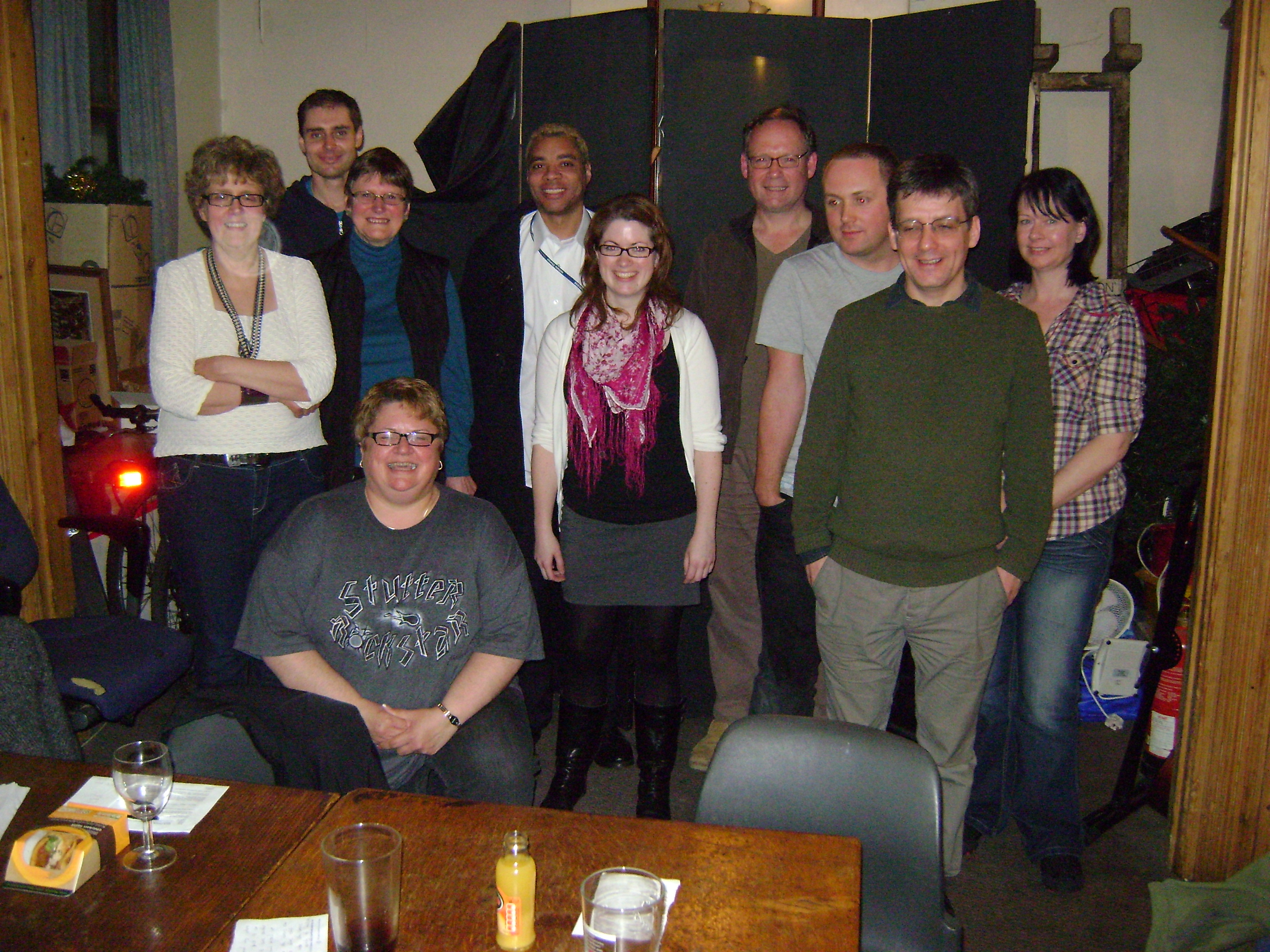
BSA Support meeting, North London 3/29/2010
This might sound very weird, but attending a stuttering self help meeting in London was one of the highlights of my trip to England. When Steven from BSA emailed me through one of the stuttering chat groups I belong to telling me there was a meeting the week I would be there, I was immediately excited. I knew we had to go. All I had to do was convince my friends.
Lisa had never been to a support group before. As a matter of fact, I was the first person she had met face-to-face that stutters. Attending a meeting meant she would meet a whole bunch of people all at one time, and that could be overwhelming. I knew I would have my work cut out for me. I had directions, the tube stops and someone’s phone number in case we got lost. We needed all of that, as it was tricky getting there. And Lisa and Tone were up for it. A little nervous, but up for it.
We didn’t get lost. We arrived at the meeting with 5 minutes to spare, time enough to visit the loo (after our long walk) and get a libation. We met some of the members in the pub area. They apparently recognized us right away. Tone and I looked like foreigners and sounded like it too, with our Norwegian and American accents. After warm greetings, we headed up to the meeting, which was held in an upstairs room of “The Wenlock Arms”, as traditional an English pub as one will find!
This is an ideal place for a meeting for two reasons. Rent was cheap (translation – FREE), and the group breaks at mid-point to go downstairs and refill their libation. Now that is an absolutely wonderful idea. Spirits definitely get people talking. One I might suggest for my meetings here in New York!
From the minute we walked in to the meeting, we felt welcomed. We could feel the welcoming energy in the room. There were 9 persons in attendance, plus us three guests. The group leader, Liz, wisely thought it would make sense to break down into smaller groups of 4, to give everyone the chance to chat and get to know each other. Having foreign visitors prompted good introductions and small talk about who we were, why we were there and what we shared in common.
It was great chatting with different people. And it was great seeing several women there, being very open and comfortable. Liz did a great job facilitating the meeting and Christine shared very openly about her stuttering experiences. I was most impressed with Christine – who put herself out there with severe stuttering and secondaries, but she was totally OK with it. I admired her courage and self-respect, because I felt a bit uncomfortable at first listening to her. (I trust she is OK with me saying this – because I am being honest).
It’s somewhat peculiar to me that a stutterer would find another person’s stutter uncomfortable to listen to. But in my case, I had not heard another woman with a severe stutter. I was proud to interact with Christine and feel her genuine desire to be herself and share herself.
After the small group meetings, the large group re-joined and some general sharing took place. That was great as well. People talked about what they are looking for in a support group, and why fellowship is so important. That I could relate to easily – for me, just being part of a group and feeling that I belong is very important.
A fellow named John asked to share some of his experiences with the group. John identified himself as a recovering stammerer ,and wanted to let people know what worked for him. He talked about NLP (Neuro Linguistic Programming). He had taken a course in the United States and felt that the cognitive reconditioning aspect of NLP really helped him gain fluency. He also spoke about success he has had with hypnosis and the fact that he took some acting classes, which also tremendously helped with his fluency.
I found myself listening intently as John spoke. I was not necessarily listening to his message. No, I was trying hard to hear any evidence that he had stuttered! Yep, I will admit that. When he first starting talking about NLP and hypnosis, I was skeptical. I thought he was trying to drum up business. But it became evident that he was just very passionate about these strategies that had worked for him. And I did hear some very mild stuttering once or twice, so he proved his credibility to me! Thanks John!
John took our email addresses and offered to share with anyone interested more in depth about what worked for him. He also acknowledged that what works for one may not work for another. I liked that – he wasn’t trying to offer false hope to anyone. There were a couple of young people there and at least one first-timer, and it is important, wherever we are, to not get anyone’s hopes up about “curing stuttering”. Right?
I was so happy to attend this meeting. Everybody was wonderfully kind, friendly and open. It affirmed for me what I already knew. That the stuttering experience is a shared experience. We all get it, and feel the same things, whether we are male or female, young or old, British or American or Polish or Indian. I will remember that special evening in North London for along time. The hospitality, the warmth, the camaraderie and the freedom – to be ourselves, all of ourselves, including our stuttering, for all the world to see.
“You Have An Unusual Stutter”
Posted on: April 8, 2010
- In: Posts
- 3 Comments
Sheila made this comment to me while we comfortably sat in her kitchen drinking tea. As mentioned in Sheila’s post yesterday, this was all so surreal. Drinking tea in someone’s kitchen in England, over 3000 miles away from my home and we were chatting about stuttering like we had known each other our whole lives.
Anyway, I was most perplexed when Sheila mentioned that my stutter is unusual. I wanted her to elaborate more, of course. I wondered, “Did she think I sound awful? Was I unpleasant to listen to?” Why do we always assume the worst? Do these things go through everyone’s mind – those of us who stutter? It seems I am constantly trying to read someone’s mind. What an incredible waste of time and energy, as I clearly am not a mind-reader.
Anyway, when I pressed Sheila to explain, she said, “Yes, Pam, you have an unusual stutter. You make and keep eye contact and smile when you stutter. That is unusual.”
It felt good when Sheila shared that with me. A person I had just met – who is also a woman who stutters – felt comfortable enough to share that with me.
That made an impression, obviously, as I am writing about it. Reminds me of the time someone told me my stutter is attractive.
Is it that unusual for people who stutter to make eye contact and actually smile while stuttering? Hmmm, I hope not. Let’s strive to make that the norm, OK?
Guest Blogger: Sheila Shares
Posted on: April 6, 2010
- In: Posts
- 8 Comments
Note: I have asked some of the amazing people I journeyed with last week to share some of their feelings about meeting for the first time. This is the first of several guest posts.
Reflections from Sheila from meeting my Face book friends Pam, Lisa and Tone (2 female stutterers and an aspiring SLP).
I was delighted when Pam asked to me to share my feelings, thoughts and emotions before, during and after meeting three fantastic female face book friends. It was bizarre and surreal; even though I knew about this meeting for a while, I put it to the back of my mind for a long time for several reasons!
1. Would it really happen? – I guess many of us have talked online to people about meeting up and it did not actually happen, so for us four to meet up from all corners of the world was just awesome. To be honest I had the easy part because they came to my house and I did not have to travel at all.
2. How many times do you hear about the warnings about online friendships becoming real and then someone is murdered? (Yes, I have a wild imagination)
3. I was a little worried about telling my husband about our planned meeting when in fact he was very supportive and said “Great go ahead girl!!! “
I had a crazy week leading up to our meeting. Work was very busy as always and the life of a working Mum is super busy anyway. It was also that dreaded week that so many of us women hate – the PMT week (as called in the UK – it is PMS in the States). I was not feeling confident at all. This is an important issue for females who stammer/stutter and it is often glossed over. It affects a woman’s confidence, which subsequently affects our speech.
**I am a recovering stammerer with the McGuire Programme for nearly six years now, although I don’t really like that tag and it has been argued that it is a negative tag and can give me “permission” to use bad technique or sometimes I like to say – “I am working hard on my speech’ ** (more on this later)
As a graduate and primary coach of the McGuire Programme I feel I should have prepared my speaking and speech for this meeting by warming up with costal breathing, using Kinaesthetic, making warm up calls to other McGuire Grads, reading mantras out loud etc. BUT I am a woman, so I prepared my house for meeting other females and a light lunch with the help of my darling hubbie!
In my mind, my thoughts were I have no idea what to expect so I am just going to be “me” Sheila Denny not Sheila Denny, Primary Coach with the McGuire Programme. This would be a test for me and my online friends, we had all trusted our instinct and liked and admired each other and now we were meeting up for real! HOW EXCITING.
I was nervous about meeting the girls but I have learned over the years how to deal with nerves and kept myself busy that morning. The thoughts of the journey that my girlfriends had to make were preying on my mind. It was a few hours car ride away but not easy when you do it for the first time. What if they get lost and they won’t ask for directions because of their stuttering!! I need not have worried because Lisa had one of those magic boxes in her car that gives you directions every step of the way. “Holiday traffic” delayed them, not fear about the meeting.
I got a text saying they were 2 minutes away so I immediately put my shoes on to go outside to check which direction they would be coming from and to direct them into my drive. I saw a girlie car coming along and starting waving them into my drive. I wasn’t sure it was them actually because I wasn’t wearing my glasses but as they drew closer I could see all the smiling faces of Pam, Lisa and Tone. We seemed to naturally hug each other and say hello and it was so good to see happy faces all around. I welcomed everyone in and made Tea for my now soon to be REAL FRIENDS.
Over the next few hours the conversation naturally flowed between us all, there was no one cutting in or finishing off someone else’s words, it was so nice. I was aware I was talking a lot. I think I was excited but I must admit I talk a lot and very fast too so I told the girls “Hey I am talking too fast”, and then explained about what I should do to avoid blocking and take it down to three or four words per breath. I had had no difficulties or blocks with my speech up to then but I knew this would not last. J
We shared an emotional few moments when I told them some of my story that was the pivotal point for me in joining the McGuire Programme (as well as my only child began to stammer).
I was at a meeting and was asked to introduce myself first in front of 35 people which totally threw me as I never get asked to introduce myself first. When I finally got my name out, the Chairman said, “Thank you very much, Michala”. MY heart sank to the floor that day. I felt totally demoralized and I vowed to myself, I must try yet ANOTHER form of speech therapy.
Pam carefully asked me some skilled questions about my journey with the McGuire Programme and Toastmasters. I told her what was special and different than any other speech therapy I had had in my lifetime was the SUPPORT of the McGuire Programme. It is the best! I was aware that Lisa was at a different stage of the journey than Pam and I were on and made a mental note to reign in my outspoken way of talking about my stammering. I didn’t want to frighten Lisa away.
We decided to take a ride out to a coastal town as planned for the tourists and talk about other things besides stammering and have fun in each other’s company. After all, there is more to friendship than stammering and being females. We LIKE each other. I got to know Tone a bit more too. I was dead impressed with her eloquent use of our English language, which is not Tone’s mother tongue.
During this time, I had some difficulty with my speech. I was blocking and gradually started using tricks. It didn’t prey on my mind too much, until Pam asked me on the way back, “Do I find I stutter more being around others who stutter?”
I answered, “I don’t know, maybe I do … after today”.
This was a completely different experience for me being around other stutterers that are not in the McGuire Programme. It’s easier to keep up techniques when everyone around you is another McGuire graduate or when you are around fluent speakers. Then you know you have to make an effort to focus on technique. Now I know it is very easy to slip back into old ways of speaking….. I thought about this for a while and made more of an effort to focus on the way I spoke when we returned to our house for more TEA!!
The girls left that evening and I felt lonely after they had gone, as this was a very special day. We shared lots very openly and so naturally, as for me…. So what if my speaking technique was a bit bumpy towards the end? It definitely wasn’t going to affect our friendship or what they thought about me. It’s OK to stammer, it is just one part of ‘me’ and ‘you’ and ‘you’ and ‘you’
I am very excited when we next meet up when and wherever it might be. I know it will happen and how much will have changed for us all .
Sheila, thank you so much for your sincere honesty. I actually laughed and cried as I read this. Readers, what did you think as you read this? Can you relate to what Sheila felt? Please share your thoughts and feedback for Sheila.
Traveling With Fellow Stutterers
Posted on: April 1, 2010
This is not one of my typical blog posts. Today finds me winding down a whirlwind week of traveling to a different country and meeting up with other people who stutter. I took a risk and decided to visit people I had met through the stuttering community.
The internet has made the world so much smaller that it is possible to meet people from all over the world and talk with them as if we are in the same room. So through social media networks, I have become friends with people from other parts of the world who also share the stuttering experience.
We decided we wanted to meet each other, and in this day and age, it is possible. So I have met people face-to-face that I have communicated with via Skype, face book and twitter.
Life is about taking risks, stepping out of our comfort zones and expanding our horizons. I certainly have done that this week. I plan to write about some of my experiences meeting other people who stutter from the UK. What do we have in common? What do we have different views on? How did we get along? Is stuttering, or stammering, universal?
Stay tuned. I am also going to ask my fellow travelers to write and share a bit about their journey as well.
Bulls-Eye
Posted on: March 29, 2010
- In: Posts
- 7 Comments
I finally have a better understanding of why I have been so resistant to fluency shaping targets. I shared with a friend how I felt about not attending a recent weekend stuttering workshop that focused on practicing fluency targets.
I have gone to this workshop for the past three years. I enjoyed participating and sharing with other people who stutter, but never really “worked on fluency”. I was working more on acceptance, which is what I need and think other people need as well. I started talking more about acceptance and thinking about it and embracing it. I have never been comfortable with using targets. I never seemed to “use” them right or found I could stop and use them in the moment of stuttering.
I think perhaps some of the coordinators of the fluency workshop may have had a problem with my resistance to practicing fluency targets. It sort of felt like if I wasn’t working on fluency, then I shouldn’t go to this workshop. That’s the message I got anyway. I had wanted to go, planned to go, but the universe clearly had other ideas.
My friend put into words what I had been feeling in a real visual way. When I think of a target, what comes to my mind is the game of darts, where you try to “hit” the target or the little round circle in the middle known as the bull’s-eye. If you miss and hit the outer circles, or even throw the dart completely off the board like I used to, you don’t get any points. And you lose. So if you miss the target, you have failed or are a loser.
Ever since I was introduced to the concept of fluency shaping and practicing targets, something didn’t feel right. I never liked the idea that if I didn’t reach a certain goal or target, that I failed in some way. I had been given so many messages of failure as a kid growing up that I certainly didn’t need to internalize failure as an adult.
And that’s what it has seemed like with me and target practice. If I couldn’t do it or get it, I felt I wasn’t trying hard enough and somehow I was failing to meet expectations.
When my friend and I talked about target use, all of a sudden the light bulb in my head flashed on. “Hitting a target” implies something negative. Hitting something. If the target is not hit, then we have failed. And I don’t like that word. I had enough of that as a kid. I work with kids. I praise them on their effort all the time. Even when they don’t succeed, they are not failures. None of us are. But when it is implied that if we had tried harder, we might have succeeded, it is hard to not feel like a failure.
I remember when I read the book The Secret by Rhonda Byrnes, I felt the same way. The book’s premise is the law of attraction. If you think positive thoughts about something, then it will happen or you will get what you want. To me, it implied failure if our positive thoughts didn’t lead to the positive result. Like somehow, I failed.
I remember last year I wrote about not wanting to be fixed. I still feel like that. There is nothing wrong with stuttering. I don’t need to hit targets to feel successful as a communicator. All of us have different speech patterns and we all communicate in different ways. I don’t need to hit the bull’s eye. I am fine with the outer circles and even going off the board a lot.
Is it wrong of me to think like this? And if I do, should I really stay away from fluency-focused events? Even if I like the support and camaraderie?
Support Groups
Posted on: March 25, 2010
There is a good thread started on one of the stuttering lists about the importance of self-help support groups. A couple of people shared that coming together with other people who stutter, even just once per month, has helped decrease shame and isolation and promote acceptance. One person wrote, “we can talk freely about where it gets difficult and painful , and the triumphs too, and be heard by others who have been there”.
This is so well said. The basic premise of self-groups has always been to encourage people with similar issues to come together and share. Simply knowing that you are not alone often is enough. Even if you don’t say anything at meetings, being there and feeling supported by others who “get it” is a big deal.
I remember being introduced to Ala-teen meetings when I was a teenager. These were support meetings for children of alcoholics. I went to several and remember feeling very overwhelmed, as I had always thought that the negative effects of alcoholism were a normal part of growing up. Just seeing other kids who had crazy households meant a lot to me, even when I was not ready to share. As an older teenager, I also went to some Al-Anon meetings, which are support meetings for family members of alcoholics. Most people who attended those meetings were spouses, but I still gained enormous benefit from knowing that I was not alone.
To this day, two members of my family regularly attend AA (Alcoholics Anonymous) meetings, and have done so for many years. The support and fellowship is priceless.
I have found the very same spirit of support and acceptance in the support groups I have attended for stuttering. I remember how I felt when I attended my first NSA chapter meeting four years ago. It was the first time I had heard other people stutter. It had a powerful effect on me – still does. It is a very real reminder that we who stutter are not alone.
I am looking forward to visiting another country soon. My fellow travelers and I have been invited to attend a BSA (British Stammering Association) support meeting. It will no doubt serve to be very reassuring to see that people from around the world derive support from coming together and sharing.
My personal experiences with the AA model of self-help and the self-help stuttering support system has been extremely positive. In face, both have changed my attitudes and understanding that neither stuttering or alcoholism in the family is anyone’s fault.
Has anyone here had experiences with self-help groups? Has it been positive? Would you recommend self-help to others experiencing similar issues?
 Make Room For The Stuttering
What people are saying!